Portuguese
  Spanish


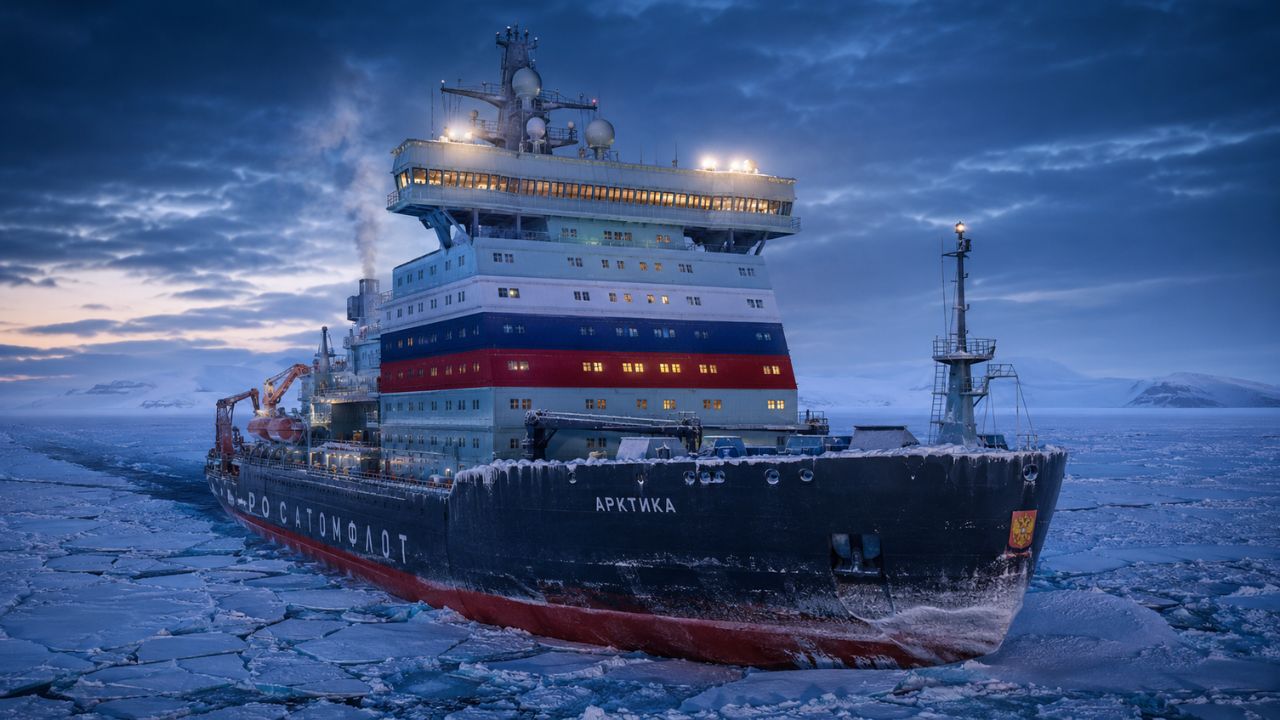


The icebreaker ship Arktika operates in the Russian Arctic with two nuclear reactors and 80,000 HP. See how it keeps the Northern Sea Route navigable.
The icebreaker ship Arktika has established itself as one of the main components of Russia’s strategy to keep navigation in the Arctic active throughout the year. Built to operate in temperatures as low as -50 °C and in regions of polar darkness, the nuclear giant leads Project 22220 and works on opening maritime corridors in the so-called Northern Sea Route, a connection between the Atlantic and Pacific Oceans along Russia’s Arctic coast.
With a length of 173.3 meters, a displacement of 33,540 tons, and the ability to break through ice layers up to 3 meters thick, the Arktika was designed to allow the continuous passage of cargo ships, ore carriers, and liquefied natural gas tankers operating in Siberian ports. The vessel began operations in October 2020 and is part of a series of six units managed by Rosatomflot.
Icebreaker ship Arktika was created to keep the route active in winter
The main function of the Arktika is to ensure that the Northern Sea Route remains navigable even during the harshest periods of the polar winter. The route is considered strategic because it reduces the distance between Europe and Asia by up to 40% compared to the traditional route through the Suez Canal.
-
Miguel Krigsner opened a small compounding pharmacy in Curitiba in 1977, turned Brazilian fragrances into a national success, and created O Boticário, now one of the largest beauty networks in the world.

-
Meet the charming parrot grandpa, who became known for hugging free birds and revealed how he gained their trust over the years.
-
After 18 years of development, Bridgestone launches the AirFree airless tire, which requires no inflation and is puncture-proof, into daily service in Japan, starting with autonomous vehicles up to 20 km/h, used for transporting elderly people.

-
Couple buys 1905 colonial house, plans to tear down walls to unite three rooms, but finds hidden service staircase and rethinks the entire renovation to preserve details that have survived for over a century.



To turn this advantage into practical operation, Russia needed to invest in vessels capable of facing extreme conditions. The Arktika was developed precisely to open channels wide enough for large merchant ships to cross frozen areas of the Arctic.
Additionally, the ship can operate continuously in scenarios of low visibility and thick ice, maintaining the region’s logistical flow throughout all seasons of the year.


Dimensions and performance draw attention
The technical data of the icebreaker place the Arktika among the largest and most powerful ships in its category. In open waters, the vessel can reach speeds of up to 22 knots, equivalent to approximately 40.7 km/h.
When operating on ice, performance changes according to the thickness of the frozen layer. At cruising speed, the ship can advance over ice 2.8 meters thick. At reduced speed, between 1.5 and 2 knots, the capacity reaches 3 meters.
Another differential is the dual draft system, which allows adaptation to different depths:
- 10.5 meters in open sea
- 9.03 meters in shallow estuaries
This feature expands the ship’s area of operation and facilitates operations in regions close to northern Russian ports.
Nuclear reactors are the heart of the ship
The strength of the Arktika comes from two RITM-200 nuclear reactors. Each unit produces 175 MW thermal, totaling 350 MW. This energy is converted into 60 MW on the ship’s shafts, equivalent to about 80,000 horsepower.
The nuclear system design was developed to occupy less space and increase operational efficiency. According to information from the RITM-200 page, components such as the steam generator, primary circuit pumps, and pressurizer are integrated into the reactor vessel itself.

This configuration reduces weight, eliminates external piping, and makes the assembly more compact for naval application.
Among the main details of the system are:
- Each reactor is 7.3 meters tall
- The diameter reaches 3.3 meters
- Refueling occurs only every 7 years
- The model is lighter and more powerful than previous versions used in Soviet ships
Additionally, the 11th RITM-200 reactor was completed on May 13, 2026, and will be destined for the future icebreaker Leningrad.
Project 22220 fleet expands Russian presence in the Arctic
The Arktika does not operate alone. It leads a series of vessels from Project 22220 built at the Baltic Shipyard, located in Saint Petersburg.
The expansion of the fleet shows Russian interest in strengthening its maritime structure in the Arctic on an industrial scale.
Check the status of the units until May 2026:
| Ship | Commissioning | Status |
| Arktika | October 2020 | In active operation |
| Sibir | January 2022 | In active operation |
| Ural | November 2022 | In active operation |
| Yakutia | December 2024 | In active operation |
| Chukotka | Scheduled for 2026 | Under construction |
| Leningrad | Scheduled for 2028 | Under construction |
Meanwhile, the new ships under construction are expected to further expand the escort and route opening capacity in the polar region.
Icebreaker Arktika sustains strategic cargo transportation
The continuous operation of the Northern Sea Route depends directly on the performance of nuclear icebreakers. Without them, large maritime areas remain blocked for much of the year.
In practice, the Arktika keeps active the corridors used by:
- freighters
- ore ships
- liquefied natural gas (LNG) tankers
Therefore, the vessel plays a central role in the maritime logistics of the Russian far north.
By combining high autonomy, great power, and the ability to operate in severe environments, the icebreaker Arktika has become one of the pillars of the maritime infrastructure built by Russia to ensure a constant presence in the Arctic.
With information from Revista Forum