Portuguese
  Spanish


The case of Bento Medeiros Versuti shows how students with high abilities still face obstacles to receive adequate support, even when they accumulate good academic performance, reports, medals in scientific competitions, and family support to continue learning beyond the traditional school pace.
Bento Medeiros Versuti, 8 years old, lives in Jardim Imperador, in Peruíbe, on the coast of São Paulo, and has more than 15 medals in Scientific Olympiads, in addition to a IQ of 134 and a percentile of 99%, a score that places him above 99% of the population.
Even with above-average performance in mathematics, technology, programming, and astronomy, the boy’s routine is marked by a difficulty reported by the family: getting the school to offer adaptations compatible with students with high abilities or giftedness.
The mother, psychologist Helen Medeiros Versuti, 40 years old, states that the main barrier is not only in recognizing the condition but in the practical application of the educational rights provided for gifted children.
-
End of an Era: Major Manufacturer Shuts Down Factory After 64 Years, Laying Off Over 150 Workers in Brazil

-
Former Banker Invests $24,000 to Create Award-Winning Burgers with Unique Brazilian Ingredients, Drawing Customers from Across Regions

-
Imported Electric and Hybrid Cars in Brazil Face 35% Tax Increase, Raising Prices Starting July 1st
-
Rio de Janeiro Buses Stop Accepting Cash: How to Pay and Maintain Fare Integration




“The biggest difficulty is for schools to agree to make these necessary adaptations and create the individualized educational plan that the gifted and neurodivergent child is entitled to,” she reported.
High abilities and resistance in the school environment
When Bento was 4 years old, according to Helen, the first school he attended received reports presented by the family but did not accept the boy’s condition nor applied specific pedagogical strategies to support him.
In the current institution, the situation is also far from ideal because, as the mother reports, the student still does not have an individualized plan that organizes challenges, content, and forms of support.
“He does not have an individualized plan, which is a right of the gifted child. Unfortunately, this is the reality for most of these children,” Helen stated.
In June 2026, the case gained new context with the sanction of the Law 15.436/2026, which established the National Policy for Students with High Abilities or Giftedness in Brazil.
The regulation created guidelines for identification, monitoring, and specialized educational support, as well as anticipating the training of education professionals, strengthening support structures, curriculum enrichment, and acceleration in specific areas.
For the family, however, the decisive point is to transform the legal provision into a school routine, especially in municipalities where there is a lack of trained professionals, tests, proper guidance, and structure to support these students.
Lack of stimulation affects learning and behavior
Without challenges compatible with their own pace, children with high abilities may lose interest in classes and fail to develop part of the potential they demonstrate in specific areas, according to Helen.
The psychologist defines this scenario as a form of “invisible abandonment”, where the student remains in the classroom but does not find stimuli proportional to what they already master or the speed at which they can learn.
Besides the impact on academic performance, the mother points out effects on behavior and emotional well-being, as Bento would have cognitive development above his age, but still experiences the emotions typical of an 8-year-old child.
“Today Bento is 8 years old, but cognitively he is close to 12. Emotionally, however, he remains an 8-year-old child,” said Helen, explaining the asynchrony observed in some children with high abilities.
This mismatch requires welcoming, mediation, and careful planning, because the student may understand complex content but still needs emotional support appropriate to their age and own maturation process.
Family seeks support outside the classroom
To fill gaps in regular education, the parents began investing in complementary activities during off-school hours, through Amplexo Educação, focusing on expanding the challenges offered to the boy.
Before this reinforcement, Bento was already seeking knowledge on his own in educational channels, driven by curiosity about specific topics and the desire to understand subjects not covered in depth in classes.
With the new routine, curriculum enrichment became part of the family’s daily life, which reorganized schedules, priorities, and investments to follow the child’s academic interest.
Helen states that some Olympiads are paid and that certain international competitions can exceed R$ 1,500 per stage, making the student’s development also dependent on the family’s financial capacity.
The father, Gabriel Medeiros Versuti, 31, marketing director, says the family ended up taking on tasks that should have more structured support from the school and public authorities.
“The academic part is something we work on every day to make up for what the school does not provide,” said Gabriel, reporting limitations in the adaptations offered to his son.
In his evaluation, proposing slightly more difficult tasks does not solve the problem when the school does not consider what Bento already masters nor the content that could stimulate real progress.
Public Service and Continuity of Support
In accessing specialized public services, the family also reports difficulties in maintaining a stable routine of care, even after obtaining occupational therapy from the municipality for a period.
Gabriel states that, after a few months, obstacles arose in scheduling new sessions, a situation that would have compromised the continuity of support and increased the parents’ responsibility over all areas of support.
The instability makes family organization heavier, because studies, therapies, competitions, commuting, and extra activities need to be reconciled with the common demands of a school-aged child.
Even so, Bento maintains a routine marked by curiosity and says he enjoys the Math Olympiads because he finds challenges that stimulate him to think more deeply.
Among his favorite achievements, he mentions a gold medal in the Brazilian Astronomy and Astronautics Olympiad and an international math award, both related to areas that are among his main interests.
Scientific Olympiads and Bento’s Future
At school, the boy sums up directly what he would like to find more often: “I wish there were more difficult things”.
For the coming years, Bento already talks about becoming a civil engineer or astronaut, as well as competing and winning Olympiads outside Brazil, maintaining his connection with mathematics, astronomy, and technology.
Outside of school, part of the family’s routine appears on the profile @falabentopodcast, on Instagram, created to share experiences about giftedness, inclusion, studies, and Scientific Olympiads.
The space also brings together guardians who face similar difficulties in seeking specialized care, pedagogical adaptations, and recognition of the needs of children with high abilities.
In Helen’s view, the new national policy could reduce the dependence on families’ financial conditions and increase the early identification of these students, especially in cities with little specialized infrastructure.
The mother states that she has already heard, in her own municipality, advice to give up on the evaluation due to a lack of tests and qualified professionals, a scenario that helps explain the invisibility of many gifted children.
DP World announced an expansion package of £1 billion, about R$ 6.3 billion, for the London Gateway, one of the main logistics complexes in the United Kingdom, with the proposal to increase the container terminal capacity through the construction of two new 400-meter “all-electric” berths each, raising the planned total to six docking fronts capable of receiving some of the world’s largest container ships.
The company also reported that the plan includes a second rail terminal to strengthen multimodal integration and reduce dependence on exclusively road flows within the supply chain.
£1 billion investment and expansion of the London Gateway port
The announcement positions the London Gateway as a large-scale port expansion project in a country that heavily relies on imports and exports by sea.
DP World describes the investment as an expansion of the UK’s trade capacity and states that, with the expansion, the terminal will be served by quay cranes that the company classifies as the tallest in Europe, associated with the operation of the additional berths.
The operation, according to the same corporate source, is part of an integrated hub that combines port, railway, and warehousing logistics within the same perimeter, focusing on predictability and productivity.


Thames Freeport, River Thames, and integrated logistics
The London Gateway is located on the north bank of the River Thames, in the county of Essex, and is part of the Thames Freeport area, a regime that seeks to stimulate industrial and logistics activities with incentives and operational facilities.
In institutional material about the location, DP World presents the complex as a deep-water terminal with direct connection between ships, trains, and trucks, as well as an adjacent logistics park designed to shorten distances between unloading, storage, and distribution.
By maintaining expansion on the same site, the company attempts to capture efficiency gains typical of integrated port operations, where container movement is planned from the quay to land dispatch.
400-meter “all-electric” berths and capacity for mega ships
The public justification for the investment is based on two pillars.
One is the physical infrastructure, with new berths and quay equipment designed to accommodate large ships and increase simultaneous docking capacity.
The other is the expansion of the cargo entry and exit network by rail, through a second rail terminal, which DP World identifies as a central piece to absorb volume growth without concentrating the impact on road congestion and collection windows.
In port operations, this layer is often decisive because productivity at the quay can quickly be lost if yards and land accesses do not keep pace with unloading and loading.
BOXBAY Automation and £170 million investment
The project also gained a high-visibility technological component: DP World announced an additional investment of £170 million in a container handling system associated with BOXBAY, aimed at automating part of the flow and redefining storage and movement standards, focusing on efficiency and safety.
In a corporate statement on the subject, the company presents the solution as a step in the digitization and automation of processes, reinforcing an agenda of operational modernization in a sector pressured by costs, route volatility, and the need to reduce delays.
BOXBAY, in turn, also released information about the adoption of a high-density storage system at London Gateway, placing the contract within the context of the port’s ongoing expansion.
Record of 3 million TEUs and growth in movement

The expansion of London Gateway is not isolated from recent movement numbers.
DP World announced that the terminal recorded a significant increase in volumes and reached an annual record of over 3 million TEUs in 2025, attributing the performance to the capacity expansion with the introduction of a new berth in operation and an increase in calls on relevant routes.
Specialized port sector vehicles also reported the milestone of 3 million TEUs, attributing the result to the increase in calls and the incorporation of additional capacity at the terminal.
In the context of container terminals, TEU is the standard unit equivalent to a 20-foot container, used to compare capacity and annual movement between ports.
Construction, approval, and expansion schedule
Corporate communications indicate that the construction of the two additional berths was planned to be completed in about four years, a schedule informed by DP World when it announced the start of construction after obtaining project approval.
Maritime sector publications also reported the start of construction based on the same information, reinforcing the understanding that London Gateway seeks to accelerate the trajectory to consolidate itself among the largest container ports in the country.
The strategic reading is that by increasing docking fronts and incorporating more equipment, the terminal expands its capacity to receive larger ships and maintain more predictable operation windows, something valued by shipowners and shipping alliances.
Electrification and modernization of port infrastructure
The design of the expansion is relevant because port infrastructure, unlike other areas, usually requires long-term investments and complex works in regulated environments.
In the case of London Gateway, the choice of “all-electric” berths is presented as part of an electrification and modernization agenda, aligned with pressures for emission reduction and improved energy efficiency in port operations.
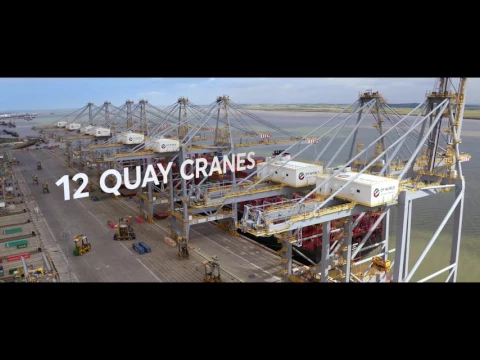
DP World emphasizes in its material that the expansion reinforces the country’s capacity and associates the investment with productivity benefits, while other sector sources highlight the potential impact on jobs and the ability to service routes.
Docking flexibility and impact on the supply chain
In operational practice, additional berths mean more docking points for ships and greater flexibility to handle demand peaks, delays in schedules, and variations in vessel sizes.
In container ports, this type of flexibility is usually translated into reduced waiting times, better use of tide windows, and greater stability for supply chains that depend on tight schedules.
The ability to simultaneously accommodate several large ships, mentioned by DP World when referring to the possibility of six of the world’s largest ships at the complex after expansion, has a direct impact on the terminal’s competitiveness perception compared to other European ports.
Railway, container flow, and logistical reach
The railway reinforcement also has implications beyond the port.
Terminals that can transport a larger portion of containers by train tend to relieve pressure on roads, reduce emissions per ton transported, and expand the distribution reach to distant logistics centers.
In the case of London Gateway, DP World states that the second railway terminal was designed to meet the expected increase in containerized trade associated with the growth of berth capacity, creating a continuity line between investment in quays and investment in land exit.
This linkage is relevant because bottlenecks outside the port can limit productivity gains within the port.
Automated yard, high-density storage, and efficiency
The introduction of automated solutions, announced through the investment associated with BOXBAY, adds another layer to this scenario.
Storage and handling systems with a high degree of automation aim to reduce redundant movements, reorganize stacking to speed up unit retrieval, and decrease operational conflicts in the yard.
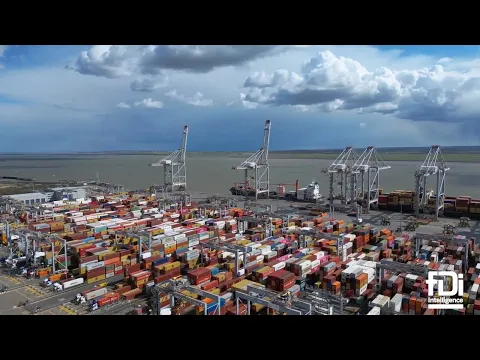
DP World describes the initiative as a leap in efficiency and safety, aligned with the digitalization of processes, while BOXBAY presents the project as the implementation of high-density technology in a British port hub.
In a terminal where volumes grow and physical area is limited, gains in the yard can have a direct impact on the effective handling capacity without the need to indefinitely expand the footprint.
Supply, distribution, and competition among European ports
The London Gateway, being located in a logistics hub close to one of the country’s largest consumption concentrations, also engages with retail supply, industry, and refrigerated chains, which often depend on regularity in unloading and speed in distribution.
This proximity is often used as a commercial argument by terminals in the Thames region, and the volume growth reported by DP World reinforces that the port is trying to establish itself as a hub capable of capturing additional traffic on global routes, especially when shipping companies seek alternatives with operational efficiency and integration with land logistics.
In an environment of competition between ports in the UK and Northern Europe, the combination of additional berths, electrification, railway expansion, and advanced automation has become the core of DP World‘s public narrative for the London Gateway.
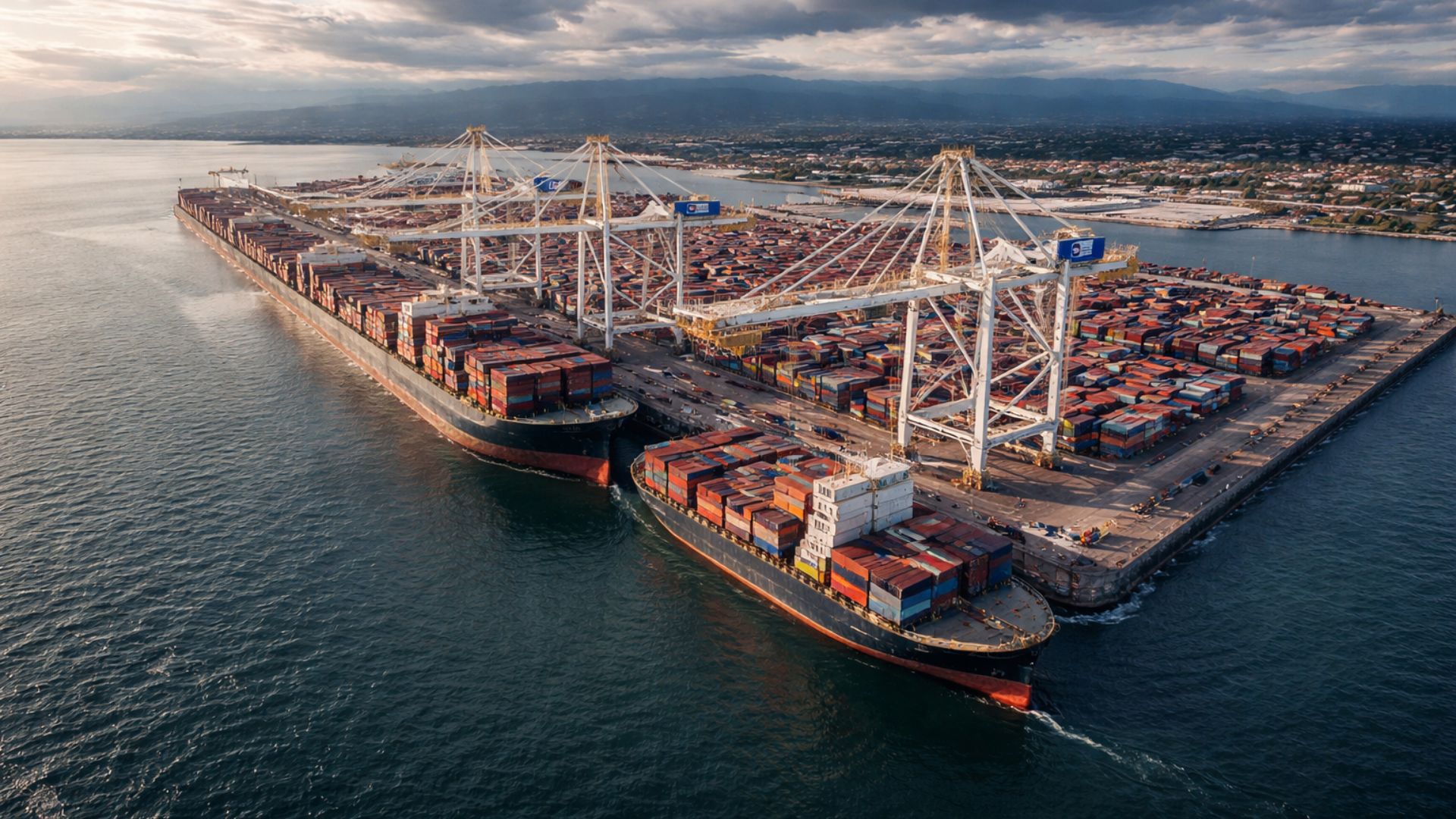
The company presents the investment as infrastructure to strengthen trade capacity and modernize operations, while industry sources record TEU records and highlight the expansion of berths as a growth factor.
The strategy, in practical terms, is to transform a physical expansion into a package of productivity, predictability, and technology, elements that directly influence the choice of routes and scales in container shipping.
To what extent can the race for electrified and automated megaterminals redefine which ports become the new transshipment and distribution centers on Europe’s maritime routes?