Portuguese
  Spanish



Furthermore, safety regulations require rigorous testing for the widespread adoption of brake-by-wire systems. Brembo itself indicates that the transition will be gradual.
Sensify is expected to initially appear in premium vehicles and more advanced platforms before reaching popular models.
Software takes on a central role even in critical car systems
The transformation of brakes into an electronic platform shows how software is taking on a dominant role in the automotive sector.
-
Nissan Kicks S Direct 2018: Affordable Used SUV with Over 13 km/l Fuel Efficiency, 432-Liter Trunk, and CVT Automatic Transmission

-
Iconic Orange Double-Decker Bus, a Dutch Fan Favorite for Over 20 Years, Arrives in Texas for the World Cup After Touring Brazil, England, Qatar, and More
-
$100 Million Hypercar Collection, Including Ferrari LaFerrari and McLaren Speedtail, Found Abandoned at Los Angeles Airport
-
Hyundai ix35 2019: A Forgotten SUV with 2.0 Engine and 650 km Range Costs Less Than a New Kwid in Brazil


Today, performance, energy efficiency, driver assistance, and even braking increasingly depend on algorithms. This brings modern cars closer to the logic of highly integrated computational devices.
The automobile slowly ceases to be merely a mechanical machine and transforms into a digital system on wheels.
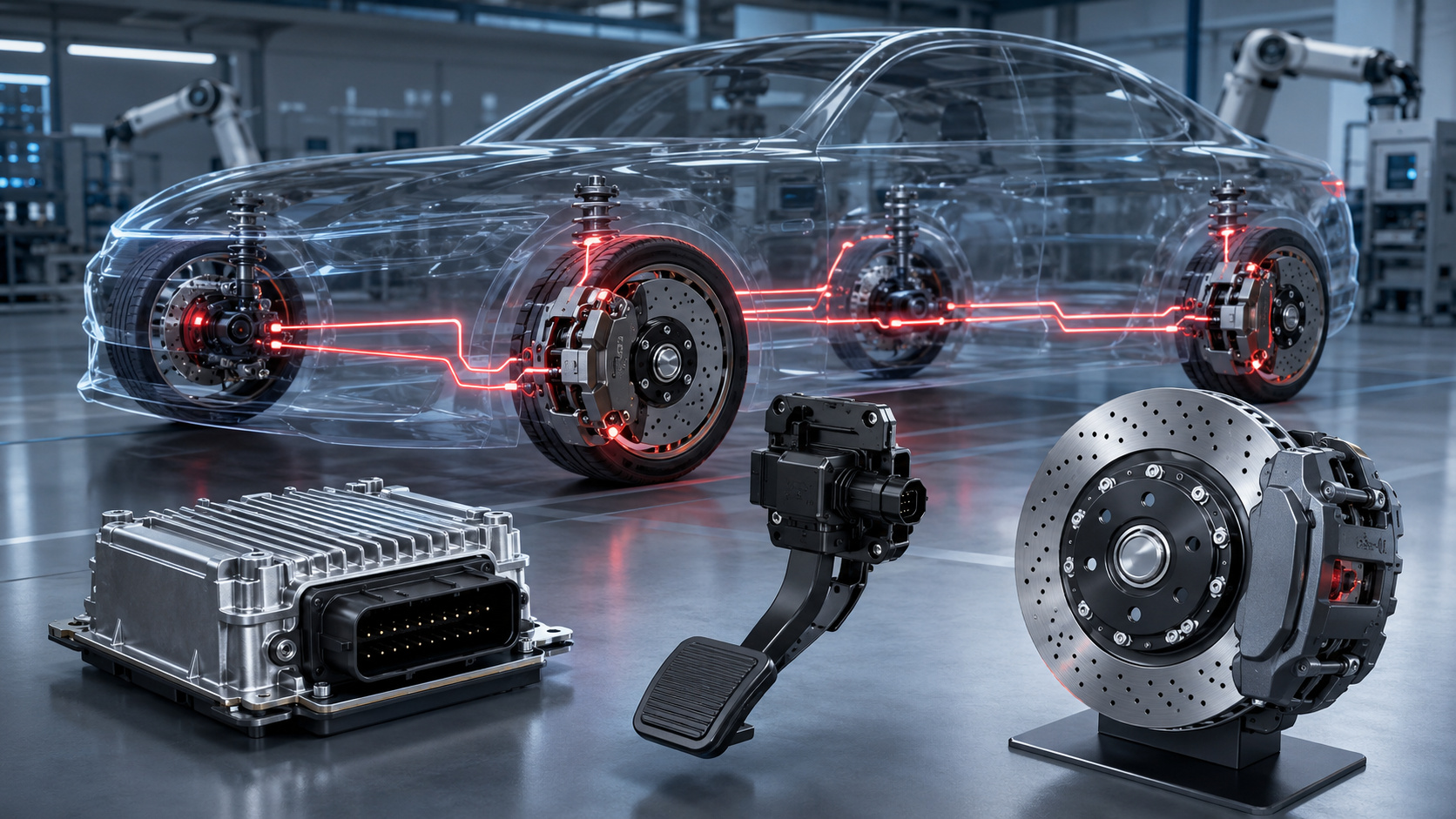
Brembo starts production of Sensify, a brake-by-wire system that replaces part of traditional hydraulic braking with intelligent electronic control.
On May 4, 2026, the Italian company Brembo, headquartered in Bergamo, confirmed that Sensify has entered large-scale production for a major global automaker, marking a direct advance over one of the most traditional automotive systems: the conventional hydraulic brake. According to Brembo’s official statement, the platform will be installed as a standard item in 100% of the vehicles in the initial program, while new contracts already signed are expected to allow the supply of hundreds of thousands of units per year.
What makes Sensify so disruptive is the replacement of centralized hydraulic logic with a brake-by-wire architecture, controlled by sensors, software, and electronic actuators capable of modulating braking on each wheel.
Brembo itself describes the system as an intelligent braking platform, with a fluid-free architecture that removes hydraulic circuits and centralized actuation, bringing modern cars closer to the era of software-defined vehicles, where critical components are commanded by electronics, data, and real-time automation.
Brembo attempts to replace part of mechanical braking with intelligent software
For over a century, automotive braking systems have essentially operated with the same basic logic.
When pressing the pedal, the driver activates a hydraulic master cylinder that sends pressurized fluid to the brake calipers on the wheels. Sensify profoundly changes this architecture.


Instead of relying solely on conventional hydraulic transmission, electronic sensors interpret the driver’s command and distribute braking force individually to each wheel.
Braking ceases to be merely mechanical and begins to function as a real-time software-controlled system.
Brake-by-wire system controls each wheel independently
According to Brembo, Sensify can individually manage braking pressure and behavior on each wheel of the vehicle.
This means the car can adapt the system’s response with extreme precision depending on grip, weight transfer, speed, and road conditions. On wet surfaces, for example, the software can quickly modulate actuation on each wheel to prevent loss of control.
The system transforms brakes into a dynamic electronic platform, much more adaptable than traditional purely hydraulic systems.
Technology reduces dependence on conventional hydraulic lines
The brake-by-wire concept reduces the need for classic mechanical components. Extensive hydraulic lines, traditional valves, and part of the conventional architecture can be simplified or replaced by electronic modules.
This also changes how vehicles are designed. In modern electric cars, where various functions have already migrated to electronic control, Brembo believes that the fully intelligent brake naturally fits into the new automotive generation.
The logic is similar to fly-by-wire used in modern aircraft, where electronic commands replace direct mechanical connections.
Sensify blends electronics, AI, and safety redundancy
One of the most critical points in brake-by-wire systems is safety. As braking is one of the most important systems in a car, any electronic failure needs to be compensated immediately.
Therefore, Brembo states that Sensify uses a redundant architecture, with multiple sensors and safety systems capable of maintaining operation even in the event of partial failures.

Additionally, algorithms continuously monitor vehicle and braking behavior. In practice, the system transforms the brake into an active safety computational platform.
Electric cars accelerate adoption of electronic brakes
The expansion of electric vehicles is accelerating profound changes in automotive architecture. Electronic steering, energy regeneration, centralized software, and digital platforms are reducing dependence on purely mechanical components.
Brake-by-wire appears as another step in this transformation. In electric cars, the integration between regenerative braking and physical brakes already requires sophisticated electronic management.
This makes it the ideal environment for systems like Sensify to gain ground more quickly.
System can improve stability and precision in extreme situations
According to Brembo, independent wheel control can enhance stability in critical braking. Instead of applying uniform force, the software constantly adjusts the action of each brake according to vehicle dynamics.

This allows for faster responses in curves, uneven surfaces, and sudden changes in grip. Furthermore, the technology can work integrated with advanced driver-assistance systems and autonomous driving.
The brake ceases to be merely a stopping mechanism and becomes integrated into the car’s dynamic intelligence.
Automotive industry has already started abandoning classic mechanical components
Sensify is part of a larger structural change in the sector. Steer-by-wire steering, electronic accelerators, and digital systems have already drastically reduced traditional mechanical connections in modern cars.
Now, braking enters this same transition. Manufacturers see advantages in reducing weight, simplifying architecture, and increasing digital integration capability. The modern car begins to exchange physical connections for sensors, actuators, and embedded software.
Traditional hydraulic brake will still remain dominant for years
Despite technological advancements, conventional hydraulic systems are not expected to disappear quickly. Traditional brakes remain extremely reliable, inexpensive, and widely mastered by the global industry.
Furthermore, safety regulations require rigorous testing for the widespread adoption of brake-by-wire systems. Brembo itself indicates that the transition will be gradual.
Sensify is expected to initially appear in premium vehicles and more advanced platforms before reaching popular models.
Software takes on a central role even in critical car systems
The transformation of brakes into an electronic platform shows how software is taking on a dominant role in the automotive sector.
Today, performance, energy efficiency, driver assistance, and even braking increasingly depend on algorithms. This brings modern cars closer to the logic of highly integrated computational devices.
The automobile slowly ceases to be merely a mechanical machine and transforms into a digital system on wheels.