Portuguese
  Spanish


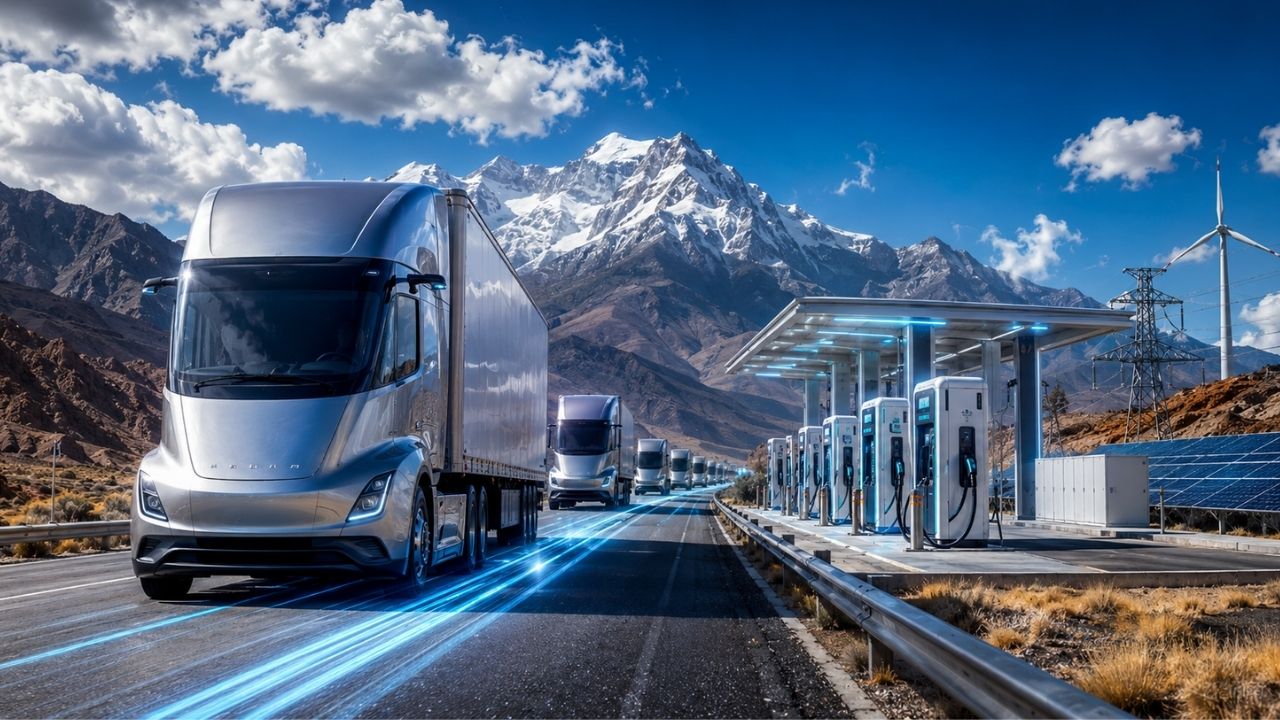

The Chilean electric highway begins with Route 5 South, with two high-power points already operating, five electrostations planned in the first stage, truck recharging in about an hour, and a plan to advance through Concepción, Temuco, and Puerto Montt by 2030, reducing diesel and emissions in heavy freight.
The Chilean electric highway has begun to redesign heavy freight logistics in the country. The initiative installs high-power chargers along 400 km, creates a route for electric trucks, and attempts to reduce diesel dependency in a sector historically linked to smoke, the external cost of fuel, and emissions.
The first stage already has two points in operation on Route 5 South, with a forecast to reach five high-power electrostations. The plan is to advance south, connecting Concepción, Temuco, and by 2030, Puerto Montt, in a logistical shift supported by electrification.
Electric highway begins with Route 5 South

The first electric highway in Chile was presented as a high-performance network aimed at the trucks that support an important part of the national economy. The idea is to offer recharging infrastructure for heavy vehicles on long-distance routes.
-
End of an era in Brazil: beloved sedan by Brazilians is discontinued despite having a 2.0 engine with 151 hp, CVT transmission, 466-liter trunk, and up to 650 km of range.

-
New Law Proposal in Brazil Could Heavily Penalize Drivers: Dangerous Overtaking May Become a Serious Offense with Fines Increased Tenfold and a 12-Month License Suspension; Update on 2026 Progress

-
Electric Revolution: Watts W125 Motorcycle Offers 160 km Range, 90 km/h Speed, and Affordable Price Starting at $3,000
-
General Motors Replaces Over a Thousand Workers with 50 Cobots at Electric Vehicle Plant, UAW Union Criticizes Move Amid Industry’s Automation Push


The focus is on freight transport, precisely one of the sectors most dependent on diesel. For years, Chilean logistical advancement has been linked to trucks powered by fossil fuel, with a direct impact on emissions and exposure to international prices.
Now, the country is trying to change this logic by bringing electricity to the roads. The goal is to allow electric trucks to circulate outside Santiago with more operational safety, reducing the fear of running out of charge during long journeys.
Route 5 South appears as the initial axis of this plan. On it, the infrastructure begins to be installed to support the expansion of heavy electromobility.
Two points already operating in 400 km of corridor
The first stage includes a corridor of about 400 km. In this section, two high-power charging points are already operating: Itawe, in the Maule region, and Copelec, in the Ñuble region.
These stations are the practical beginning of the electric route. They show that the proposal has moved from just a plan to offering real infrastructure for truck drivers and transport companies.
By the end of the year, two more stations are expected to be added in the O’Higgins region, along with the connection to the Metropolitan Region. With this, the first phase should reach five high-power charging stations.
This number is still initial, but marks an important change. The electrification of heavy transport depends precisely on this type of infrastructure: reliable, well-distributed points capable of serving trucks with large batteries.
Truck charging can take about an hour

One of the most relevant points for drivers is the charging time. According to the report presented, charging an electric truck to 100% at a high-power station can take about one hour to one hour and twenty minutes.
For road transport, this interval needs to be integrated into the travel routine. Therefore, the stations also offer support structure for truck drivers, such as bathrooms and showers, allowing the charging time to be used for rest and basic needs.
This detail is important because the transition to electric trucks does not depend solely on the battery. It requires a new logic of stopping, route planning, and time use during operation.
If the infrastructure is adequate, charging ceases to be seen merely as a delay and becomes part of the work journey. This adjustment will be decisive in convincing more drivers and companies to migrate.
Chile wants to reduce diesel dependence
The project also has a strategic objective: to reduce diesel dependency. The statement presented in the source highlights the importance of not being tied to international fuel price fluctuations.
For a country with strong renewable energy generation, bringing electricity to transportation is an economic and environmental opportunity. Chile is already positioned as a reference in renewables, and electromobility can connect this advantage to the logistics sector.
In heavy freight transport, diesel still weighs on operational costs and carbon footprint. Replacing part of this matrix with electricity can reduce emissions and provide more predictability for companies.
This change, however, depends on scale. The electric highway starts with strategic points but will need to grow to serve longer routes and different operation profiles.
Truck Drivers Enter the Center of Change
The transition will not be made solely by governments and energy companies. Truck drivers also need to adhere. The video itself highlights the experience of a driver who has been working with electric trucks for two years.
She reports trips outside Santiago, initially to Concepción, using electric trucks. This type of practical experience helps to show where the technology already works and where it still needs improvement.
For drivers, autonomy, charger availability, stop comfort, and route confidence are decisive factors. Without this, the environmental promise may not turn into real adherence.
Therefore, infrastructure needs to keep pace with operation. Electric trucks only make sense on a large scale when roads offer enough charging points to reduce uncertainties.
Plan Targets Concepción, Temuco, and Puerto Montt by 2030


The expansion of the electric highway should not stop at the first 400 km. The cited plan aims to advance south, connecting Concepción and Temuco, until reaching Puerto Montt by 2030.
This goal extends the project’s reach and transforms the route into a backbone for heavy electromobility in Chile. By bringing high-power chargers to long stretches, the country creates conditions for electric trucks to operate in more relevant logistics corridors.
Reaching Puerto Montt would have symbolic and practical importance. The city is located in the south of the country, and its inclusion shows the intention to transform electrification into a national infrastructure policy, not just a regional test.
By 2030, existing chargers must be complemented by new high-power stations. This reinforcement will be necessary to meet growing demand and make the operation more reliable.
Initiative depends on public-private collaboration
The Chilean electric highway was born from a public-private collaboration. This model is important because the electrification of heavy loads requires investment in infrastructure, technology, energy, and logistics.
Governments can organize goals and corridors, while companies help to enable stations, operation, and services. Without this combination, the expansion tends to be slower.
The project anticipates the growth of electromobility in the country. Instead of waiting for electric trucks to become popular before installing chargers, Chile is starting to build the infrastructure before full demand.
This anticipation can reduce a classic barrier of electric mobility: no one buys vehicles if there are no chargers, and no one installs chargers if there are not enough vehicles. The highway tries to break this cycle.
Heavy load becomes a real test of clean energy
The electrification of passenger cars has been discussed for years, but heavy trucks pose a greater challenge. They require more energy, travel long distances, and need high reliability to avoid compromising deadlines and supply.
Therefore, Chile’s first electric highway functions as a real test of clean energy in logistics. If heavy loads can reduce diesel, the environmental and economic impact can be more significant than in smaller segments.
Road transport is an essential part of the production chain. Food, supplies, industrial products, and goods depend on trucks to circulate between regions.
By electrifying this stage, the country tries to reduce emissions precisely in an activity difficult to replace. The road becomes not only a path for cargo but also a point of energy transition.
Electric highway marks a logistical shift in Chile
Chile’s electric highway shows a concrete attempt to change the energy base of heavy transport. With high-power chargers over 400 km, two points already operating, five electric stations planned in the first stage, and expansion to Puerto Montt by 2030, the country is betting on a new infrastructure for trucks.
The change does not eliminate all challenges. It will still be necessary to expand the network, convince drivers, reduce electric vehicle costs, and ensure enough energy for long routes. But the direction is set: diesel begins to lose ground in one of the most difficult sectors to electrify.
The initiative puts heavy cargo at the center of Chile’s energy transition and can serve as an example for other countries in the region that rely on trucks to move their economies.
And you, do you think an electric highway for trucks can truly change the logistics of Latin America, or will diesel still dominate heavy transport for many years? Share your opinion.