






 Portuguese
  Spanish
  7 min of reading
  0 comments


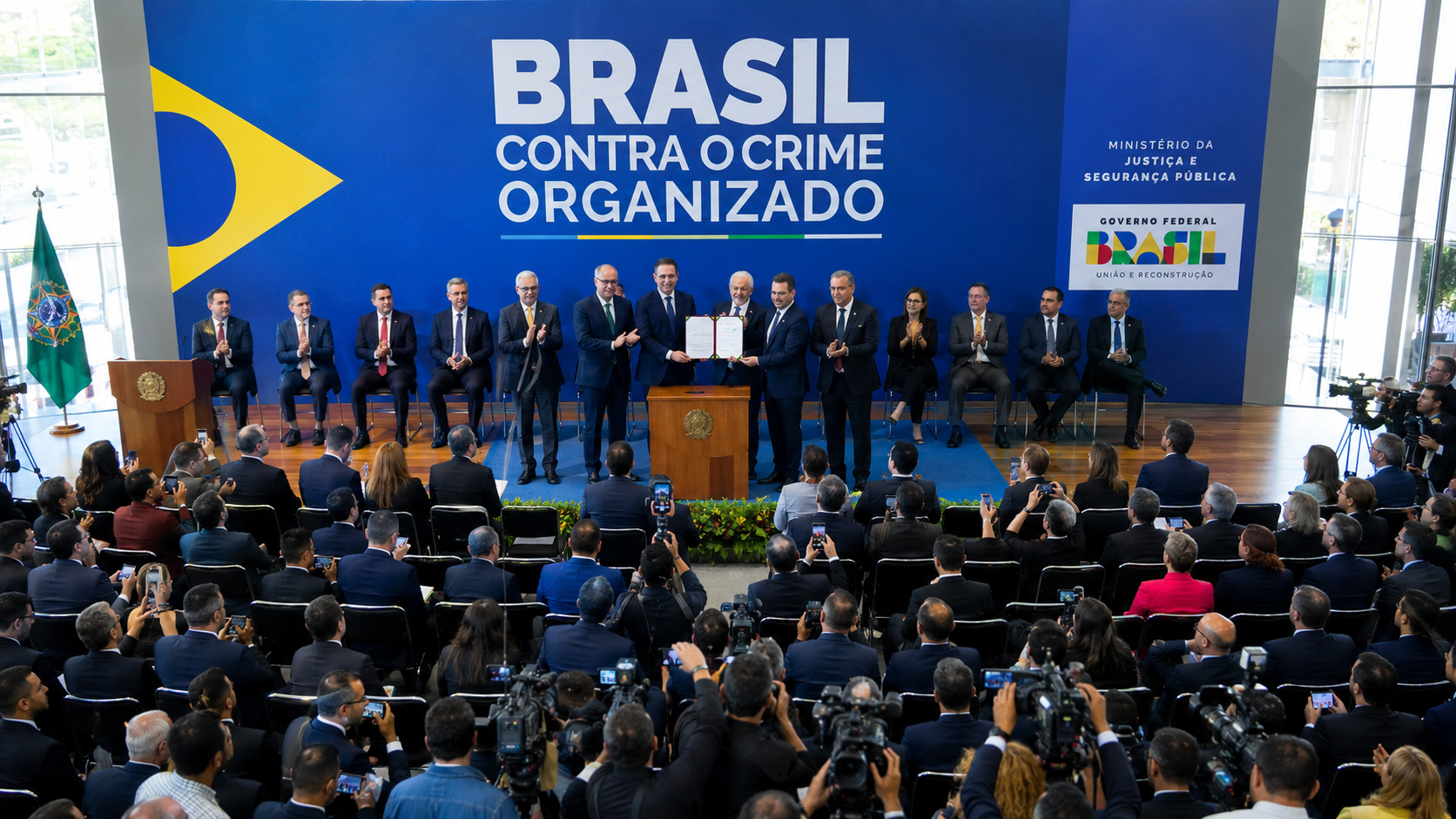
Brazil Against Organized Crime Program targets money laundering, arms trafficking, prison security, and international integration after meeting between Lula and Trump
The federal government launched the Brazil Against Organized Crime plan with the objective of directly targeting the financial, operational, and logistical structure of criminal factions, militias, and networks linked to arms and drug trafficking in the country. The initiative, presented this Tuesday (12) at the Palácio do Planalto by President Luiz Inácio Lula da Silva, seeks to expand cooperation between the Union, states, municipalities, and international security forces.
The information was released by the Ministry of Justice and Public Security, according to data published about the launch of the “Brazil Against Organized Crime” program, announced alongside the Minister of Justice and Public Security, Wellington César Lima e Silva. According to the government, the plan was built in dialogue with all states, specialists, and public security forces.
In this sense, the proposal attempts to address one of the greatest challenges for Brazilian public security: the capacity of criminal organizations to move money, control territories, operate within prisons, and maintain supply networks for weapons, drugs, and communication. Therefore, the focus is not just on arresting faction members, but on weakening the system that sustains these organizations.
-
Survivor of 1966 SS Daniel J. Morrell Shipwreck in Lake Huron Recounts 38-Hour Ordeal in Extreme Cold

-
The Greatest Hoax in World Cup History? The Film That Denied Brazil’s 1958 Victory and Exposed How Fake Evidence Can Seem Convincing on TV
-
Fake South Korean Online Stores Offer Shopping Thrill Without Spending Money or Receiving Products
-
The War of Jenkins’ Ear: How a Severed Ear Sparked One of the 18th Century’s Most Unusual Conflicts


Organized crime plan will have 4 strategic axes
The program was structured into four main axes, all aimed at directly confronting the bases of organized crime in Brazil. They are:
1. Financial strangulation of criminal organizations
The first axis targets the factions’ money. For the government, combating organized crime requires blocking the circulation of resources obtained from drug trafficking, arms trafficking, extortion, money laundering, and other illegal activities.
Among the planned measures are actions to track financial assets linked to criminal factions, expansion of centralized auctions of seized assets, and intensification of monitoring suspicious financial movements.
Furthermore, the plan provides for special attention to operations involving fintechs and possible money laundering schemes in economic sectors. This point is considered strategic because criminal organizations have ceased to operate only territorially and have also begun to operate through more sophisticated financial structures.
Therefore, the expression used by the government itself — “financially strangling” — summarizes the central logic of the offensive: to prevent factions from continuing to finance weapons, drugs, corruption, internal communication, and territorial expansion.
2. Reinforcement of security in the prison system
The second axis deals with security in prisons, one of the most sensitive areas in the fight against organized crime. The government intends to adopt standard security plans inspired by federal prisons in state units considered strategic.
In practice, this means expanding the use of cell phone blockers, X-ray equipment, and integrated actions to remove weapons, drugs, and cell phones from prison units.
This measure is relevant because criminal factions frequently maintain command capacity even with imprisoned leaders. Thus, by hindering communication within prisons, the government tries to reduce orders for attacks, collections, financial movements, and territorial disputes executed from the outside.
Furthermore, the strengthening of penitentiary security seeks to create a more uniform response between states and the Union, especially in units that concentrate high-risk leaders or members.
National FICCO and integrated forces should expand operations against factions

Another central point of the plan is the strengthening of FICCOs, the Integrated Forces for Combating Organized Crime. The government also foresees the creation of a National FICCO, focused on interstate operations.
This structure is important because criminal factions do not respect state borders. On the contrary, many of them operate simultaneously in different regions of the country, moving drugs, weapons, money, and members along national and international routes.
With a National FICCO, the intention is to expand coordination among police forces and prevent investigations from becoming fragmented. This way, operations against organizations operating in more than one state can gain more speed, intelligence sharing, and response capability.
Furthermore, the plan reinforces the need for integration between Brazilian police forces and international organizations. This cooperation became even more relevant after the meeting between Lula and the President of the United States, Donald Trump, in which the fight against organized crime was among the topics discussed.
Homicide investigations and criminal forensics become central to the strategy
The third pillar of the program deals with the qualification of criminal investigation and the clarification of homicides. For this, the government promises investments in scientific police and in IMLs, the Legal Medical Institutes.
The expansion of Genetic Profile Databases and the integration of the National Ballistics Analysis System are also planned. These instruments are fundamental for connecting crimes, identifying suspects, tracing weapons used in homicides, and improving evidence production.
At this point, the plan addresses a historical problem of Brazilian public security: the low capacity to solve homicides in many states. Therefore, by strengthening forensics, forensic genetics, and ballistics analysis, the government seeks to transform technical data into more robust investigations.
Furthermore, the national integration of this information can allow a weapon used in a crime in a given state to be linked to occurrences in other regions. This helps to reveal routes, involved groups, and connections between different criminal cells.
Fight against arms trafficking will have a national network and focus on borders
The fourth pillar of the program is the fight against arms trafficking. For this, the government foresees the creation of RENARME, the National Network for Combating Arms Trafficking.
The strategy also includes the strengthening of SINARM, the National Arms System, as well as integrated operations in border regions to trace weapons used by organized crime.
This point has a direct impact on the firepower of factions. After all, illegal weapons fuel territorial disputes, attacks on security forces, executions, and the expansion of criminal groups.
On the other hand, weapon tracing allows identifying not only who uses the weaponry but also how it reaches the hands of criminal organizations. In this sense, border control and international cooperation become fundamental parts of the strategy.
Cooperation with the US includes real-time data exchange
The plan’s launch occurred one week after the meeting between Lula and Donald Trump. According to the federal government, Brazil and the United States established a cooperation agreement for real-time data exchange and shared cargo monitoring at customs.
The focus of this integration will be the fight against arms and drug trafficking. The measure is considered strategic because part of the criminal routes involves transnational circulation of goods, money, and weaponry.
Despite this, Lula stated that he did not discuss with Trump the possible classification of Brazilian criminal organizations, such as PCC and Comando Vermelho, as terrorist groups by the United States.
“That was not discussed [classifying a criminal organization as a terrorist group]. We did not discuss criminal factions and terrorism with President Trump,” Lula said at a press conference in Washington, D.C.
Still, the president stated in a social media post on Friday (8) that the government intends to “destroy the financial potential of organized crime and factions.”
Integrated base in Manaus will reinforce action in the Amazon and at borders
Another important announcement was the creation of an integrated base in Manaus, aimed at combating organized crime in the Amazon region and on Brazilian borders.
The structure should include representatives from police forces of South American countries. With this, the government intends to expand regional cooperation in an area considered strategic for drug and arms trafficking and other transnational crimes.
Lula stated that he advocated for the creation of a working group with countries from South America, Latin America, and other regions of the world to strengthen the fight against organized crime.
“I told him [Trump] that we are willing to build a working group with all countries in South America, with all countries in Latin America, and with all countries in the world, so that we can create a strong group to combat organized crime,” the president declared.
The president also highlighted that the fight against organized crime should not be seen as the hegemony of one country over another, but as a shared action. According to Lula, Brazil has experience in this confrontation, especially through the Federal Police.
Government states plan respects competencies of states and municipalities
In a note to R7, the Ministry of Justice and Public Security stated that the program “respects the constitutional competencies of each federative entity” and seeks to strengthen cooperation between the Union, states, and municipalities.
This observation is relevant because public security in Brazil involves shared responsibilities. States command military and civil police forces, while the Union acts through the Federal Police, Federal Highway Police, federal penitentiary system, and national security policies.
Therefore, the effectiveness of the plan will depend on the coordination between different levels of government. Furthermore, it will be necessary to integrate databases, standardize procedures, and ensure the continuity of joint operations.
Plan targets economic power, communication, and logistics of factions
Brazil Against Organized Crime is born with a broad strategy: simultaneously targeting money, prisons, investigation, and arms trafficking. This combination attempts to respond to how factions have expanded in recent years, creating national and international networks.
On one hand, financial asphyxiation seeks to interrupt the flow of resources that sustain these organizations. On the other hand, strengthening prisons aims to limit internal communication and command. Furthermore, expanding forensics and ballistic analysis can increase the capacity to clarify homicides and track crimes.
At the same time, cooperation with the United States and South American countries extends the strategy’s reach beyond Brazilian borders. In this way, the government attempts to build a more integrated response against groups operating on a national and transnational scale.
Still, the plan’s success will depend on the practical execution of measures, the adherence of the states, and the ability to transform institutional integration into concrete operations. After all, criminal factions, militias, and trafficking networks operate with speed, technology, and significant financial power.





Be the first to react!