






 Portuguese
  Spanish


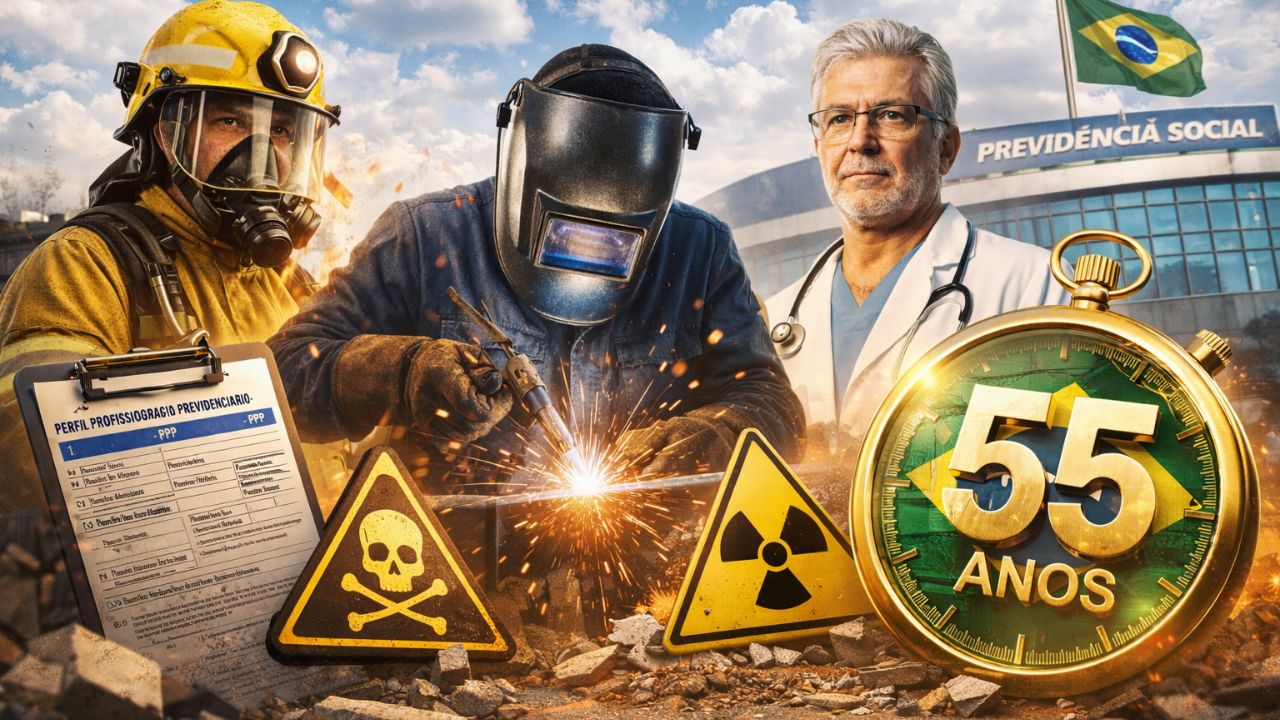


Understand How Special Retirement at 55 Works: Special Retirement Requires PPP, Proof of Hazardous Agents, and Attention to the 2019 Reform.
The news about special retirement at 55 has circulated strongly after the release of a list of professions linked to proven risks, but the central point is not the job title but the exposure to hazardous agents.
With the stricter rules after the 2019 Reform, understanding minimum age, contribution time, mandatory PPP, and how to prove the risk became the difference between obtaining the benefit early or having the request denied.
What Is Special Retirement and Why It Can Be Obtained at 55

The special retirement at 55 is a benefit aimed at workers continuously exposed to hazardous agents, such as high noise, chemical products, biological agents, and electrical shock risks, among other types of occupational hazards.
-
Seniors Over 60 Can Travel for Free Across Brazil: Elderly Statute Ensures Two Free Bus Seats and 50% Discount When Full for Low-Income Passengers

-
Detran RJ starts requiring a toxicological test for those obtaining their first driver’s license in the car and motorcycle category starting June 29; see who will be affected.

-
Florida takes TikTok to court and accuses the Chinese giant ByteDance of ignoring the law that bars minors under 14, while parents and authorities demand more protection for children on social networks.
-
Chamber approves constitutional amendment reducing the age of criminal responsibility from 18 to 16 years; what now?




What defines the right is the combination of proven exposure and time of contribution in special activity, which can vary from 15, 20, or 25 years, depending on the classification of the activity and the risk involved. It is not a reward for the profession; it is protection against the risk.
2019 Reform: What Changed in Minimum Age
The 2019 Pension Reform brought a requirement for minimum age in special retirement, ranging from 55 to 60 years, depending on the type of activity and the required time.
Therefore, when discussing special retirement at 55, it is essential to remember that this minimum age is connected to the correct classification and the evidence of exposure.
The same job title may or may not generate rights, depending on the environment and the agents present.
Mandatory PPP: The Document That Decides the Game
To request special retirement at 55, the worker needs to prove exposure through the Social Security Profession Profile, the PPP. This document is issued by the employer based on technical reports and is regarded as an essential piece in the granting process.
In practice, the PPP describes the activity, sector, risk agents, and the intensity or conditions of exposure. Without a consistent PPP, the benefit tends to get stuck.
Attention: Sometimes the PPP Needs to Be Contested
A sensitive point is that the PPP may come incomplete, generic, or even divergent from the reality of the work. In many cases, it may be necessary to contest the PPP and request an examination to confirm the risk.
This matters because a poorly filled detail can undermine the chance of special retirement at 55 even when the exposure truly existed. PPP is not bureaucracy; it is proof.
The List of Professions: What Appears and How to Interpret
The list mentioned in the news includes professions frequently associated with risk, such as engineers, health professionals, electricians, and miners, as well as occupations linked to industries and activities with exposure to hazardous agents.
Examples mentioned include engineering in areas such as civil construction, metallurgy, mining, electricity, and chemistry, along with medicine, dentistry, nursing, X-ray technicians, laboratories, pharmacists, and related fields.
Mining activities, quarries, tunnels, and galleries, extraction, transportation, and industrial functions such as welding, sandblasting, spray painting, and other operations with risk are also included. The list provides guidance, but does not replace proof of exposure.
The Error That Most Derails Requests: Sticking to the Job Title
An important warning is to not get stuck on the job title. Two workers with the same position may have different outcomes.
A simple example: an engineer working only in an office is unlikely to have relevant exposure, while another working inside a factory with noise and chemical products may have rights if the exposure is proven. That’s why special retirement at 55 depends on real and documented risk, not on the title on the badge.
A Practical Path for Those Who Want the Early Benefit
If you are aiming for special retirement at 55, the safest path is usually:
- Map out where exposure occurred and for how long
- Check the PPP and the reports that support the document
- Verify if the special time adds up to 15, 20, or 25 years as applicable
- Understand how the 2019 Reform impacts your minimum age and applicable rules
- Adjust the request to rely on documentation, not assumptions
And now a quick question: have you checked if your PPP correctly describes the risks of your work, or did you only discover this document when you started considering retirement?









Infelizmente em se tratando do Brasil os trabalhadores nunca será beneficiado por nada que venha desses políticos e ministros do STF que são os verdadeiros governamentais do Brasil em quanto eles se aposentam com 2 mandatos e guarda uma grande fortuna durante os mandatos e. Para os trabalhadores tem que trabalhar 55 anos pra sabe-se lá quando vai poder se aposentar, isso é o país da exploração humana