






 Portuguese
  Spanish
  6 min of reading
  0 comments



Understand What Labor Market Regulation Is, Why It Exists, How It Originated, and What Its Essential Role Is in the Relationships Between Employers and Employees Throughout History to the Present Day.
The regulation of the labor market directly impacts the lives of workers and employers.
Therefore, both beginners and professionals in the field need to understand how the rules shaping formal work operate. This helps interpret market transformations, guarantee rights, and make informed decisions.
When we talk about regulation, we refer to a set of laws, norms, and institutions that organize labor relations.
-
Dismissing a retired worker or one eligible for retirement constitutes ageism and creates a duty to compensate: a unanimous decision by the TRT mandates reinstatement to employment, payment of back wages, and upholds compensation of R$ 15,000 for discrimination.

-
Work less and produce more? Nobel Prize in Economics explains why shorter workdays can increase productivity

-
Unions are growing again in Brazil after more than a decade, but they face an urgent challenge to win back digital workers and maintain relevance.
-
From the typewriter to the home office: how work has changed and why new generations think differently




These rules define the maximum working hours, the rights of the worker, the method of hiring, the duties of the employer, the role of unions, and the mechanisms of inspection.
Thus, these regulations aim to balance the interests of the involved parties: the employer, who needs flexibility to manage their business, and the employee, who seeks security and protection against abuses.
This balance is fundamental for the construction of a fair and sustainable labor market.
The Origin of Labor Regulation
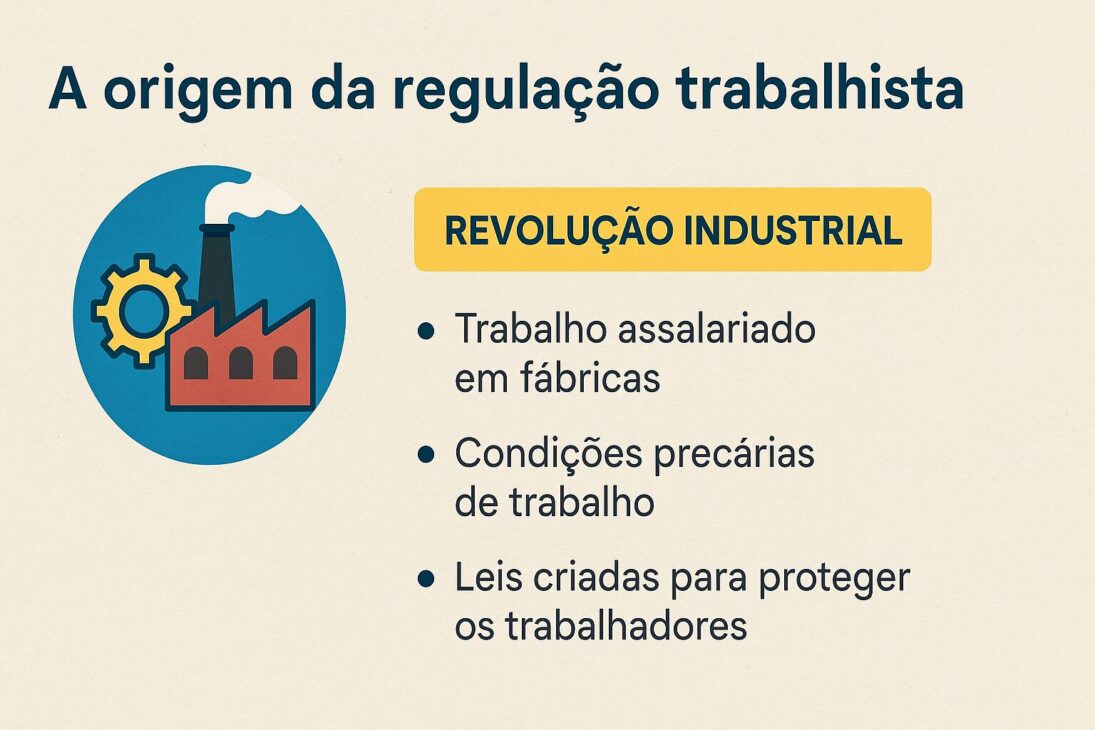
The origin of modern labor regulation is linked to the Industrial Revolution, which occurred in the 18th century. According to the website of the International Labour Organization (ILO), before this period, labor relations primarily took place in the countryside or in family workshops.
There was no presence of large employers or wage earners in the form we know today.
With the advancement of machines and the growth of factories, wage labor expanded.
However, conditions in the early decades of industrialization were precarious: working days of up to 16 hours per day, child labor, absence of vacation, and minimum safety.
This scenario generated protests and mobilizations for better working conditions.
It was, therefore, in this context that the first labor laws emerged.
The regulation of the labor market was largely born in response to the need to protect workers from exploitation and ensure a minimum of dignity in professional relationships.
According to the Ministry of Labor and Employment (MTE), these early legislations were characterized as protective.
Moreover, labor regulation began to be seen as an essential right to promote social justice. In various parts of the world, the labor movement gained strength, pressuring governments to recognize the need to formalize and regulate working conditions.
Consolidation of Labor Laws in Brazil
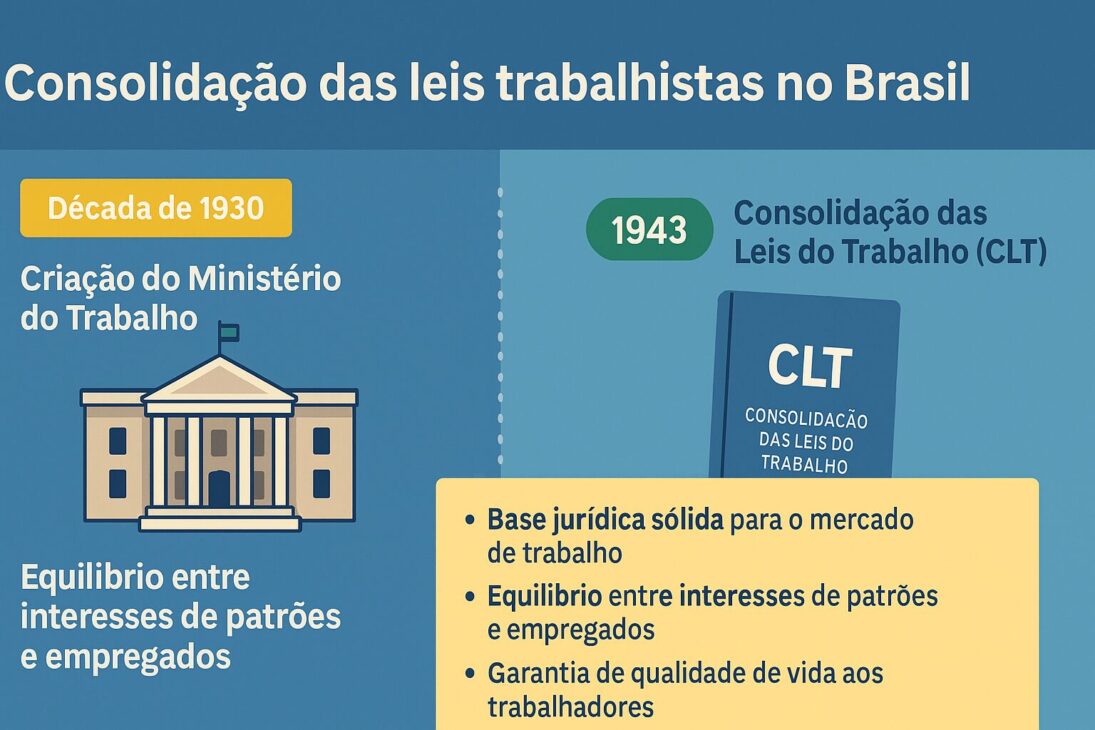
In Brazil, labor regulation consolidated from the 1930s.
It was with the creation of the Ministry of Labor and the consolidation of laws through the CLT (Consolidation of Labor Laws) in 1943 that the regulation system began to have a solid legal foundation.
The CLT was inspired by legislations from other countries and gathered various norms.
According to the official website of the Brazilian government, the CLT established a solid legal basis for the functioning of the formal labor market in Brazil.
The regulation of the labor market has a clear social function: to balance the interests between employers and employees. In a purely liberal system, the worker would be at a disadvantage in negotiations, as they depend on their job for survival.
Therefore, the role of the State is to guarantee a minimum level of protection and establish fair limits to prevent this relationship from becoming abusive.
Moreover, regulation contributes to economic and social stability. When there are clear and fair rules, there are fewer conflicts, greater legal security, and more predictability for companies and workers.
The CLT was also fundamental in regulating important issues such as vacation, 13th salary, paid weekly rest, and maternity and paternity leaves.
These rights aim to guarantee a quality of life for workers. According to the ILO, the inclusion of these norms was a milestone in Brazil and represented a significant advance in the recognition of labor rights.
The Main Pillars of Regulation
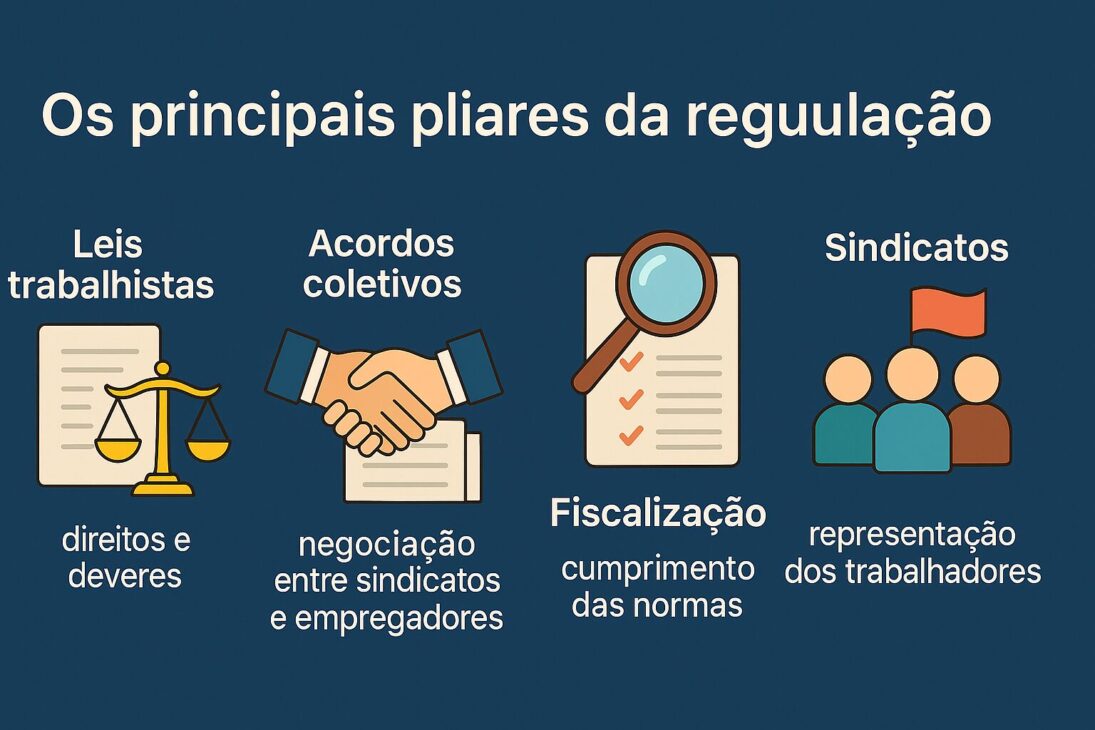
The regulation of the labor market relies on different fronts. The first of these is the labor laws, which define the rights and duties of both parties.
These laws can be national, as is the case with the CLT, or international, such as the conventions of the International Labour Organization (ILO), of which Brazil has been a signatory since 1919, according to the ILO website.
Another important pillar is collective agreements, established between worker unions and employers.
These agreements allow for adapting some general rules to the reality of each category or sector. This respects local needs and ensures more direct negotiation.
Collective negotiation offers flexibility to adjust working conditions, wages, and benefits, but always within the limits established by national laws.
Moreover, inspection is a crucial third front. It is conducted by bodies such as the Ministry of Labor and Employment (MTE), which verify compliance with the rules, investigate complaints, and impose penalties in case of irregularities.
Inspection ensures that workers’ rights are respected and prevents practices such as slave labor, moral harassment, and discrimination in the workplace.
Finally, unions play a central role in regulation, representing the interests of workers.
They negotiate agreements and promote awareness and rights advocacy. Acting as mediators in the relations between employees and employers, unions always seek to improve working conditions and the benefits offered.
Contemporary Challenges of Regulation
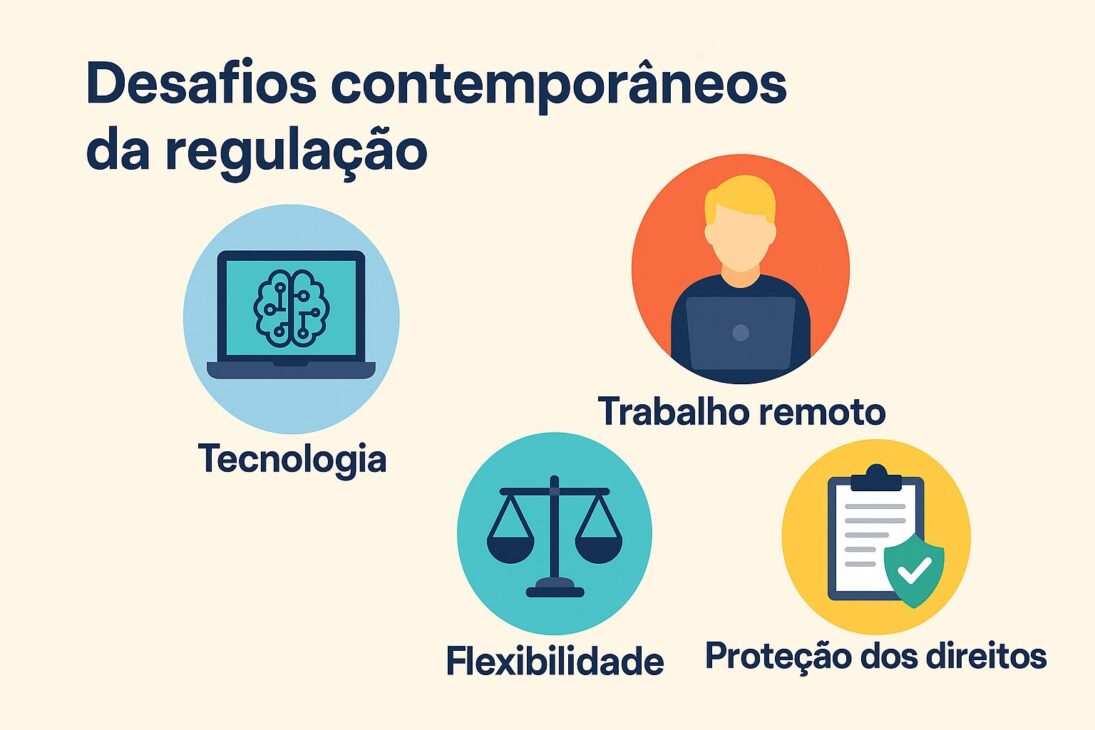
Over time, the world of work has undergone profound changes.
Technology, globalization, automation, and the advancement of remote work are reshaping production methods and labor relations. This new scenario poses significant challenges for regulation.
According to the Ministry of Labor and Employment (MTE), how to protect app workers, who often do not have a formal connection with companies?
How to guarantee the rights of those working from home? How to balance the need for flexibility with the preservation of basic rights?
These transformations create a dilemma: how to adapt labor laws from the 20th century to the new realities of the 21st century?
Regulation needs to be flexible enough to ensure protection without stifling innovation and the growth of new business models.
In Brazil, the labor reform of 2017 brought important changes, flexibilizing some points of the CLT.
Among the main changes are the expansion of the possibility of temporary contracts, the strengthening of negotiation between employer and employee, and the end of the obligation for union contribution.
These changes have generated both criticism and praise and continue to be a topic of debate among workers, employers, and the government.
Adapting regulation to the current context is an urgent necessity to ensure that all involved in the labor market have their needs met.
The Issue of Informality
One of Brazil’s major historical challenges is the high rate of informality in the labor market. Many people work without formal contracts, without guaranteed rights, and outside the protection of the laws.
Regulation plays the role of seeking ways for inclusion, promoting policies that encourage formalization and improve the conditions for those on the margins of the system.
According to the federal government website, programs for individual micro-entrepreneurs (MEI), incentives for the formalization of small businesses, and public policies for professional training are strategies that can help expand access to the formal market and strengthen the regulating role of the State.
However, it is also necessary to improve inspections to ensure that informal workers are not left to precarious working conditions.
Informality also affects tax collection and the social protection of workers.
Without adequate formalization, many workers remain unprotected in situations of work accidents, illness, or retirement.
Education and Citizenship in the World of Work
Understanding the regulation of the labor market is important not only for specialists or entrepreneurs but also for any citizen who wants to know their rights and duties.
Labor education should be present from basic education, helping young people and adults understand how employment relationships function.
This helps individuals act in situations of abuse or unjust dismissal, as well as teaching them how to seek assistance in cases of need.
Moreover, education can help combat myths and misinformation about the legislation, such as the idea that labor rights hinder the economy or prevent job creation.






Be the first to react!