





 Portuguese
  English
  Spanish
  4 min of reading
  6 comments


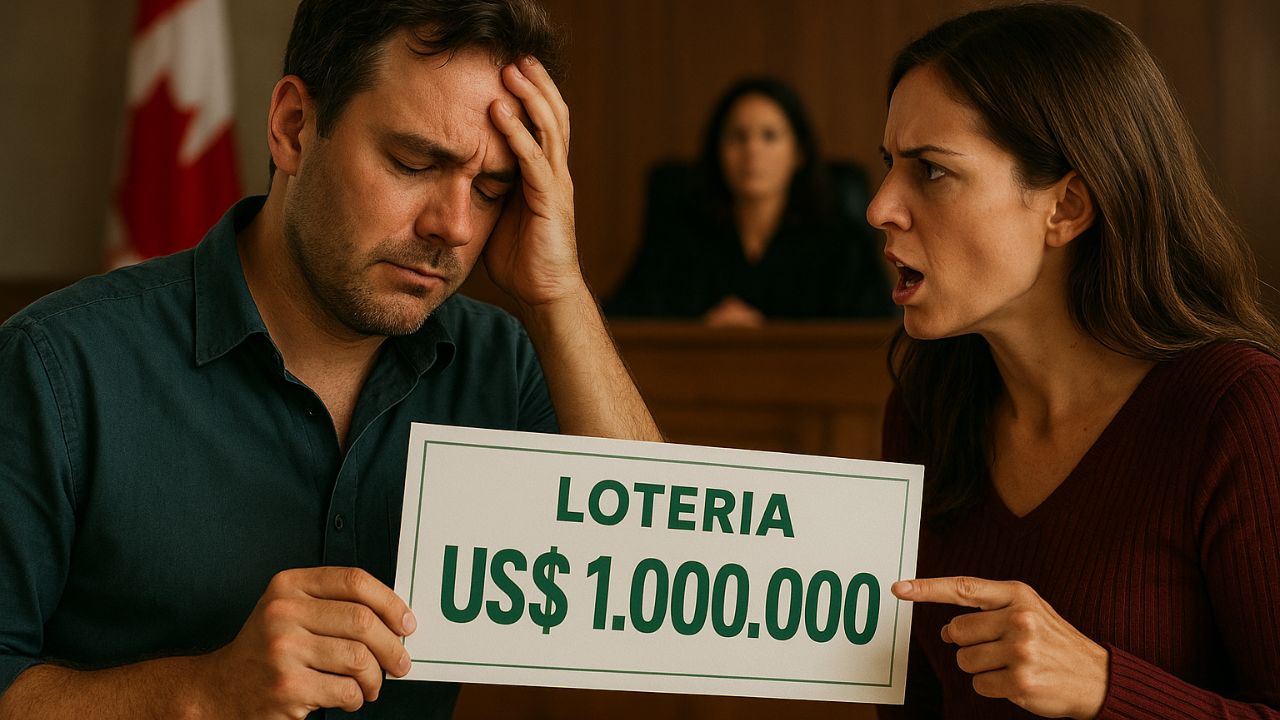


Lawsuit Sparks Debate Over the Validity of Verbal Agreements and Lottery Ticket Ownership, Revealing That Big Wins May Come with Complex Legal Challenges.
A prize that should change a life for the better has turned into a script of legal dispute. The scenario where a man wins US$ 1 million (or more) and then an ex-partner files a lawsuit claiming part of the prize has become surprisingly common. Although the topic is attention-grabbing, real cases that reach Canadian courts often involve even larger sums, such as prizes of 5 and 6 million dollars, intensifying the complexity and what is at stake.
These cases unfolding in Canadian courts expose the fragility of informal agreements when large sums of money are at stake. The fundamental question that judges need to decide is whether a pact made in trust, without any signed document, has the force of law. The answer, according to experts, is complex and critically depends on the ability to prove the existence and terms of that agreement, a challenge that turns the celebration into a draining and costly process.
Is a Promise Worth More Than the Paper? The Dilemma of Verbal Contracts
In Canada, a verbal agreement can, indeed, be legally binding. According to the analysis by the law firm Forum Law, the validity of a contract does not necessarily depend on it being written. For a verbal agreement to be recognized by the courts, essential elements of a contract must be present: a clear offer, acceptance, consideration, and the mutual intention to create a legal relationship. The major obstacle, however, is the proof. Without a document, the existence of the agreement boils down to a battle of credibility.
-
Two global aviation giants are convicted in Paris and will have to pay R$ 1.3 million each for the crash of the Rio-Paris flight that killed 228 people in 2009.

-
Deputies against the government join forces to maintain a 6×1 schedule, workweeks of up to 52 hours, a 10-year transition, halving the FGTS, and special rules for certain sectors.

-
New law prohibits motorcycle passengers, imposes a fine equivalent to R$ 2,100, and was created to try to curb robberies and attacks committed by criminals using motorcycles in Peru, Brazil’s neighboring country.

-
Gun permits for veterinarians advance in the Chamber: see what changes and what the requirements are




Forum Law emphasizes that, in disputes over verbal agreements, the court examines all available evidence, including the behavior of the parties before and after the alleged pact, third-party testimonies, and any communication that may corroborate one of the versions. In the context of lottery prizes, this means that a history of jointly purchasing tickets or conversations with friends about sharing the prize can become crucial evidence. The absence of such evidence makes the claim extremely difficult to sustain.
The Case of Robertson v. Thibeault: When Trust Becomes a Million-Dollar Dispute
One of the most emblematic cases that illustrates this situation is that of Denise Robertson and Maurice Thibeault, detailed by CBC News. Robertson sued her ex-boyfriend for half of a lottery prize of US$ 6 million, claiming that they had a longstanding verbal agreement to share any winnings. According to her, the pact was an established practice during their relationship. The dispute took on dramatic contours when, after the win, Thibeault lied about the winning ticket and left the house they shared.
CBC News reports that Thibeault’s actions after the win were central to Robertson’s case. The Ontario Lottery and Gaming Corporation (OLG), faced with the dispute, took decisive action: it paid the undisputed half of the prize to Thibeault and withheld the other contested half, awaiting a judicial resolution. This intervention shows how serious and complex these claims have become, forcing the institutions themselves to act cautiously.
Birthday Present or Trust Agreement? The Stalemate in Campbell v. McKay
Another case, also reported by CBC News, adds a different layer of complexity to the issue. In Campbell v. McKay, the dispute involves a prize of US$ 5 million. Krystal McKay claimed to be the rightful winner, stating that the ticket was a birthday present from her then-partner, Lawrence Campbell. Campbell, on the other hand, contradicted the version, stating that he asked her to hold the prize in trust, without the intention of gifting her the entire amount.
The report by CBC News explains that the court had to intervene with an injunction to freeze the assets, preventing the money from being spent until legitimate ownership was determined. This case highlights how the intention behind handing over a ticket can be interpreted in drastically different ways. It was not about an agreement to share, but rather the nature of the ownership of the physical ticket: was it an unconditional gift or an act of trust? The resolution entirely depends on which narrative the court finds more plausible.
Luck Requires Caution
The cases of lottery disputes in Canada serve as a powerful warning: the euphoria of winning a big prize can quickly be overshadowed by bitter and protracted legal battles. Although Canadian law recognizes verbal contracts, the difficulty of proving them in court turns these disputes into a risky and emotionally draining process for all parties involved. The lesson is clear: formalizing any agreement, no matter how simple it may seem, is the only way to ensure that luck does not turn into litigation.
And you, do you believe in verbal agreements to share lottery prizes? Have you arranged something similar with friends or family? Share your opinion in the comments.







me falaram uma vez quando você terminar um relacionamento que não tenha filhos com namorada fica 5 anos de boa não posta nada não se amostra porque a b******* vai vir babando
é por isso que quando eu terminei eu fiquei cinco anos de boas sem da Bandeira nenhuma eu não conheço esse problema aí
Que palhaçada, nao têm nem como provar, vou ficar de olho no próximo ganhador e alegar que o prêmio é meu.