Portuguese
  Spanish


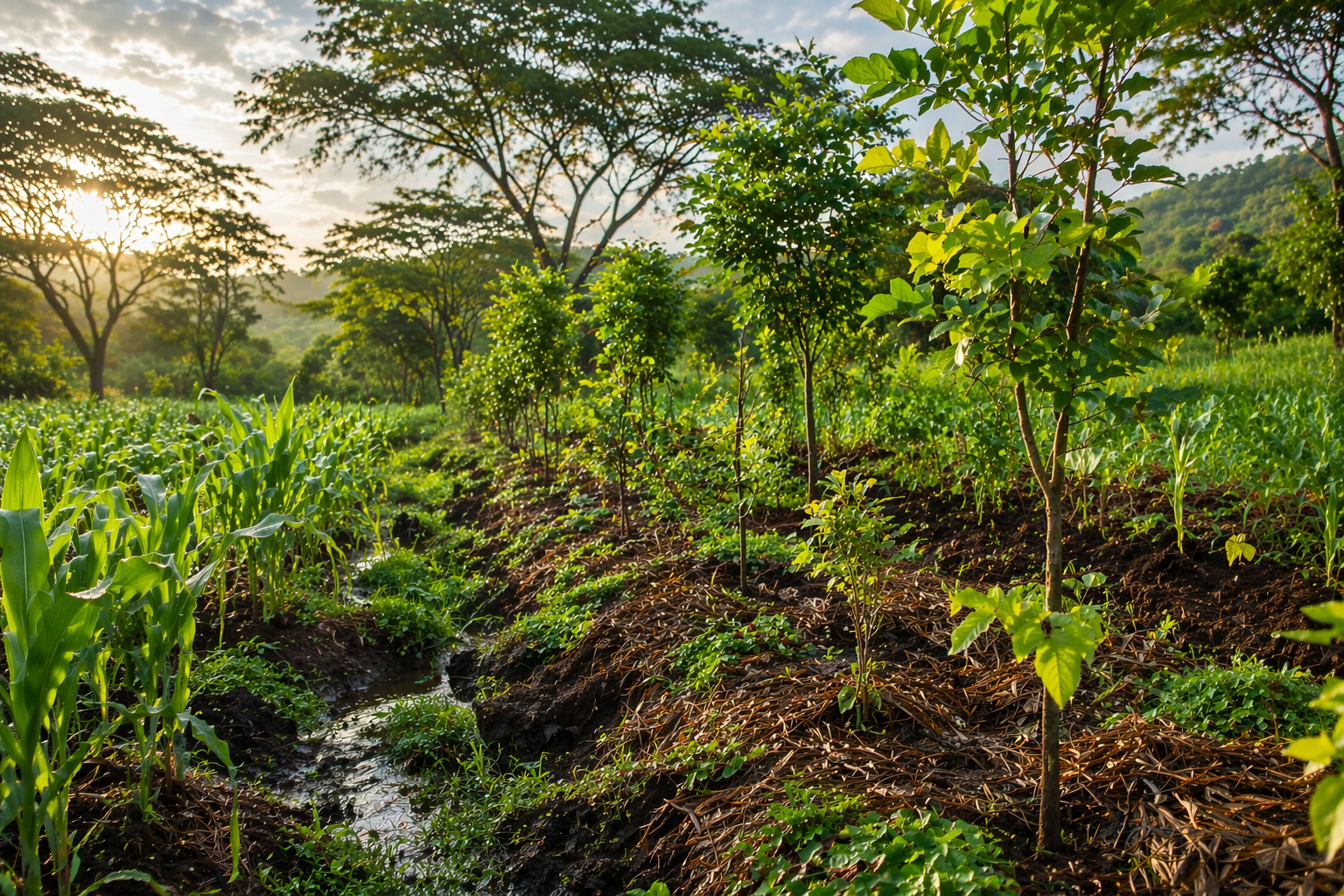

Natural regeneration phenomenon transforms soil and reduces costs in the field
Africa surprises specialists and rural producers, as a natural phenomenon has been observed in various agricultural regions.
Trees reappear without direct planting, revealing the potential of assisted natural regeneration in the field.
This process occurs when native vegetation resurfaces from existing roots and seeds in the soil.
Sustainable management techniques begin to value local biology instead of replacing it.
Recent analyses released by international organizations show that, since 2020, this model has gained strength in productive African areas.
Regions previously considered unproductive are now showing gradual and consistent recovery.
-
Pennsylvania Mine Creates Ice in Summer Heat and Melts in Winter, Turning a Mountain Crevice into a Reverse Natural Refrigerator

-
China Accelerates Global Expansion of Robotics: From Smart Vacuums to Industrial and Humanoid Machines, Millions Exported to Over 150 Markets
-
Polar Air Mass to Hit Brazil: Temperatures to Plummet in Nine States, Near Freezing in the South with Frost Risk Until Monday
-
Chinese “dark factories” produce electric cars 24/7 with minimal human intervention, as Zeekr assembles 800 units daily, raising concerns in Brazil.





The silent movement demonstrates that nature can act as a strategic ally of agricultural production.
The intelligent use of these natural resources favors food security and economic return in the long term.
Agronomic investigation reveals direct impact on soil fertility
Natural regeneration directly impacts soil fertility, as it maintains essential biological structures.
The presence of deep roots and native vegetation creates a favorable microclimate for the microbiota.
As a result, there is a more efficient cycling of nutrients, which improves the productive base of the land.
Moisture remains for longer, reducing the need for intensive irrigation.
The process also protects the soil against erosion, especially in scenarios with strong winds or heavy rains.
The surface layer remains more stable throughout the harvests.
Management that prioritizes natural shoots promotes continuous organic enrichment.
The soil texture improves and facilitates the absorption of applied fertilizers.
This renewal cycle maintains productivity over time.
The need for constant mechanical interventions in exhausted areas is reduced.
Operational efficiency grows with cost reduction in the field
The use of assisted natural regeneration directly impacts operational costs.
The practice eliminates expenses with seedlings and labor for conventional planting.
The capital needed for the recovery of agricultural areas decreases significantly.
Operational efficiency increases, as nature itself provides the structural base.
The model strengthens the protection of productive margins and permanent preservation areas.
The producer maintains environmental balance with lower initial investment.
Rural management becomes more efficient and sustainable over time.
The productive potential grows without increasing operational costs.

Natural regeneration consolidates a sustainable model in the global scenario
The advancement reinforces the importance of nature-based practices for the future of agriculture.
Degraded areas undergo continuous and structured organic recovery.
Productivity increases without compromising soil health.
The model consolidates as a viable alternative for different regions of the world.
The scenario shows that natural solutions generate concrete results.
The integration between production and preservation becomes more efficient.
Natural regeneration gains space in the global debate on sustainable agriculture.
Producers and experts begin to consider this model as a long-term strategy.
To what extent can nature take a central role in transforming global agriculture?