Portuguese
  Spanish



Strategy with cover crops transforms degraded areas into sustainable productive systems, improves soil, reduces costs, and drastically increases productivity in the field
If you are facing problems with sandy soil, low soybean productivity, and difficulty in controlling weeds, know that this reality can change completely. This information was shared by agricultural sector specialists in practical field demonstrations, showing that, with the correct use of technology and smart management, it is possible to transform areas that do not even cover production costs into highly profitable systems.
Initially, the scenario is common in many rural properties: the soybean does not close the rows well, productivity is below expectations, and weeds grow easily. Additionally, there is a high incidence of nematodes, low fertility, and difficulty in moisture retention. As a result, many producers deal with averages below 50 sacks per hectare, which compromises profitability.
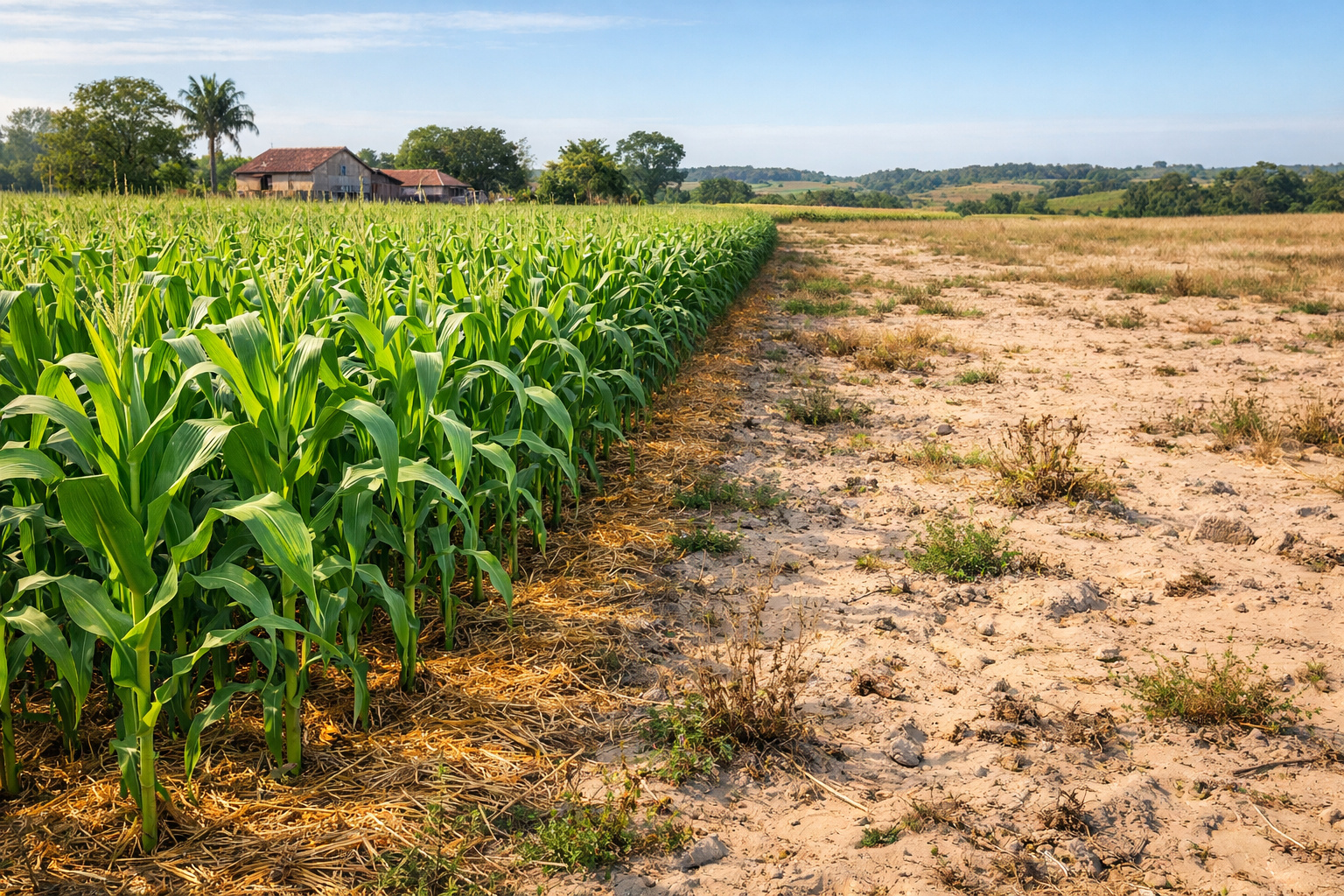
However, when we analyze neighboring areas that adopted a different system, the reality changes drastically. In just a few meters distance, it is already possible to see a clear contrast: while one area suffers from low productivity, the other presents vibrant corn, intense coloration, and productive potential above 100 sacks per hectare.
-
Half of Brazil’s Federal Public Works Projects Stalled: Audit Reveals 11,469 Abandoned Constructions and Billions Spent Without Delivering Schools, Hospitals, or Roads
-
End of an Era: Major Company Shuts Down Factory After 64 Years, Leaving Over 150 Unemployed; Facility Produced 85,000 Tons Annually of Essential Tire Material
-
End of an Era: Major Company Shuts Down Factory After 64 Years, Leaving Over 150 Unemployed; Facility Produced 85,000 Tons Annually of Essential Tire Material
-
End of an Era: Major Company Shuts Down Factory After 64 Years, Leaving Over 150 Unemployed; Facility Produced 85,000 Tons Annually of Essential Tire Material
How the use of cover crops completely changes the soil

The main difference between these areas lies in the implementation of a system based on the use of cover crops, such as stylosanthes, associated with strategic management during the dry period.
First, after harvesting the soybean, the producer desiccates the area using herbicides such as glyphosate and 2,4-D. Then, they apply approximately 20 to 25 kg of stylosanthes seeds per hectare, which remain in the soil throughout the dry season.
During this period, the producer maintains weed control using selective graminicides and adjusted doses for broadleaf plants, ensuring a clean area until the rains arrive.
Subsequently, at the beginning of the rainy season, the system allows for the planting of corn directly over this vegetation cover. And it is precisely at this moment that the great transformation occurs.
As the leaves of the Stylosanthes decompose, they release important nutrients into the soil. Thus, the roots of the corn begin to explore this layer rich in organic matter, absorbing essential nutrients for the crop’s development.
Additionally, the straw formed creates a natural thermal protection, keeping the soil cooler and wetter, even after short periods without rain. This directly favors root growth and improves water use efficiency.
Direct benefits on corn and soybean performance
With this system, corn shows a completely different pattern. The roots penetrate easily, the soil becomes less compacted, and the plant can seek nutrients in deeper layers.
Another important point is the natural stimulation of root system development. When the cover crop is cut, the Stylosanthes enters recovery and directs energy to its roots, aiding in the process of soil decompaction.
Moreover, the spacing of approximately 90 cm between rows allows greater sunlight entry, favoring photosynthesis for both corn and the cover crop. As a result, there is continuous biomass production, which will be reused in the next harvest.
This cycle creates a highly efficient system. On one side, corn produces straw of up to 10 tons per hectare. On the other, the Stylosanthes continues generating organic mass. In this way, the soil receives a double layer of protection, increasing thermal comfort and moisture retention.
Consequently, there is a significant gain in natural fertility. The system also contributes to the increase of available nitrogen in the soil, reducing the need for chemical fertilizers over time.
Productive transformation and sustainability in the field
In the long term, this model allows for a true transformation in the production system. Areas that previously showed losses begin to generate consistent profits, with greater stability and sustainability.
Additionally, the soil gains structure, increases organic matter content, and improves its water retention capacity. This reduces risks during drought periods and enhances the performance of subsequent crops, especially soybeans.
It is important to highlight that this is not an immediate process. On the contrary, it requires planning, technical monitoring, and gradual adaptation. Therefore, experts recommend starting in small areas, testing the system, and evolving as results appear.
Nevertheless, the results already observed show that it is possible to move from a low productivity scenario to levels exceeding 100 sacks per hectare in corn, something that previously seemed unfeasible in sandy soils.
Therefore, it is clear that there is no miracle in agriculture, but rather technology, proper management, and consistency in the application of techniques.
Have you tested any cover crop techniques in your field or are you still facing problems with sandy soil?