





 Portuguese
  English
  Spanish
  7 min of reading
  0 comments


A city in the interior of São Paulo holds an environmental history linked to students, centenary trees, industry, and urban memory, in an episode that still helps explain its public identity more than a century later.
Hundreds of children participated on June 7, 1902, in the planting of 242 seedlings in the center of Araras, in the interior of São Paulo, in an action recorded by public agencies as the first Tree Festival in Brazil.
The episode, inspired by the Arbor Day in the United States, gave rise to the environmental tradition associated with the municipality and helped consolidate the nickname City of Trees.
The initiative was organized in a period prior to the creation of modern environmental policies in the country.
-
Beneath the streets of Rome, there was a 1,700-year-old Roman barracks with 39 rooms, mosaics, frescoes, and remnants of the imperial guard; the discovery altered the Line C metro project and forced engineers to dismantle the ruins to reconstruct them inside the station.

-
Iron beads found in pre-dynastic tombs in Egypt were made from metal that came from space, scientists confirmed by detecting nickel, cobalt, and germanium typical of meteorites, in material used in necklaces over 5,000 years ago, before the Iron Age itself.
-
A house built with thousands of discarded glass bottles draws attention in the Tucson desert.
-
Father displaced by war marries off 13-year-old daughter to feed 11 people in Yemen; humanitarian aid rule in refugee camps raises alarm about girls pushed into child marriage


According to records from the São Paulo government and the City Hall of Araras, the mobilization brought together students, scientists, public representatives, and residents around the planting of trees in an urban area, with an educational and civic character.
Tree Festival of Araras in 1902
The Tree Festival of 1902 was conceived by the Swedish naturalist Alberto Löfgren and had the participation of the engineer João Pedro Cardoso, then linked to the Agricultural District of Araras.
According to the Institute of Environmental Research of São Paulo, the event followed a well-known American reference called Arbor Day.
The seedlings used in the planting came from the São Paulo Botanical Garden.
Among the species mentioned in official records are faveiro, peroba, oak, and guarantã.
The sources consulted confirm the number of 242 seedlings, but differ on the exact number of children: the City Hall of Araras mentions about 500 participants, while the Institute of Environmental Research cites about 600.
For this reason, the safest formulation is to state that hundreds of children participated in the action.
The number maintains the historical sense of the episode without adopting a specific count that does not appear uniformly in official sources.
The City Council of Araras records that the Tree Festival was instituted by Law No. 25, of June 2, 1902.
The municipal legislature also describes the celebration as the first ecological and environmental preservation manifestation in Latin America.
The repercussion of the event helped associate Araras with tree planting and environmental education.
Since then, the municipality has been called the City of Trees, an expression that remains linked to the memory of the planting carried out at the beginning of the 20th century.


How Araras Relates to Arbor Day
The national celebration of Arbor Day was formally defined decades later.
In 1965, a presidential decree established the Annual Tree Festival in Brazil, taking into account climatic differences between the regions of the country.
In the states of the South, Southeast, and Midwest, the date was associated with September 21, a period close to the beginning of spring.
The relationship between the national festival and the Araras episode appears in official São Paulo records, which point to the 1902 action as a reference prior to the institutionalization of the date.
The planting carried out by students also helped to bring together school, public space, and environmental preservation.
According to the City Hall of Araras and the São Paulo government, the only remaining tree from that planting is a century-old palm tree located in front of the Coronel Justiniano Whitaker de Oliveira School.
The record of the remaining tree maintains a physical link between the 1902 episode and the current urban landscape.
At the same time, the history of the festival continues to be used in educational actions and municipal events related to afforestation.
City of Trees and Current Data of the Municipality
The image of Araras as a tree-lined city appears in institutional materials of the municipality and the City Council.
The city is located in the interior of São Paulo, about 170 kilometers from the state capital, and is part of a region marked by coffee expansion, the arrival of the railway, and the development of industrial activities.
The name Araras precedes the environmental nickname and is linked to the historical identification of the municipality.
The original text related the naming to the birds that inhabited the banks of the Ribeirão das Furnas, but detailed confirmation of this formulation was not found securely in the official sources consulted for this edition.
Data from IBGE help to size the municipality.
Araras had 130,866 inhabitants in the 2022 Census and an estimated population of 135,744 people in 2025.
The Municipal Human Development Index, measured in 2010, is 0.781, classified as high.
The school enrollment rate among children and adolescents aged 6 to 14 is 99.37%, also according to the IBGE.
The city also hosts a campus of the Federal University of São Carlos, where the Center for Agricultural Sciences operates.
At the Araras campus, UFSCar offers undergraduate courses such as Agronomic Engineering, Biotechnology, Agroecology, Biological Sciences, Physics, and Chemistry.
The unit also includes postgraduate programs, laboratories, and teaching and research activities.
First Nestlé Factory in Brazil in Araras
The economic history of Araras marked another milestone in 1921, when Nestlé established its first factory in Brazil in the municipality.
According to the company itself, the unit began producing Milkmaid condensed milk, which later became known to Brazilian consumers as Leite Moça.
The establishment of the factory occurred in a context of infrastructure expansion in the interior of São Paulo.
The City Council records that the Paulista Railway reached Araras in 1877, initially linked to the transportation of the region’s coffee production.
The presence of the railway helped connect the municipality to other economic centers and the flow of goods.
This scenario explains part of the subsequent industrial development, without attributing the business decision of Nestlé solely to the railway.
More than a century later, the Araras unit continues to operate.
In April 2026, Nestlé reported that the factory produces Nescafé for the Brazilian market and for another 57 countries.
The company also stated that the plant is among its reference units in soluble coffee production.
In 2025, the company announced an investment of about R$ 1 billion until 2028 to modernize and expand the soluble coffee factory in the municipality.
The city also has historical records prior to industrialization.
According to the City Hall of Araras, the last enslaved person in the municipality was freed on April 8, 1888, before the signing of the Lei Áurea on May 13 of that year.
The date is commemorated with a tribute installed in Praça 8 de Abril, in the city center.
Parks and Squares of Araras Preserve Urban Memory
The relationship of Araras with green areas appears in the main public spaces of the municipality.
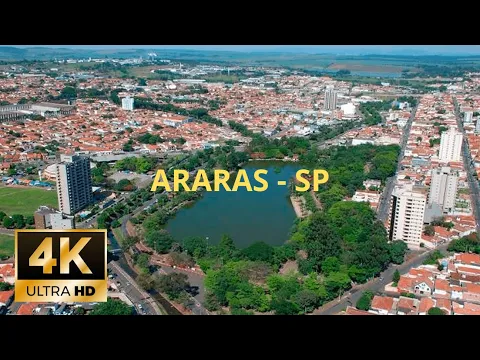
The Fábio da Silva Prado Municipal Park, known as the Municipal Lake, is located in the central region and includes circulation areas, leisure equipment, and spaces for social interaction.
According to the municipal tourism portal, the park features an interactive fountain, sensory garden, bike path, koi pond, pedal boats, waterfall, areas for physical activity, cultural presentations, and kiosks.
The site also houses a structure related to the rehabilitation of wild birds and environmental education.
Barão de Araras Square is another point linked to the city’s memory.
The space began construction as a Public Garden in 1894, received a bandstand in 1901, and underwent renovations in the following decades.
Municipal tourism information indicates that the square was listed by the municipality in 1989.
The listing involves its outline, monuments, lakes, trees, fountains, bandstands, and benches, elements that help preserve the historical configuration of the site.
Another space mentioned in municipal documents is the Gilberto Rüegger Ometto Ecological and Cultural Park.
The Araras Tourism Master Plan lists it among the city’s natural attractions and mentions activities such as tree climbing, zip-lining, pedal boats, and leisure areas.
These facilities reinforce the presence of green areas in the urban daily life of Araras, but the association between the city’s current structure and the 1902 planting should be made with caution.
The historical event is a milestone of environmental memory, while contemporary arborization results from different public actions and urban transformations over time.
Gastronomy of Araras brings together immigration and industry
The cultural formation of Araras also appears in the local gastronomy.
The city brings together influences from the São Paulo countryside, Italian immigration linked to the coffee cycle, and industrial presence associated with condensed milk.
The product manufactured by Nestlé since the company’s arrival in Brazil has become part of the local memory due to the installation of the first factory in the municipality.
This relationship does not mean that the city’s sweets depend exclusively on the brand, but it helps explain the presence of the theme in tourist and historical narratives about Araras.
Traditional cantinas, bakeries, confectioneries, and restaurants maintain recipes associated with Italian cuisine, country food, and popular confectionery.
Among the most common examples are pasta, puddings, brigadeiros, chicken with okra, crackling piglet, and fried cassava.
The City Council records the presence of European immigrants, especially Italians, in the local economic development at the end of the 19th century.
This context helps explain the persistence of Italian references in the city’s food and cultural habits.
The Tree Festival remains one of the main historical references of Araras.
The 1902 episode brings together elements of education, child participation, environmental preservation, and public action, all documented in official records of the municipality and the São Paulo government.
More than 120 years later, the history of planting 242 seedlings still appears in institutional materials, educational activities, and events related to the city’s memory.
The persistence of this record shows how a school act carried out at the beginning of the last century became part of the public identity of Araras.





Be the first to react!