Portuguese
  Spanish


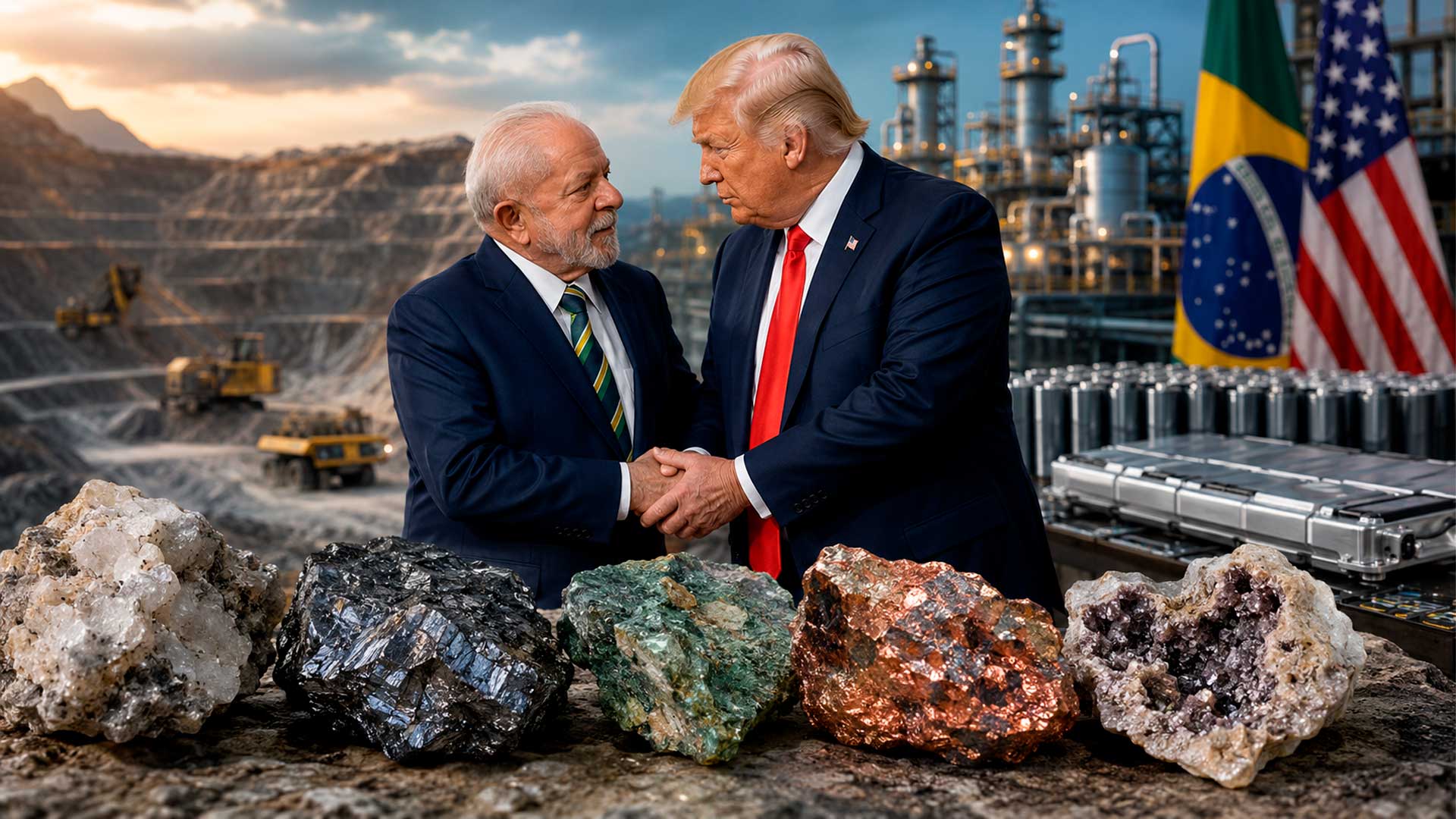

Brazil emerges as a strategic piece in the global race for inputs used in batteries, clean energy, defense, artificial intelligence, and advanced technologies
The United States wants to expand financial support for critical minerals projects in Brazil, in a move that places the country at the center of a global race for inputs used in batteries, electric vehicles, clean energy, defense, and advanced technologies.
This indication was made by the U.S. Consul General in São Paulo, Kevin Murakami, during a LIDE panel on economic relations between Brazil and the United States, held on June 9, 2026. According to Money Times, the diplomat stated that critical minerals are a priority for the United States and that there are American instruments aimed at financing projects in the country.
The statement reinforces an important change in the international scenario. Minerals such as rare earths, lithium, nickel, copper, graphite, and niobium have ceased to be just a mining topic and have become part of the economic, industrial, and energy security agenda of major powers.
-
Ancient Mines in Spain Reveal Tools and Metals That May Explain Bronze Age Trade with Scandinavia

-
XCMG Launches 240-Ton Mining Truck in Brazil, Promising Increased Productivity with Lower Fuel Consumption
-
Canadian Investment Transforms Remote Brazilian Amazon Town into Copper Hub for Global Electric Vehicle and AI Data Center Markets

-
Brazilian Company in Minas Gerais Innovates by Using Electric Currents to Extract Critical Metals from Industrial Waste


For Brazil, foreign interest opens a window of opportunity. At the same time, it creates a sensitive discussion about how far the country can attract capital without limiting itself to the role of raw material exporter.
American financing targets mining and strategic infrastructure
The main instrument mentioned by Murakami is the Development Finance Corporation, the DFC, a financial agency of the United States government that supports projects considered strategic in partner countries. The institution can operate with loans, guarantees, investment participation, and partnership structures with the private sector.
The DFC opened its first Latin American office in São Paulo in 2024. According to BNDES, the agency signed a framework cooperation agreement with the Brazilian bank in October of that year to expand co-investment opportunities in areas such as mining, critical infrastructure, connectivity, batteries, semiconductors, biofuels, decarbonization, and green hydrogen.
In practice, this means that the United States is not only looking at mineral extraction. The interest also extends to logistics, energy, processing, technology, and industrial chains capable of transforming ore into higher value-added products.
This point is central for Brazil. Without roads, railways, competitive energy, predictable licensing, and processing plants, the country can have large reserves and still remain dependent on other countries to transform these minerals into components for batteries, magnets, electric motors, and high-tech equipment.
Why critical minerals have become a priority for the USA
The race for critical minerals has gained momentum because much of modern technology depends on these inputs. Lithium and graphite are used in batteries; nickel and cobalt appear in different energy storage formulations; copper is essential for electrical grids; and rare earths are important in permanent magnets used in motors, turbines, and electronic equipment.
This dependency has become even more relevant with the expansion of electric cars, artificial intelligence, data centers, renewable generation, and the defense industry. Instead of treating these minerals merely as commodities, governments have begun to see them as part of national security and industrial competitiveness.
According to the U.S. Chamber of Commerce, Brazil holds a significant position in this scenario by having large reserves of niobium, graphite, rare earths, and nickel. The problem is that, except for some more mature chains, the country still has limitations in mineral processing and the production of higher-value industrial items.
Global concentration also influences the American decision. The refining and processing chain of various strategic minerals remains concentrated in a few countries, increasing the risk of interruptions, trade disputes, and excessive dependence on specific suppliers.
Therefore, the USA seeks alternatives in countries considered partners. Brazil fits into this map due to its broad mineral base, relatively clean energy matrix, relevant industrial market, and strategic location in the Americas.
Brazil wants to attract money without giving up mineral sovereignty
The Brazilian government is trying to take advantage of this interest without handing over the entire value chain abroad. According to the Ministry of Mines and Energy, the country is working to expand geological knowledge, stimulate mineral exploration, develop internal processing, and seek international partnerships for financing and market access.
The official strategy includes lithium projects in Minas Gerais, copper in Pará and Bahia, nickel in different states, graphite in Bahia, rare earths in Minas Gerais, Goiás, Bahia, and Rondônia, as well as vanadium, titanium, niobium, and other minerals used in the energy transition.
Brazil’s concern is clear: the country does not want to repeat a model where it exports cheap ore and imports expensive technology. The stated goal is to advance in beneficiation, refining, industrial components, and innovation, which could generate more qualified jobs and higher revenue.
This discussion also appears on the regulatory agenda. According to Reuters, the Brazilian government is preparing rules for critical minerals focusing on national sovereignty and value addition through domestic processing, without foreseeing major new tax incentives.
The Brazilian option, therefore, seems to combine public capital, private capital, and foreign investment, but with some degree of state coordination. The challenge will be to turn this intention into concrete, competitive, and environmentally responsible projects.
Eco Invest and BNDES enter the race for foreign capital
Besides American interest, Brazil is trying to structure its own financing mechanisms. Reuters reported that the government plans to mobilize around R$ 50 billion in a new round of Eco Invest, a program aimed at sustainable technologies and strategic sectors.
The planned areas include green fertilizers, battery systems, critical mineral processing, sustainable fuels, automation, artificial intelligence in production, green chemistry, and circular economy of mineral and industrial waste.
The program design foresees the use of public resources to attract private capital, including foreign. This combination is known as blended finance and seeks to reduce risks for investors in sectors that require high capital and long-term returns.
BNDES also appears as an important player. The bank already participates in initiatives to support strategic minerals and has a direct relationship with the DFC, which can facilitate joint operations in Brazilian projects.
For mining companies, this type of structure can be decisive. Critical mineral projects often require years of research, licensing, infrastructure, industrial testing, and sales contracts before generating consistent revenue.
Opportunity comes with environmental pressure and geopolitical dispute
The entry of more foreign capital into the Brazilian mineral sector can accelerate projects but also increases the demand for governance, traceability, and environmental responsibility. International investors tend to demand clearer licensing standards, respect for local communities, dam safety, and reduction of social impacts.
This point is especially important in a country that has already experienced environmental tragedies related to mining. For the discourse of energy transition to be convincing, the extraction of minerals used in clean technologies needs to avoid new environmental and social liabilities.
There is also a geopolitical tension. The interest of the United States adds to that of other blocs and countries that want to reduce risks in their supply chains. This can give Brazil greater bargaining power, provided the country can maintain a balanced policy and not accept agreements that limit its industrial autonomy.
The central question is whether Brazil will be able to transform mineral reserves into technological development. Otherwise, the international dispute may only change the destination of exports without changing the country’s position in the global chain.
What changes for the mining sector in Brazil
With the advancement of this agenda, Brazilian and foreign companies with lithium, rare earths, nickel, graphite, copper, and niobium projects should gain more visibility. The trend is for investors to pay more attention to projects with local processing potential, long-term contracts, and robust environmental standards.
The movement can also benefit regions with projects under development, such as Minas Gerais, Pará, Bahia, Goiás, and other states with mineral potential. But the economic gain will depend on infrastructure, legal security, and the ability to transform projects on paper into real production.
For the average consumer, the topic may seem distant, but it is linked to products increasingly present in daily life. Batteries, cell phones, electric cars, solar panels, turbines, and high-tech equipment depend on secure mineral chains.
In the end, the dispute for critical minerals shows that the energy transition does not depend solely on clean energy. It also depends on mining, industry, science, financing, and political decisions capable of defining who will control the inputs of the future economy.