Portuguese
  Spanish


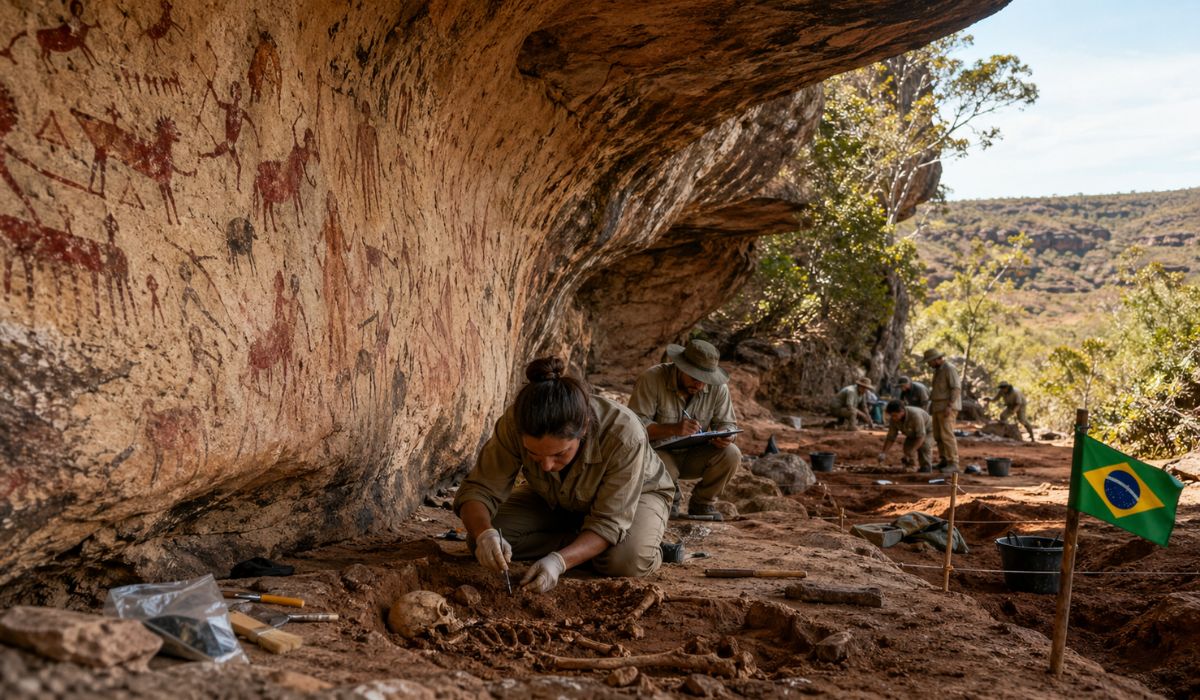


Rock shelters in Serranópolis preserve ancient traces of human presence in the Cerrado and help researchers investigate occupations, tools, rock paintings, and funerary practices predating the formation of current cities.
In Serranópolis, in southwestern Goiás, rock shelters preserve traces of human occupation dating back approximately 11,000 years before the present, according to information released by the National Institute of Historic and Artistic Heritage.
Among sandstone cliffs, researchers identified rock paintings, stone tools, remains of bonfires, and funerary structures that help reconstruct part of the ancient human presence in the Brazilian Cerrado.
The region’s landscape is currently marked by farmlands, rural roads, and activities related to agribusiness.
-
A 12-year-old boy from the municipal network of Canoas won gold in the Brazilian Mathematics Olympiad, earning the school’s first national medal in history and standing out in a competition that brought together more than 18 million students, demonstrating how public education can uncover hidden talents in Brazil.

-
Why did a company that was already earning US$ 1 million decide to completely change its strategy? The answer begins with used bottles, worms, and an unexpected decision.

-
Where it almost never rains, residents hung giant nets in the desert mountains and started to ‘fish’ drinking water from the fog: the nets can collect thousands of liters per day directly from the mist.

-
Young people from Minas created a robot without screws or metal parts, betting on a strong and flexible structure to compete against a thousand teams in Houston and took Brazil to the top of world robotics for the first time; Sofia, 15, also made history with an unprecedented leadership award.


Beneath this contemporary scenario, the archaeological sites hold layers of information about hunter-gatherer groups, human displacements, instrument production techniques, and forms of territorial occupation over thousands of years.
Archaeological research in Serranópolis began in the 1970s, with work associated with professors Pedro Ignácio Schmitz and Altair Sales Barbosa.
Since then, different surveys have registered dozens of sites in the region, making the municipality a reference area for studies on human presence in the Central Plateau.
Serranópolis and archaeology in the Brazilian Cerrado
The scientific relevance of Serranópolis is linked to the concentration of rock shelters, many of them with rock paintings and engravings.
These spaces were used in distinct periods and may have served as places of residence, passage, burial, and artifact production, as indicated by research conducted in the area.
On the sandstone walls, human figures, animals, and geometric shapes appear.
In some places, the pigments are still visible, although they are subject to the action of time, humidity, natural organisms, and potential impacts caused by uncontrolled visitation.
For specialists, rock art can function as a visual document about ways of life, symbolic choices, and forms of communication of ancient populations.

Still, interpretation requires caution.
Without complementary evidence, it is not possible to state with certainty that certain images represent rituals, astronomical observations, or daily life scenes.
In addition to the paintings, the Serranópolis sites preserve lithic tools, ceramic fragments in more recent layers, and organic remains associated with ancient bonfires.
The cross-referencing of these materials allows researchers to study technology, diet, space use, and environmental changes that occurred at different times of human occupation in the Cerrado.
Ancient skeleton found in Gruta do Diogo 2
In 2023, an excavation at the Gruta do Diogo 2 site revealed a nearly complete human skeleton.
The estimated age of the find reached approximately 12,000 years, initially based on the dating of charcoal found near the fossil, between 11,700 and 11,900 years.
At the time, researchers reported that direct analyses of the bone material would still be necessary to confirm the exact age.
The find had repercussions because it can contribute to the debate about ancient human presence in the Central Plateau.
The discovery occurred in an area researched for decades and indicated that the Serranópolis sites can still offer new data on the occupation of Brazil’s interior.
Another research front in the municipality was disclosed by Iphan in 2022.
That year, the agency reported the identification of a funerary structure with ten human skulls at the GO-Ja-02 site, in the Diogo complex.

According to the institute, the remains were relatively dated between 3,000 and 4,000 years old and were in a good state of preservation.
These records indicate that the occupation of the region occurred at different times, and not just in an isolated episode.
The archaeological layers point to successive uses of the rock shelters, with variations in funerary practices, object production, and the relationship of human groups with the environment.
Stone tools and prehistoric technology
The stone objects found at the Serranópolis sites are analyzed by researchers to understand how ancient groups produced and used their instruments.
Studies on lithic remains from the region describe the presence of elongated flakes and pieces made by specific knapping methods.
These tools could be used in activities such as cutting, scraping, food processing, and working with wood, leather, or plant fibers.
By observing production and use marks, archaeology seeks to understand how these populations organized tasks and utilized the resources available in the Cerrado.
The archaeological complex also contributes to broader discussions about settlement routes, adaptation to different environments, and cultural diversity among pre-colonial groups.
Instead of a single sequence of occupation, the remains suggest changes over time, with technologies, habits, and forms of land use that varied according to the period studied.
Preservation of archaeological sites in Goiás
The archaeological area of Serranópolis is located in a region with rural activities, private properties, and visitation points.
This configuration requires collaboration among researchers, landowners, public authorities, and the local community to reduce risks to the sites.
Archaeological tourism can broaden public knowledge about heritage, but it also requires planning.
Studies linked to Iphan analyzed problems and possibilities of visitation at rock art sites in the municipality, with attention to the need for heritage education, visitor guidance, and local community participation.
Unaccompanied circulation can compromise information preserved for thousands of years.
Touching paintings, graffiti, removal of fragments, littering, and trampling sensitive areas are among the factors that can affect both the objects and the archaeological context in which they were found.
In archaeology, context is an essential part of scientific information.
When a trace is removed without proper recording, its relationship with the soil layer, nearby materials, and the period to which it might have been associated is also lost.
Therefore, preservation depends not only on the physical protection of the sites but also on educational and inspection actions.


Archaeological heritage still little known
Despite the accumulated scientific production, Serranópolis is still less known to the general public than other Brazilian archaeological centers.
The difference in visibility helps to show that prehistory in the country is not concentrated in a single region and involves distinct areas, with remains distributed across various biomes.
In an exhibition about the first inhabitants of Goiás, Iphan highlighted archaeological objects found in Serranópolis and other municipalities in the state.
According to the agency, this material helps to tell a story of human occupation spanning about 11,000 years in Goias territory, involving hunter-gatherer groups, farmers, potters, and societies from more recent periods.
This past is preserved in landscapes that remain integrated into the current life of the region.
Caves, rock faces, and rock shelters function as natural records, in which each layer of sediment can contain information about diet, movement, technology, burial, or space use.
The continuation of research can expand knowledge about the peoples who occupied the Cerrado before the arrival of Europeans.
New excavations, more precise dating, pigment analyses, DNA studies, and non-invasive mapping technologies are among the methods that can offer additional data, provided they are applied with scientific control.
The archaeological heritage of Serranópolis is not limited to local interest.
For researchers in the field, the sites help to understand part of human history in Brazilian territory and reinforce the need to preserve records that can still be studied by future generations.