Portuguese
  Spanish


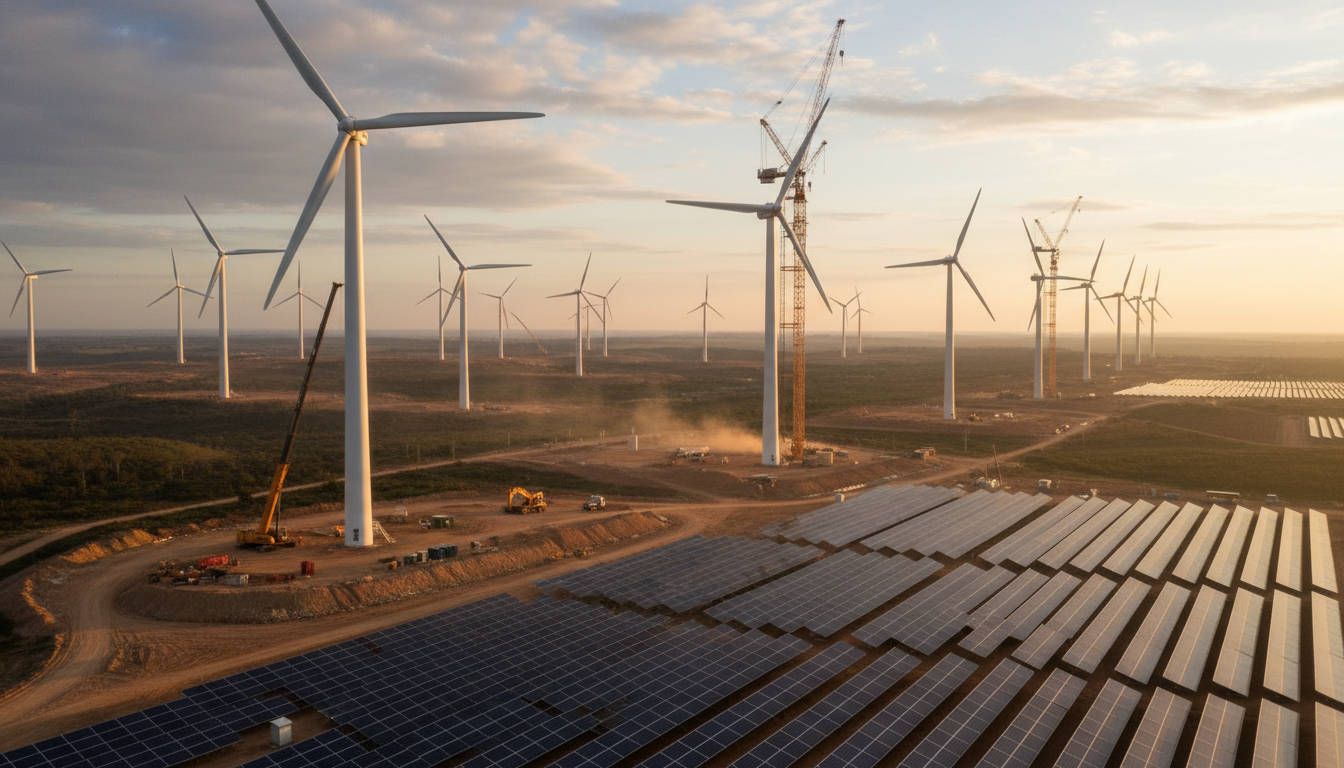

ANEEL projects Brazil to add 9,142 MW of capacity in 2026 — a 23.4% jump over 2025 — with solar energy leading with 4,560 MW and confirming the renewable shift of the Brazilian matrix
In 2026, Brazil will install the equivalent of 9 Angra III nuclear power plants in electrical generation capacity.
There will be 9,142 megawatts (9.1 GW) of new capacity, according to ANEEL’s projection, released on January 13, 2026, via the Expansion Monitoring Report (Ralie).
The number represents a 23.4% growth over the 7,403 MW added in 2025.
-
In a Place Many Doubt Solar Power Works, 360 Panels Operate in the Arctic, Harnessing Reflected Snowlight to Reduce Diesel Use at an Isolated Station

-
Island in Brazil Innovates by Installing 184 Solar Panels on Urban Lagoon to Generate Clean Energy
-
Japanese Island of 417 Residents to Test Living Half the Year Solely on Solar Power, Reducing Dependence on Diesel Brought by Ship
-
Brazilian Fishermen Use Solar Power to Produce Nearly One Ton of Ice Daily, Preventing Fish Spoilage Before Reaching Market



To get an idea of the scale, these 9.1 GW would be enough to supply an entire city the size of São Paulo.
Furthermore, the projection confirms a structural change in the matrix: solar energy has taken an absolute lead in new installations.

Solar leads by a wide margin: 4,560 MW and 61.7% growth
Centralized solar photovoltaic energy accounts for 4,560 MW of the projected expansion for 2026.
This represents a 61.7% increase over the 2,815 MW of solar added in 2025.
In practice, it means that every business day of the year, Brazil will inaugurate the equivalent of a medium-sized solar plant.
Wind, on the other hand, will contribute 1,430 MW, down from 1,825 MW the previous year.
Therefore, solar is growing while wind is slowing down — a significant trend reversal for the sector.
Fossil fuel thermal power plants still account for 2,770 MW, representing almost 30% of the total.
Biomass and hydro generation make up the remaining 362 MW.
What was installed in 2025 — the basis for comparison
In 2025, Brazil added 7,403 MW of capacity distributed across 136 plants.
The diversity is impressive:
- 63 solar plants: 2,815 MW (38% of total)
- 43 wind farms: 1,825 MW (25%)
- 15 thermal power plants: 2,505 MW (34%)
- 11 Small Hydroelectric Plants (PCHs): 199 MW
- 1 Large Hydroelectric Plant (UHE): 50 MW
- 3 Small Hydroelectric Plants (CGHs): 6.7 MW
Thus, renewables already dominated 2025.
However, 2026 promises to expand this leadership with solar growing by over 60%.
84.63% renewable — more than double the global average
As of January 1, 2026, Brazil’s total installed capacity reached 215,936 MW (215.9 GW), according to data from SIGA (ANEEL’s Generation Information System).
Of this total, 84.63% comes from renewable sources.
For comparison, the global average for renewables in the electricity matrix is around 40%.
Brazil is more than double above this average.
It has one of the cleanest electricity matrices in the world among major economies.
However, this proportion includes hydroelectric plants built decades ago, which account for the largest share.
The differential for 2026 is that solar and wind are growing rapidly, reducing the historical dependence on river water.

First quarter already confirmed the trend
In the first three months of 2026, Brazil already added 2,426 MW of new capacity.
This represents 26.5% of the annual target delivered in just one quarter.
In March alone, there were 1,140 MW distributed across 27 plants.
Of these 27, 25 were solar, totaling 1,109 MW.
The states that received the most were Ceará, Goiás, Bahia, and Pernambuco.
Additionally, a 26 MW thermal power plant and a 5 MW PCH completed the month.
Thus, solar dominance in the first quarter confirms that the annual projection is viable.
Historical context: from 2024 to peak and back
The largest expansion in the historical series occurred in 2024, with 10.9 GW.
In 2025, the number dropped to 7.4 GW — 32% below the peak.
Now, 2026 projects a recovery with 9.1 GW, although still 17% below the record.
Volatility is expected: factors such as environmental licensing, financing, and climatic conditions affect the pace.
Still, the long-term trend is clear: Brazil adds more and more renewables to its matrix each year.
The invisible revolution: distributed generation is not included in the 9,142 MW
An important detail: the 9,142 MW refers only to centralized generation — large plants supervised by ANEEL.
Distributed generation — solar panels on rooftops of homes, businesses, and industries — grows in parallel and is not included in this number.
Brazil surpassed historical milestones in distributed solar capacity in recent years.
Therefore, the actual expansion of solar is significantly greater than the official 4,560 MW suggests.
For comparison: what other countries install
Brazil’s 9.1 GW is impressive for Latin America, but modest in a global context.
China installs over 100 GW per year in renewables — more than 10 times Brazil.
The United States projects 86 GW of new capacity in 2026, of which 99% is renewable.
However, Brazil has an advantage that few can replicate: 84.63% of its matrix is already renewable.
Most developed countries struggle to reach 40%.
Thus, the Brazilian challenge is not to start the transition — it is to complete it.

The elephant in the room: 2,770 MW of fossil fuels
Despite the advances, the 2026 expansion includes 2,770 MW in fossil fuel thermal power plants.
This represents almost 30% of the new capacity.
The reason is technical: the electrical system needs dispatchable plants that can be quickly turned on when there is a lack of water in reservoirs or wind in parks.
Battery storage systems can replace this function in the future, but the technology is still in its early stages in Brazil.
Caveats
The Ralie projections are estimates that depend on the commercial operation of the plants.
Regulatory delays, financing problems, or environmental issues could reduce the final number.
Wind slowed from 1,825 to 1,430 MW — a 22% drop that concerns the sector.
The historical series shows volatility: 2025 was well below 2024, with no guarantee that 2026 will meet the target.
Still, with 84.63% renewables and solar growing 61.7% annually, Brazil continues to consolidate one of the cleanest matrices on the planet — even if the path to complete transition is still long.