Portuguese
  Spanish


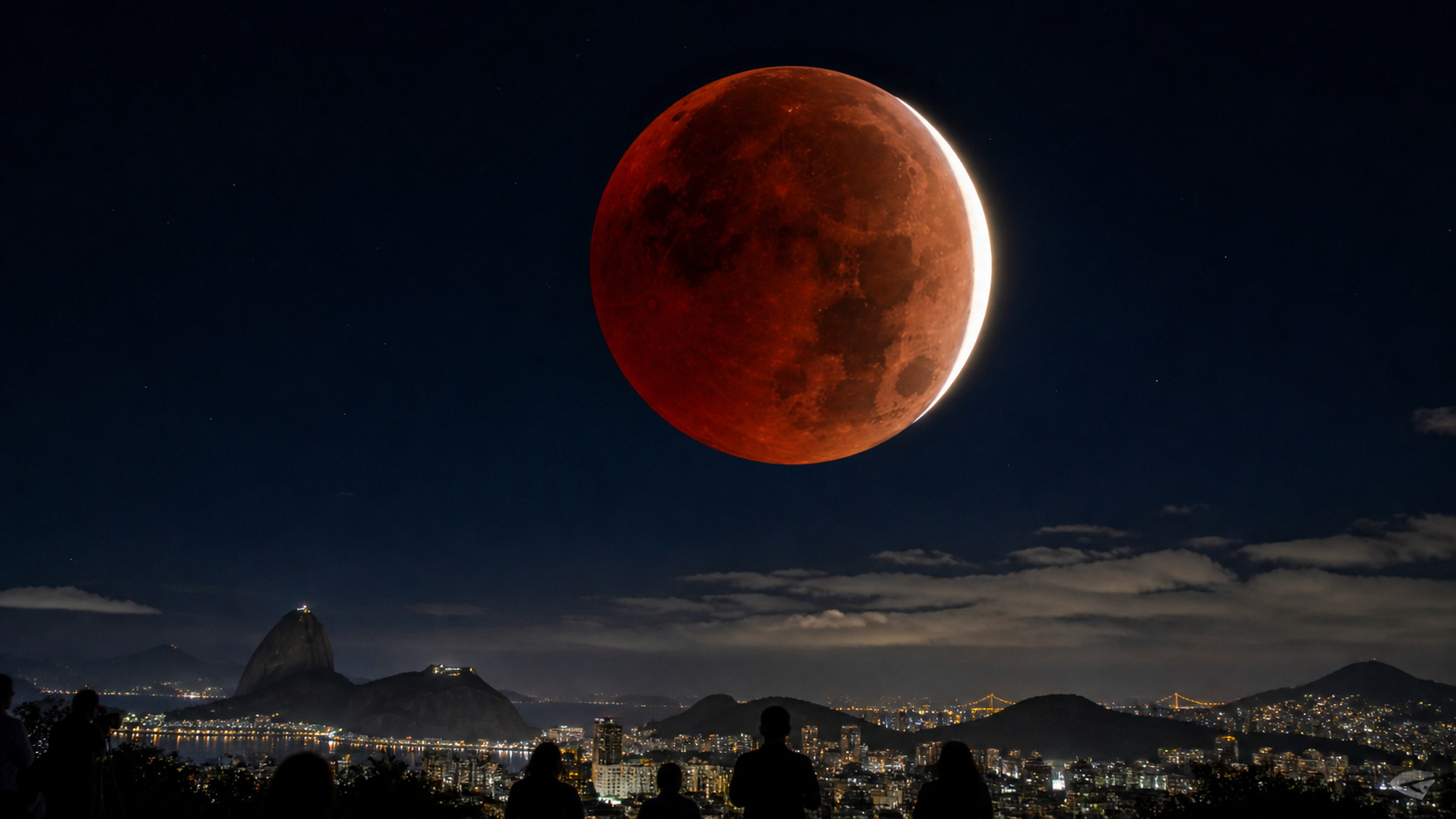

Partial lunar eclipse on August 28, 2026, will be visible throughout Brazil, with 93% of the Moon in the umbra and a reddish hue.
According to the National Observatory, on the night of August 27-28, 2026, a partial lunar eclipse will occur, visible throughout Brazilian territory, with 93% of the lunar disk entering Earth’s dark shadow, called the umbra. Astronomer Dr. Josina Nascimento, from the National Observatory, described the event with precision: “This eclipse will only be partial, but it will be almost total, as 93% of the Moon will enter Earth’s dark shadow.”
The director of the Valongo Observatory, Thiago Gonçalves, added that this magnitude should already be sufficient to produce the characteristic reddish hue of total eclipses. This happens because the fraction of the Moon within the umbra will be illuminated only by light filtered through Earth’s atmosphere, acquiring the color that makes generations of observers call the phenomenon a Blood Moon.
The event is expected to last from night until dawn, between 10:23 PM and 4:01 AM Brasília time. The Moon will be high in the sky for much of the phenomenon, allowing full observation in all regions of the country. No special equipment, eye protection, or travel will be necessary.
-
World Cup Ball Chip Uses Technology to Detect Invisible Touches, Confirms Offside, Secures Portugal’s Victory Over Croatia

-
36-Meter Hydrogen-Powered Superyacht Arrives in Brazil to Debut German Engines and Showcase Future of Clean Navigation

-
Indian Students from Jaipur Win Top Prize at World’s Largest Science Fair with EcoFog, an Affordable Mesh to Harvest Fog Water Without Energy

-
Italy Sinks Massive 11-Story Concrete Structures in the Ligurian Sea to Create a 6.2 km Barrier, Clearing the Way for 400-Meter Ships in Genoa




93% partial lunar eclipse will have visible phases throughout the night in Brazil’s sky
A lunar eclipse is not an instantaneous event. It is a process that unfolds over hours, with progressive phases that any observer can follow even without technical knowledge of astronomy. Simply look at the Moon at different times and notice the change in brightness and shadow.
Every total lunar eclipse goes through the penumbral, partial, total, partial, and penumbral phases, in that order. The August 28 eclipse will be partial, so it will not have the total phase, but it will go through all the others. The penumbral phase is the most subtle, when the Moon enters Earth’s fainter shadow region, called the penumbra, and slightly loses brightness.


The partial phase begins when the edge of the Moon enters the umbra, Earth’s dark shadow. At this moment, a dark “bite” appears on the lunar disk and progressively grows until it covers 93% of the visible surface. It is from this stage that the eclipse becomes clearly perceptible to the naked eye.
At the peak of the eclipse, 93% of the Moon’s disk will be in the umbra and only 7% still directly illuminated
At the peak of the eclipse, 93% of the Moon will be within the umbra. What remains normally illuminated will be just a 7% slice of the disk, shining with the usual silvery light, while most of the lunar surface will be immersed in Earth’s shadow.
This 93% portion will not be completely dark. It will be illuminated by sunlight that passes through Earth’s atmosphere, is deflected into the shadow, and reaches the lunar surface with a reddish or orange hue. It is the same visual principle that makes total eclipses known as Blood Moons.
In a long-exposure photograph, the contrast between the silvery slice and the reddish disk can be one of the most dramatic points of the event. After the peak, the Moon begins to exit the umbra, the dark bite diminishes, and the disk regains its full brightness over the following hours.
Why the Moon turns reddish when it enters Earth’s dark shadow during an eclipse
The explanation for the red color lies in atmospheric physics, the same that produces the orange hue of sunsets and sunrises. When Earth positions itself between the Sun and the Moon during an eclipse, it blocks direct sunlight, but its atmosphere continues to allow some light to pass through.
This atmosphere acts like a circular prism around the planet. It refracts and disperses sunlight that passes tangentially through its edges, bending mainly the longer wavelengths into the shadow which, without an atmosphere, would be much darker.

Rayleigh scattering preferentially scatters short wavelengths, such as blue and violet. What remains to pass through the atmosphere and reach the Moon are shades of red and orange. During a lunar eclipse, the Moon receives light from all of Earth’s sunsets and sunrises simultaneously.
The intensity of red depends on the Earth’s atmosphere, dust, water vapor, and clouds on the day of the eclipse
The intensity of the red color varies from eclipse to eclipse. It depends on how much volcanic dust, water vapor, clouds, and aerosols are present in the Earth’s atmosphere at the moment sunlight passes through the planet’s edges.
After large volcanic eruptions, which inject aerosols into the stratosphere, the Moon can become very dark, sometimes almost black. In years with a cleaner atmosphere, it can take on shades of vivid orange, copper-red, or reddish-brown.
August 2026 does not allow for a precise prediction of the final color far in advance. No model can accurately anticipate the optical composition of the atmosphere months beforehand. The Moon’s true hue at the peak of the eclipse will only be known that night.
All of Brazil will see the eclipse, but the far west should observe a slightly greater coverage
Visibility varies according to location in the country, but no Brazilian region should miss the event. The difference is that some areas will see phases with slightly greater intensity than others, according to orbital geometry and observation angle.
In the far west of Brazil, the Moon could reach about 96% obscuration, a percentage even closer to totality. Even so, the event will still be classified as a partial eclipse, because the Moon will not pass through the center of the Earth’s shadow and a slice of the disk will remain illuminated.
For observers in Acre or western Amazonas, the eclipse will appear slightly deeper than for observers in Rio de Janeiro or Salvador. Still, the phenomenon will be visible in all regions, with the Moon high in the sky for much of the night.
August 2026 eclipse will be more accessible in Brazil than March’s lunar eclipse
The August eclipse stands out because the geometry favors Brazil. Unlike the total eclipse of March 2026, which occurred with the Moon very low on the Brazilian horizon and already setting during a significant part of the phenomenon, the August eclipse will have the Moon in a more comfortable position for observation.
This allows for tracking the evolution of the phenomenon from start to finish, without depending on a completely clear horizon or very specific location conditions. In practical terms, all that’s needed is a clear sky and attention to the times.
Therefore, the August 28 eclipse is highlighted as the most accessible astronomical event for Brazilian observers in 2026. It does not require a telescope, binoculars, filter, special glasses, or travel to a narrow band of visibility.
Next total eclipse visible in Brazil is only expected in June 2029
The next total lunar eclipse visible in Brazil is expected to occur on June 26, 2029. This means that, after the 93% partial eclipse of August 2026, there will be an interval of almost three years without a comparable lunar spectacle for Brazilian observers.
In 2027, the three predicted lunar eclipses will be penumbral, practically imperceptible to the naked eye. In 2028, two partial eclipses will occur, but with much smaller magnitudes: one with less than 3% and another with less than 33% obscuration.
In practical terms, those who do not observe the August 28, 2026 eclipse will have to wait until June 2029 to see the Moon turn completely red again from Brazil. The 2026 window is the last major opportunity before a long interval without a lunar event of similar impact.
Lunar eclipse is different from solar eclipse because it can be seen by many more people and without eye protection
The solar eclipse, like that of August 12, 2026, which will traverse the Arctic, Iceland, and Spain, requires travel to a narrow band of totality. Those not within this band will only see a partial phase or nothing relevant.
Furthermore, solar eclipses require adequate eye protection, because observing the Sun directly can cause severe retinal damage. Totality lasts only a few minutes and depends on precise location, clear sky, and correct equipment.
The lunar eclipse works in the opposite way. It is visible from anywhere on the planet where the Moon is above the horizon, does not require eye protection, lasts for hours, and allows for progressive observation. For the casual observer, it is a much more accessible and safe phenomenon.
How to observe the lunar eclipse of August 28, 2026 and follow the Earth’s shadow on the Moon
The preparation for observing the August eclipse is minimal. The ideal is to know the times, choose a location with good sky visibility, and follow the Moon throughout the night, first to the east and then migrating westward as the hours pass.
Moving away from artificial lights improves the contrast between the illuminated part and the portion immersed in shadow. Even so, the eclipse will be visible in urban areas, especially during the partial phase, when the umbra’s “bite” will be evident on the lunar disk.
Binoculars can enhance the experience, but they are not mandatory. They reveal craters on the illuminated edge of the Moon and make the difference between the silvery slice and the reddish portion within the shadow more evident.
How to photograph the reddish Moon with a cell phone, compact camera, or telephoto lens during the eclipse
For cell phone photography, the most important feature is night mode or long exposure, which allows the sensor to capture the faint light from the portion of the Moon within the shadow. It is ideal to support the device on a stable surface or use a tripod to avoid shakes.

Compact cameras or DSLRs with a telephoto lens of at least 200 mm allow capturing the lunar disk with enough detail to show the curvature of Earth’s shadow. This curvature is not accidental: it was one of the observational pieces of evidence used since Antiquity to demonstrate that the Earth is spherical.
7×50 or 10×50 binoculars, the same ones used for bird watching or navigation, also reveal interesting details. The color difference between the 7% silvery slice and the 93% reddish disk should be the most impressive visual of the eclipse.
The August 28 eclipse begins on Thursday night and extends into Friday morning. The Moon will be high in the sky, not crawling along the horizon, and 93% of it will be within Earth’s shadow, illuminated by light that passes through the edges of the planet and reaches the lunar surface tinged with red.