






 Portuguese
  Spanish


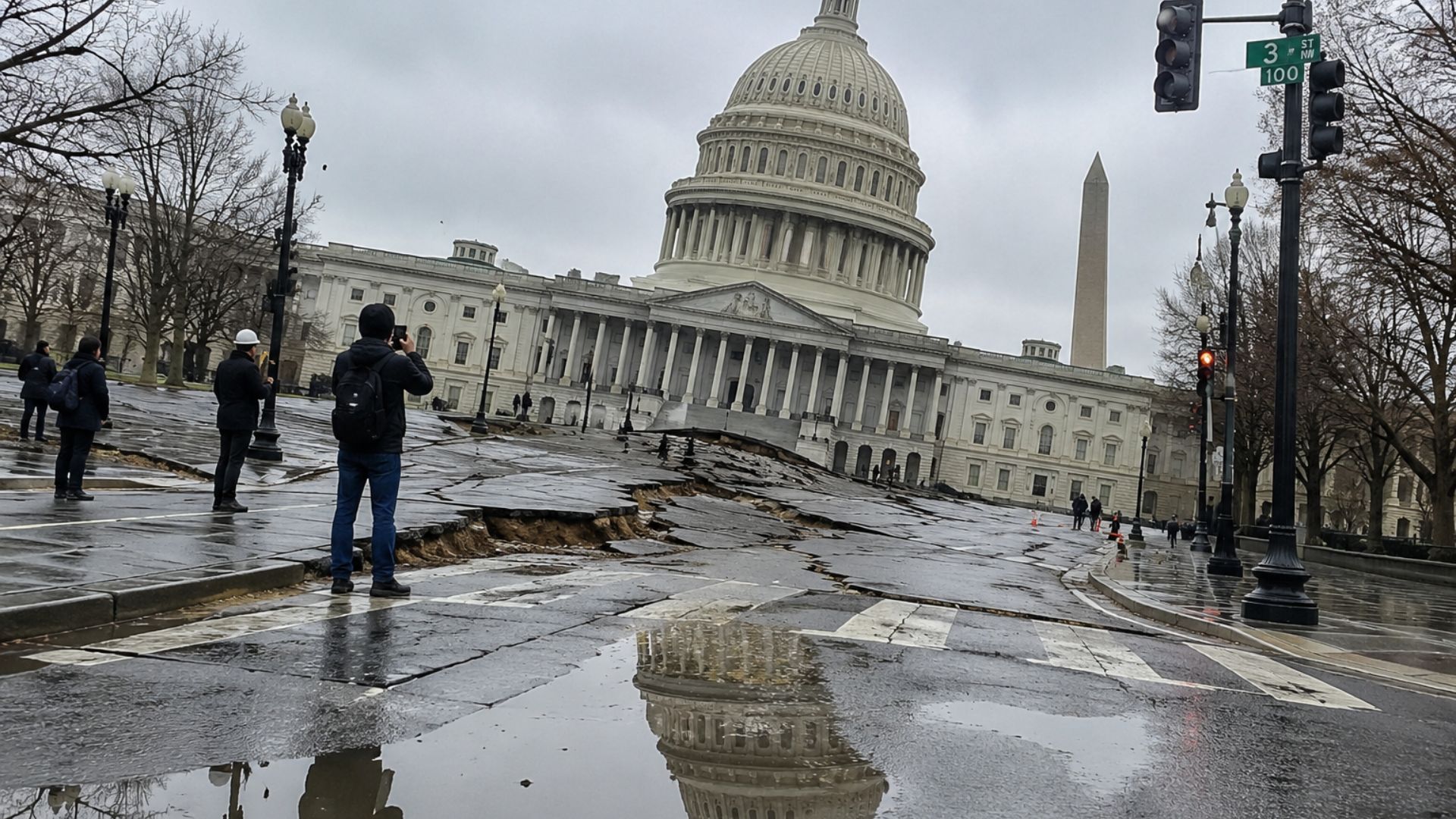


Satellite-monitored phenomenon places Washington, D.C., at the center of subsidence studies on the U.S. East Coast, as researchers track gradual impacts on urban infrastructure, drainage, and flood-vulnerable areas in one of the planet’s most symbolic and observed cities.
Washington, D.C., the political center of the United States and home to the White House, the Capitol, and national monuments, appears in recent studies on subsidence, a phenomenon where the ground slowly loses elevation and can increase risks of flooding, structural damage, and urban infrastructure wear.
The process does not indicate a sudden collapse of the American capital.
The scientific concern lies in the discreet advance, measured in millimeters per year, capable of affecting streets, foundations, underground networks, drainage systems, and areas near the Potomac and Anacostia rivers.
-
Billionaire says the most valuable skill will help overcome job elimination caused by AI, following Bill Gates’ fears

-
A Dutchman created a ‘box’ that makes trees grow in the desert almost without water and without irrigation: the invention has already brought seedlings to dozens of countries and achieves up to 90% survival where common planting did not exceed 10%.

-
Abandoned warehouse hid a giant collection of rare computers, with over 2,000 artifacts from the 1930s to the 1980s.
-
Scientists warn that melting ice is triggering an alarming chemical transformation in preserved areas, and the first signs are already concerning researchers worldwide.




Scientific maps show the advance of subsidence on the East Coast
Researchers affiliated with Virginia Tech analyzed satellite radar data to map the vertical movement of the ground on the U.S. East Coast, in a band that includes urban centers such as New York, Baltimore, Norfolk, and Washington, D.C.
Research published in PNAS Nexus identified that over 70% of infrastructures evaluated in categories such as roads, railways, airports, dikes, schools, and hospitals are located in subsidence areas on the East Coast, although less than 10% are in zones above 3 millimeters per year.
In practical terms, this means that the threat does not depend solely on the maximum speed recorded at an isolated point.
The problem gains relevance when neighboring areas sink at different rates, creating gradual pressure on structures built on a foundation that does not move uniformly.
Why Washington, D.C. worries researchers

The American capital has unusual symbolic and functional weight.
In addition to concentrating public buildings, memorials, and tourist areas, Washington houses intense roadways, tunnels, buried networks, and structures associated with the political and administrative functioning of the United States.
In this context, small losses of altitude can become significant when they accumulate over years and combine with heavy rains, river floods, or relative water level rise.
Subsidence causes the urban surface to become lower relative to the surrounding water, even when the annual sinking appears small.
NASA also highlighted the topic when discussing the American East Coast, based on studies of vertical ground movement and coastal vulnerability.
The survey helps explain why the phenomenon has begun to enter urban risk planning, and not just geological debates.
Understand the causes of ground subsidence
Ground subsidence results from a combination of natural and human factors.
In the eastern United States, part of the process is linked to the adjustment of the Earth’s crust after the end of the last ice age, when the weight of ancient ice sheets left marks that still influence the topography.
In urban areas, other factors can intensify subsidence, such as groundwater withdrawal, sediment compaction, and pressure exerted by constructions on more sensitive soils.
These elements help explain why the same metropolitan region can have stable areas alongside points of faster sinking.
A study published in Nature in 2024 warned that subsidence is often underestimated in coastal management policies, although it can increase the exposure of U.S. cities to floods associated with relative sea level rise.
Flood risk grows unevenly

Available data indicates that the East Coast is not sinking uniformly.
The PNAS Nexus study points to a predominance of subsiding areas and records sections with higher velocities, while other sectors show less movement or relative stability.
This inequality is important because urban damage usually appears gradually.
Instead of a single, visible event, the city may face more expensive maintenance, less efficient drainage, differential settlements, and increased susceptibility to flooding episodes.
In Washington, the potential risk gains additional attention because it involves historical heritage, public circulation areas, and critical infrastructure.
The warning, however, does not describe a capital about to disappear, but a city subject to slow physical changes that require continuous monitoring.
Radar technology reveals invisible changes in the terrain
The use of satellite radar allows comparing measurements over time and detecting variations that would not be perceived by the naked eye.
The technology transforms millimeter displacements into risk maps, useful for engineers, public managers, and urban planning teams.
This reading is especially important in dense cities, where visible signs may appear too late.


By identifying areas with persistent subsidence, administrations can prioritize inspections, revise drainage projects, and incorporate soil behavior into future works.
The discussion also reinforces a change in how coastal and urban floods are assessed.
The risk depends not only on the advance of water but also on land subsidence, a combination that increases the so-called relative sea level rise.
American capital faces silent changes beneath the concrete
Washington continues to be one of the most observed cities in the world for political, diplomatic, and historical reasons.
Still, some of the most important transformations occur beneath the concrete, at a slow pace, without dramatic images and without immediate signs for the population.
The advancement of scientific maps does not eliminate local uncertainties but expands the ability to see where the city is most exposed.
For a capital marked by monuments, official buildings, and complex urban networks, understanding how the soil moves has become relevant information for safety, maintenance, and planning.





