






 Portuguese
  Spanish
  5 min of reading
  0 comments


Researchers Find a Hidden Bible Chapter Centuries Old. The Discovery Promises to Provide New Information About the Early Translations of the Religious Text
A discovery has caught the attention of scholars and religious people: a lost chapter of the Bible, written more than 1,500 years ago, has been found. This find, according to experts, could offer valuable insights into how the religious text changed over time.
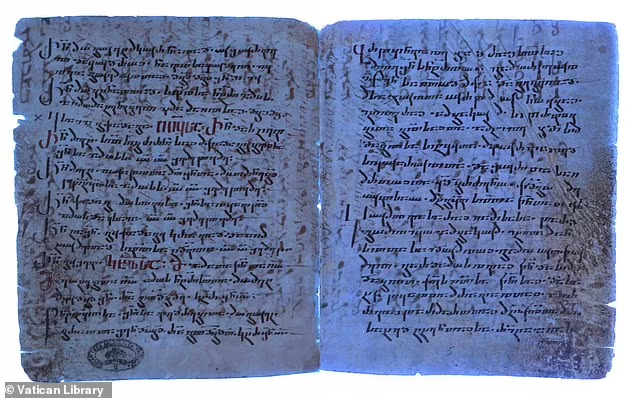
The remarkable discovery was led by medievalist Grigory Kessel from the Austrian Academy of Sciences, using ultraviolet photography, which revealed the hidden mysteries of a rare double palimpsest (a parchment or papyrus whose text was erased to allow reuse).
How the Discovery of the Bible Chapter Was Made?
The new text, which comprises parts of Chapters 11 and 12 of the Gospel of Matthew, was found in the Vatican Library.
-
Buenos Aires and Montevideo are about 200 kilometers apart in a straight line, but the road trip can exceed 570 kilometers and take up to 8 hours and 30 minutes; see how long the journey takes by plane, ferry, car, and bus.

-
Couple sold house in São Paulo, resigned from their jobs, and paid R$ 15,780 to start over in Portugal, but the promised trip turned into a fraud complaint: suitcases remain packed, tickets were not delivered, and the European dream ended up stuck in a cramped rented room.

-
The world’s largest natural bridge cave is in China, impressing in Guizhou with almost 180 meters in height, a gigantic opening, and internal space used even for cars, becoming a cool tourist refuge within a monumental karst formation.
-
Goodbye, clothesline: new option for drying clothes utilizes walls, doors, and even room height with multiple drying levels, retractable model, and compact structure that promises to transform small laundries in 2026.





The discovery was made possible through the use of ultraviolet light, which revealed traces of an ancient translation in Syriac, one of the first languages to receive a translation of the Bible.
The team of scientists applied this technique to an ancient manuscript, which had been scraped for reuse. This practice was common at the time due to the scarcity of parchment, a costly material made from animal skin.
However, even with the text scraped off, traces of the original writing remained on the material, allowing for its recovery with modern technologies.
Why the Discovery Is Important?
Although it is not the first time ancient texts from the Bible have been found, this discovery carries a special significance.
The Syriac translation found offers more details than contemporary versions of the Gospel of Matthew. This is especially relevant for text-critical scholars who seek to understand the variations and evolutions of the text over the centuries.
The discovery sheds light on the translations of the Bible made in the early days of Christianity and how the communities of that time interpreted the sacred writings.
Syriac, a language derived from Aramaic, was widely used by the early Christian communities in Syria and other parts of the Middle East.
Thus, this translation is one of the oldest examples of how biblical texts were read and understood outside the Greco-Roman world.
Variations in the Text: What Was Found?
One of the most interesting variations revealed by the discovery is in Chapter 12 of the Gospel of Matthew. In the contemporary Greek version, verse 1 states (Matthew 12:1): “At that time, Jesus went through the grain fields on the Sabbath; and His disciples, being hungry, began to pluck heads of grain and to eat.“.
However, the discovered Syriac translation brings an additional detail: “[…] began to pluck the heads of grain, rub them in their hands, and eat them“. Small differences like this may seem trivial, but for scholars, they offer a deeper insight into how the narratives were transmitted and adapted over the years.
Furthermore, the Syriac translation was made from Greek manuscripts that no longer exist. This means that this find could be one of the first pieces of evidence for alternative readings of the New Testament, predating even the famous Greek manuscripts, such as the Codex Sinaiticus, which dates from the 4th century.
What Experts Are Saying About the Find?
Dr. Garrick Allen, a professor at the University of Glasgow, believes that this discovery could provide a better understanding of early biblical translations.
According to him, “the Syriac translation is important in itself, as it is one of the earliest versions from the Greek. It gives us a glimpse into the early phases of the biblical text and the communities that produced these translations“.
Another expert, Professor Hugh Houghton from the University of Birmingham, emphasized the importance of the find in reconstructing the original biblical text. “The value of early translations lies in the fact that they were made from Greek manuscripts that no longer exist. They can provide the earliest evidence for certain readings“, he stated.
The Process of Reusing Manuscripts: How It Works?

During the early centuries of Christianity, parchment was a limited resource. It was common for ancient texts to be scraped for reuse. This created the so-called “palimpsests“, manuscripts with multiple layers of writing.
The ultraviolet light technique is an essential tool for researchers, as it allows visualizing hidden texts. In the case of this recent discovery, the team was able to identify three layers of writing on the same parchment: Syriac, Greek, and Georgian.
Syriac, in particular, holds great historical significance. The “Peshitta“, as the Syriac translation of the Bible is called, became the official version of the Syriac Church in the 5th century. This newly discovered text dates back to the 6th century when the first Christians in the Middle East were shaping their religious traditions.
What This Find May Reveal About Primitive Christianity?
The discovery of textual variants like this underscores the diversity of Christianity in the early centuries. Dr. Nic Baker-Brian from Cardiff University emphasized that “the existence of variant readings in the manuscript highlights the diverse nature of early Christianity. It reflects the growing understanding that Christianity was not monolithic, but rather an evolving religion, with various versions of stories about Jesus circulating in the early communities“.
This diversity of translations and interpretations highlights that, from its earliest days, Christianity was a multifaceted religion, with different groups emphasizing distinct aspects of Jesus’ life and teachings.
Another Chapter in the History of the Bible
The discovery of this “lost chapter” of the Bible is yet another piece in the vast puzzle that is the history of Christianity and its sacred texts.
Although the find does not dramatically change the understanding of the Gospel of Matthew, it provides new clues about how the text was transmitted and modified over the centuries.
For scholars, each fragment is important in the attempt to reconstruct the original form of the biblical texts. For Christians, this discovery serves as a reminder of the richness and complexity of their religious history.
The fact that ancient texts are still being revealed centuries after they were written shows that the past still has much to teach us about our traditions and beliefs.
The original article about the Bible chapter was published last year in the journal Daily Mail.


Be the first to react!