






 Portuguese
  Spanish


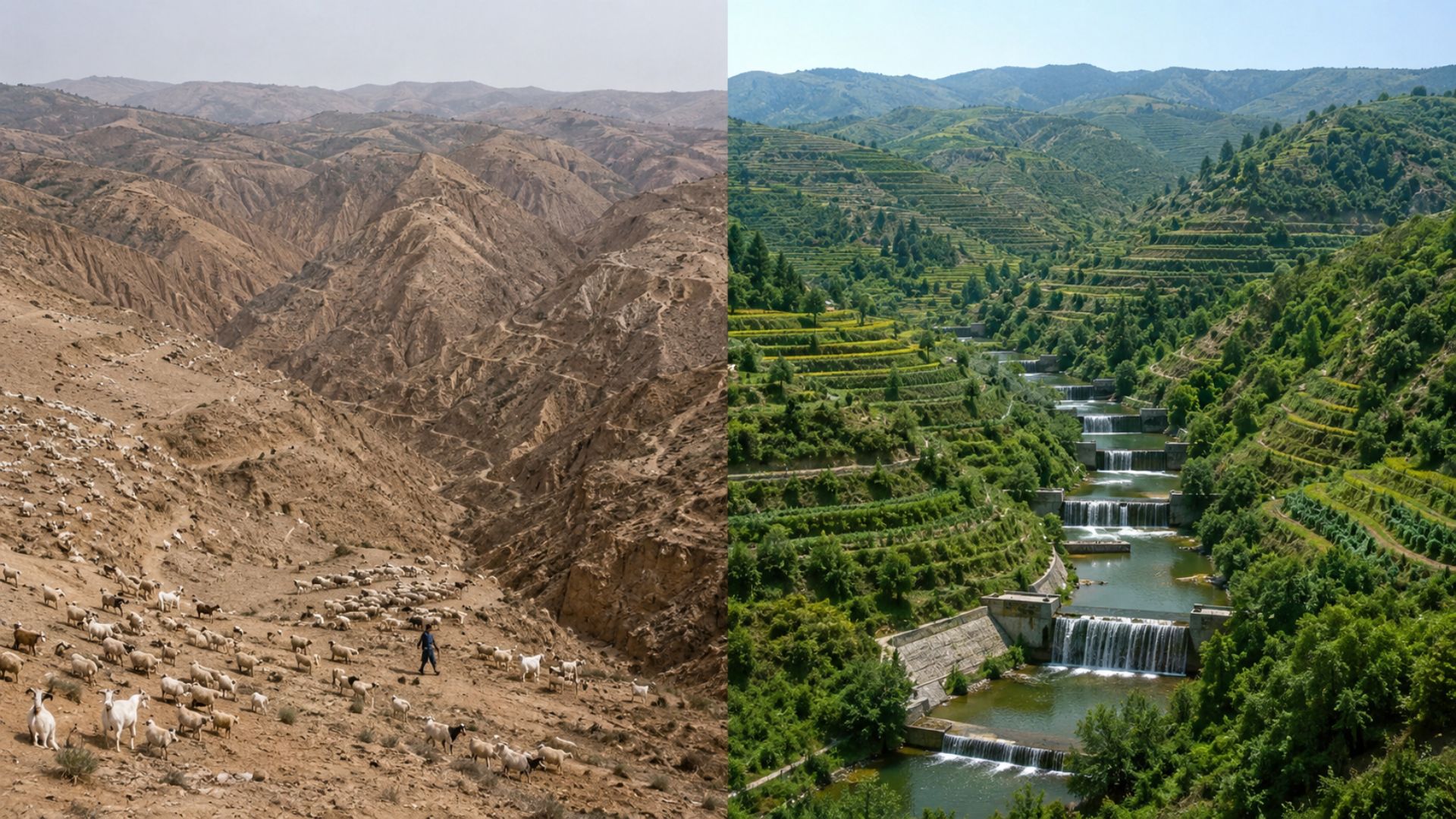


The measure alone does not explain the miracle: it was accompanied by terraces, paid reforestation, and thousands of small dams that intentionally clogged the ravines. The result lifted 2.5 million people out of poverty and reduced the sediment dumped into the river by more than 1 billion tons per year, in an effort that lasted decades.
China banned free grazing of goats and sheep in parts of the Loess Plateau, recognized as the most severe soil erosion region on the planet, and by combining this ban with the construction of terraces and thousands of small dams, managed to green slopes that once dumped about 1.6 billion tons of soil per year into the Yellow River. The effort, initiated in partnership with the World Bank in 1994 and expanded from 1999, is considered one of the greatest environmental rescues in history.
Located in the middle course of the Yellow River, in northern China, the Loess Plateau suffered centuries of degradation caused by deforestation, agriculture on steep slopes, and uncontrolled grazing. The enormous amount of sediment that flowed from the slopes into the river gave the Yellow River its famous muddy color and the sad nickname of China’s sorrow, due to the catastrophic floods it caused over thousands of years. Reversing this situation required one of the most ambitious ecological interventions ever attempted.
The most eroded plateau in the world

Its soil, called loess, is a fine sediment brought by the wind, extremely fertile and good for agriculture, but also very easily washed away by rainwater. In the past, forests and natural pastures kept this layer of soil in place, in balance with the environment.
-
Small Farm in Brazil’s Minas Gerais Produces 403 Liters of Milk Daily, Sets Benchmark for Rural Producers

-
Man Revives 1930s Abandoned Trout Farm, Learns from Scratch, and Earns $1.1 Million Annually Selling Fish to Michelin-Starred Restaurants

-
Bangladeshi Farmers Use Bamboo Levers to Pump Thousands of Liters of Water Daily Without Engines or Electricity
-
Brazilian Forests Could Expand by an Area Twice the Size of Switzerland by 2035, but Agricultural Sector Holds the Key, Study Finds



The problem began when humans started treating the land as an inexhaustible resource depot. Forests were cut down for firewood, slopes were plowed for agriculture, and herds of goats and sheep devoured the last sprouts of vegetation. Without the plant cover to hold the soil, rainwater began to flow freely down the slopes, stripping away fertile land and carving deep ravines, in an erosion process that became the most severe on the planet.
The Yellow River and the Sadness of China

Considered the mother river of China, it has nourished Chinese civilization for over four thousand years and still today provides water for tens of millions of people. But the excess sediment turned this same river into a threat, as the mud raised the riverbed and made the water overflow easily, causing devastating floods throughout history.
The numbers of degradation are impressive. Between the early and mid-20th century, the Loess Plateau dumped about 1.6 billion tons of sediment per year into the Yellow River, the largest sediment load recorded in any river in the world. It was the realization that upstream deforestation and erosion were worsening floods that led China to act on a large scale, understanding that soil degradation threatened not only the environment but also the country’s food and water security.
The ban on grazing was just one of the pieces


Here it is essential to clarify a point that is often simplified. The ban on free grazing of goats and sheep was indeed one of the central measures of the rescue, but it was not the only one, nor was it applied to the entire plateau. The prohibition applied to critical areas and was accompanied by an integrated set of actions, conducted by the Chinese government in partnership with the World Bank, within the so-called Loess Plateau Watershed Rehabilitation Project.
According to the World Bank, the project was based on four fundamental policy decisions: prohibiting planting on very steep slopes, banning free grazing, encouraging animal confinement, and ensuring land use rights for farmers. Instead of allowing herds to freely climb the slopes and devour the vegetation trying to recover, residents began raising animals in pens, cutting and bringing the pasture to them, in a model known as cut and carry.
Terraces and dams: the engineering that secured the land
Banning grazing and agriculture on the slopes would not suffice if people lost their livelihoods. Therefore, China rebuilt the plateau’s landscape itself. Tens of thousands of hectares of steep slopes were transformed into terraced fields, flat platforms carved into the hillsides that slow rainwater step by step, giving the soil time to absorb moisture and retain sediments instead of letting them run off.
At the same time, thousands of small retention dams, known as check dams, were built within the deepest ravines. These structures acted like stitches in the landscape: when floodwaters descended, they slowed the flow and trapped the mud behind them, gradually creating new flat and fertile areas for agriculture. According to the World Bank, the terraces increased crop productivity by 50% to 100% compared to the old sloped lands.
Paying to change the way of life
One of the project’s most intelligent aspects was not just prohibiting but offering alternatives. Through the Grain for Green program, launched in 1999, the Chinese government began paying farmers to stop cultivating on steep slopes, providing tree seedlings, food subsidies, and cash payments to those who converted the land into forest or pasture. The idea was to relieve human pressure on the ecosystem and give nature a chance to recover on its own.
This approach prevented the livestock industry from collapsing, as many feared. On the contrary, the number of higher productivity animals increased in several places, now raised in a controlled manner. It is worth noting, in the name of balance, that studies pointed out specific issues: in some areas, payments were delayed or insufficient, and not all families had complete freedom to decide if they wanted to participate or which trees to plant.
The results of the largest environmental rescue
The rescue numbers are impressive. According to the World Bank, the project restored over 35,000 square kilometers of land in more than a thousand micro-basins of the Yellow River and lifted about 2.5 million people out of poverty, with local income more than doubling in many areas. Vegetation cover increased significantly, and the amount of sediment reaching the Yellow River fell by more than 1 billion tons per year compared to the past.
A study published in the journal Nature Climate Change in 2016 showed that China converted more than 11,000 square miles of dryland crops on the plateau into forests or grasslands, helping vegetation cover grow by about 25% in just a decade. NASA satellite images recorded the plateau changing, year after year, from an arid yellow-brown to increasingly green tones, while dust storms decreased and water tables rose again.
The documentarian who showed the transformation to the world
A large part of the international impact of this rescue is due to the work of John D. Liu, who before dedicating himself to ecological projects had been a producer and cameraman for an American TV network for about 15 years. Invited by the World Bank to film and study the recovery of the Loess Plateau, he documented over many years the same hill, from the same angle, recording the colors slowly changing from arid yellow to green.
His documentary on the subject traveled the world, was shown at international climate conferences, and helped transform the way scientists and governments think about ecosystem restoration. Liu’s central message is powerful: many of the so-called natural disasters, such as floods, landslides, and droughts, may actually be the result of prolonged destruction of ecosystems by human action and can be reversed when this pressure decreases.
The case of the Loess Plateau is today cited as one of the world’s greatest examples of a nature-based solution, precisely because it did not rely on futuristic machines or miraculous technology, but on the decision to stop pushing the ecosystem beyond its limits. China showed that land considered almost dead can come back to life when humans stop destroying it long enough, combining science, public policies, and changes in people’s way of life. The question remains whether this model can be replicated in other degraded lands around the planet.
Do you believe that this model from China of greening the Loess Plateau could be applied in degraded areas of Brazil, such as desertification regions in the Northeast? Do you think prohibiting certain activities and paying for nature to recover is the right path? Leave your comment, tell us what you think about this environmental rescue, and share the article with those interested in the environment, agriculture, and sustainability.







Very well done excellent result. More should be done in other countries to save our planet!