






 Portuguese
  Spanish
  4 min of reading
  0 comments


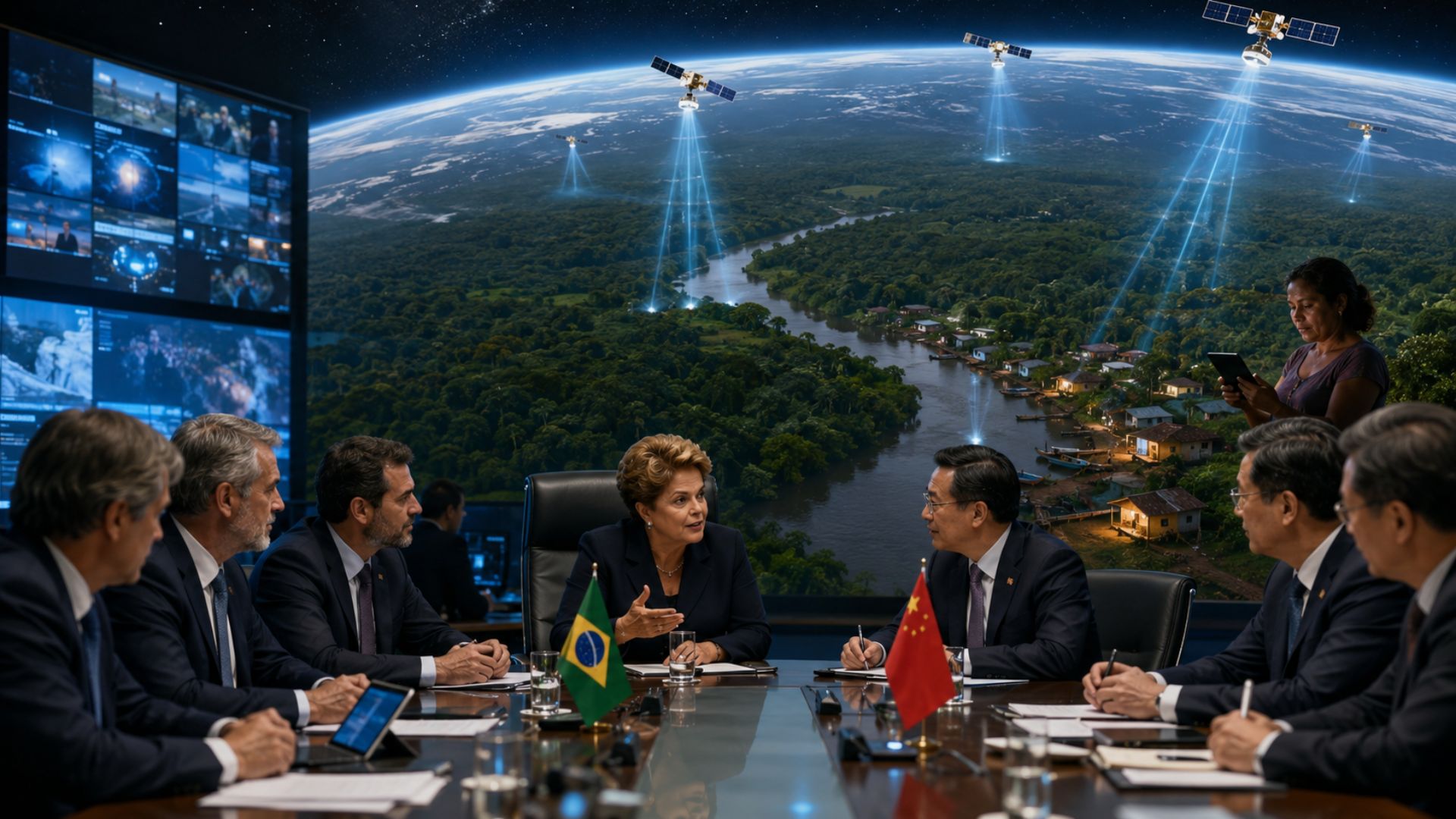
What Brazil negotiates with the Brics Bank
According to information released by the portal gov.br, the conversation with the Brics Bank addressed financing for five digital infrastructure fronts: expansion of TV 3.0, construction of data centers, implementation of submarine cables, expansion of fiber optic networks, and 5G coverage on highways and rural areas. The Brics Bank, formally called the New Development Bank, has been led by Dilma Rousseff since 2023 and has among its mandates the financing of infrastructure projects in member countries.
TV 3.0, a new broadcasting technology that integrates television and the internet, is already in the testing phase in Brazil. The first broadcasts are scheduled for the coming months in São Paulo, Rio de Janeiro, and the Federal District, with gradual expansion to other regions. Broadcasters already have financing of 500 million dollars approved by the Inter-American Development Bank and the World Bank, but the search for additional resources from the Brics Bank indicates that the total cost of the technological transition may be significantly higher.
The Chinese rival of Starlink that will operate in Brazil
SpaceSail operates a constellation of low-orbit satellites, a model similar to Starlink, and received authorization from Anatel in April 2026 to deploy up to 324 satellites in Brazil until 2031. Minister Frederico stated that “where fiber optics have not yet reached, the fastest way to connect the population will be through satellite solutions,” and the visit to SpaceSail’s headquarters in China signals that the Brazilian government sees the company as a strategic partner for connectivity in remote areas.
-
Space technology used to search for water on Mars is now hunting for invisible leaks under the streets of São Paulo, using satellites, AI, and chlorine signals to help Sabesp recover up to 6.7 billion liters of water.

-
Japan sends ship to extract mud rich in rare earths at nearly 6,000 meters deep in the Pacific, attempts to lift 350 tons per day from the seabed, and transforms sediments near Minamitori Island into a strategic weapon to reduce dependence on China.
-
Venus Aerospace promises a rotating detonation hypersonic engine that takes the Stargazer to Mach 9 and crosses oceans in 1 hour, but the flight that made history barely surpassed the speed of sound.

-
Brazilian student creates a cheap formula that makes plants grow up to 90% faster and wins an award in a global scientific competition.





The Amazon is the main target of this technology. The region has entire communities without access to broadband internet, and the geography of dense forests and extensive rivers makes the installation of fiber optics economically unfeasible in many areas. Low-orbit satellites, like those from SpaceSail and Starlink, overcome this obstacle by providing internet directly from space, without the need for terrestrial infrastructure. The entry of a Chinese competitor may pressure prices and expand options for the Brazilian government.
The Japanese components for TV 3.0
The mission to China also included a meeting with representatives of Sony Semiconductor in Shenzhen. The delegation discussed the criticality levels of components produced by Sony that can be used in TV 3.0, accompanied by the Society of Television Engineering, indicating that the supply chain of the new broadcasting technology is global.
TV 3.0 is not just an image update. The technology allows the television to function as an internet platform, integrating linear content with apps, interactivity, and digital services. For this to work, specific semiconductors are needed in the receiver devices, and the negotiation with Sony aims to ensure that these components are available on a scale for the Brazilian market.
What the mission to the BRICS Bank and China means for Brazil
The agenda combined financial diplomacy with technological diplomacy. At the BRICS Bank, Brazil sought money for long-term projects that require investments of billions. At SpaceSail and Huawei, it sought technological partners willing to expand investments in digital infrastructure in the country. The visit to Huawei, although with few details disclosed, reinforces Brazil’s relationship with the Chinese telecommunications giant at a time of 5G expansion.
The BRICS Bank has already shown openness to financing Brazilian infrastructure, and connectivity projects fit within the bank’s mandate to support the development of member countries. For the government, the strategy is clear: use resources from the BRICS Bank and Chinese technology to connect the entire country, from the Amazon to the hinterland, and prepare the country for the digital economy and artificial intelligence.
Did you know that Brazil went to the BRICS Bank to ask for money for TV 3.0 and negotiated with a Chinese rival of Starlink to connect the Amazon? Do you think the country should rely more on China or diversify technological partners? Tell us in the comments.


Be the first to react!