





 Portuguese
  English
  Spanish
  4 min of reading
  0 comments


Expectations surrounding autonomous vehicles have grown year after year. Many people hope these vehicles will achieve a level of safety superior to that of human driving, providing peace of mind and efficiency in traffic. We will see the story of a car that parks itself that went viral in China.
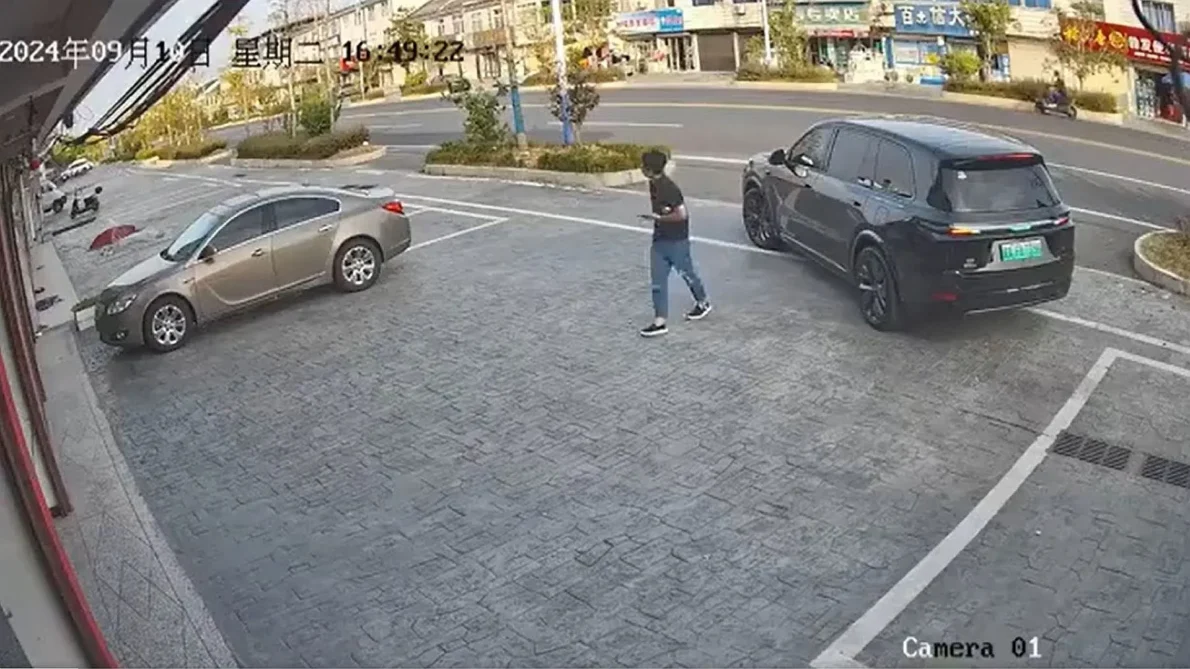
Recently, a viral video on Chinese social media showed an autonomous SUV from Li Auto, a car that parks itself, which after several failed attempts, simply “gave up” and drove away from the spot.
The Evolution of Autonomous Systems
The concept of autonomous driving is not new, captivating audiences since the early science fiction films. However, what was once just a futuristic dream has partially become a reality with driver assistance systems and, most notably, the emergence of automatic parking.
-
Chevrolet Tornado Van 2026 emerges as a compact van cheaper than many popular cars in Brazil, with a 1.5 engine, 6-speed manual transmission, 650 kg load capacity, 3.3 m³ of usable space, and fuel consumption of up to 18.1 km/l for about R$ 87,000 in tax-free conversion; an urban utility vehicle that Brazilians don’t have, but Mexico does.

-
Forget the basic popular car: used sedans like Passat CC, Kia Cerato, Nissan Altima, Mitsubishi Lancer, and Volvo S60 show that it’s still possible to buy more performance, comfort, and technology for less than many new compacts.

-
Used Honda Civic: 3 versions of the Japanese sedan with naturally aspirated engines of up to 155 hp, fuel consumption of up to 13.8 km/l, robust automatic transmission, and a reputation for reliable mechanics still dominate the used car market in Brazil.
-
Toyota Hilux becomes a ‘cargo truck’: automaker declares a new era for the pickup with greater capacity, reinforced chassis, 2.8 turbodiesel engine, raised suspension, 1,525 kg load capacity, and targets Ford Ranger Super Duty, which tows an impressive 4,500 kg.


This feature was initially available from Toyota, with the second-generation Prius in 2003, although its efficiency was limited.
Advances in artificial intelligence have allowed neural networks to be trained to learn from data from human drivers.
Thus, parking and autonomous driving systems have evolved significantly, particularly with Tesla, whose electric vehicles have demonstrated remarkable capabilities in recent years.
However, other manufacturers are also competing in the market, especially in China, where Tesla still does not have approval for its full autonomous driving package.
The Competition Between Tesla and Chinese Manufacturers
Although Tesla is widely recognized in the West, in China, local manufacturers such as Li Auto are gaining ground. These companies are committed to matching or even surpassing Tesla’s technology.
The Chinese manufacturers, being the only ones currently authorized to operate autonomous driving systems in the country, have gained the trust of local consumers, who often believe these vehicles are more advanced than foreign models.
However, videos recorded in Chinese territories show that Chinese autonomous vehicles still make mistakes, some appearing to be quite novice. This raises doubts about the true level of maturity of the technology.
Part of the cause of these problems lies in the reliance on lidar, radar, and high-definition mapping, which, in some cases, limit the performance of the autonomous systems.
The Curious Case of the Li L9 SUV, A Car That Parks Itself!
The recently viral video on Chinese social media shows a Li L9 SUV, a luxury hybrid vehicle produced by the startup Li Auto. The model is promoted as the “smart SUV” of the brand, thanks to its advanced autonomous driving system, the Li AD Max.
Equipped with an Nvidia Orin-X processor and a vast array of sensors, including a 128-line LiDAR, several high-resolution cameras, radars, and ultrasonic sensors, the L9 seemed to take charge cautiously at the beginning of the video, performing parking maneuvers hesitantly.
However, after several parking attempts, the SUV “decided” to abort the mission and left the spot, leaving viewers surprised and perhaps a bit skeptical about the reliability of this technology.
How Does the Autonomous Driving System of the Li L9 Work?
Li Auto has heavily invested in developing the autonomous driving system of the L9, standing out for using two Nvidia Orin-X processors, which are responsible for quickly processing data from sensors and cameras, allowing for more agile decision-making. The L9 has a robust set of sensors, including:
- Front LiDAR: A 128-line sensor for mapping the environment in high definition.
- High-Resolution Cameras: Six 8-megapixel cameras and five 2-megapixel cameras, providing complete visibility around the vehicle.
- Millimeter-Wave Radar and Ultrasonic Sensors: Used to detect nearby objects and avoid collisions.
This advanced system should, in theory, allow the L9 to autonomously and safely perform parking tasks. However, the incident captured in the video demonstrates that despite the technology’s robustness, challenges still remain, particularly regarding adaptability and responsiveness in real-world scenarios.
Challenges and Future of Autonomous Driving
Autonomous driving systems have evolved rapidly, but the episode of the Li L9 SUV raises questions about the actual maturity of these technologies. Vehicle autonomy requires complex synchronization between sensors, artificial intelligence algorithms, and the ability to respond adequately to unexpected situations.
However, the path to achieving a level of reliability superior to that of human driving still faces obstacles.
Many of these systems are designed to operate under ideal conditions, with decisions based on a limited set of programmed variables. Yet, in the real world, the challenges are much more complex, with unpredictable scenarios that can confuse the algorithms.
Promising Technology, But With a Long Way to Go
The incident involving the Li L9 SUV serves as a reminder that despite all the advancements, autonomous driving technology still has a long journey ahead before it becomes infallible. Consumer trust is essential for the popularization of this technology, and each mistake, no matter how small, raises a question mark about its safety and viability.
As companies like Li Auto and Tesla continue to invest in and improve their systems, it is likely that we will see more examples of failures and successes as technology advances. Autonomous driving, while fascinating and promising, still needs to overcome significant challenges before we can fully hand over the wheel to artificial intelligence.








Be the first to react!