Portuguese
  Spanish


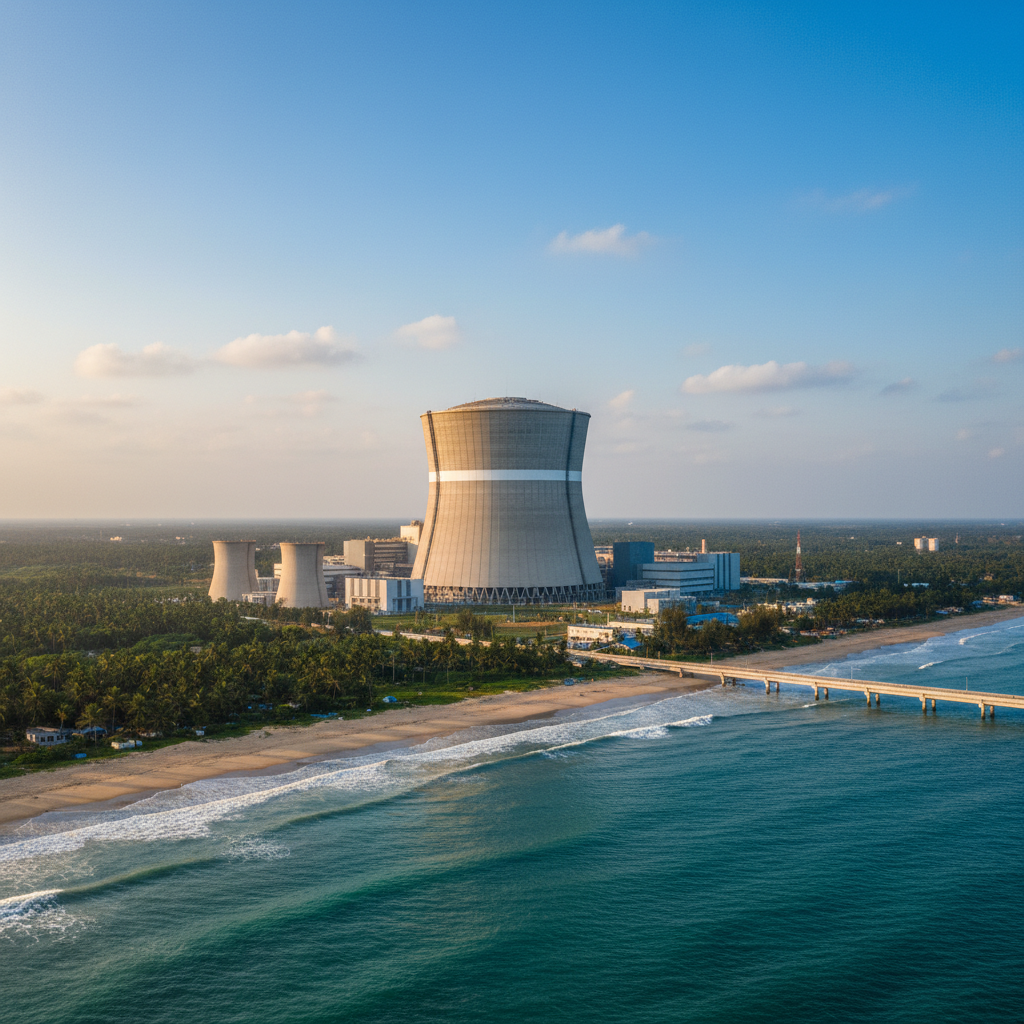


On April 6, 2026, at 8:25 PM, the 500 MWe PFBR reactor in Kalpakkam initiated a self-sustaining chain reaction — and India became one of the few countries with a reactor that produces more nuclear fuel than it consumes, advancing its three-phase program towards energy independence
There is a type of nuclear reactor that seems to defy logic.
It generates more fuel than it consumes.
It’s not science fiction — it’s a fast breeder reactor.
-
Brazilian Innovator Converts Old Car into Electric Vehicle Using Laptop Batteries and Forklift Motor, Achieves Nearly 90 km/h in Urban Settings

-
Samsung Unveils Smart Oven with Built-In Camera, AI Food Recognition, and Real-Time Monitoring via Smartphone.
-
Ocean Transformed into Sci-Fi Lab: 87-Meter Structure with Submarines, Deep-Sea Robots, Helicopter, Genetic Labs, and 8K Cameras Unveils Rare Creatures
-
11-Year-Old Develops Solar Water Purifier to Aid Communities in Kenya and Gambia




On April 6, 2026, at 8:25 PM, India switched on its own for the first time.
The Prototype Fast Breeder Reactor (PFBR), with a capacity of 500 MWe, achieved first criticality in Kalpakkam, Tamil Nadu — initiating a controlled and self-sustaining fission chain reaction.
The announcement was made by the Government of India (PIB) the following day.

How a reactor “breeds” fuel
In a conventional reactor, nuclear fuel is consumed and becomes waste.
In a fast breeder reactor, the process is different.
It uses plutonium as initial fuel.
Around the core, a “blanket” of uranium-238 absorbs neutrons and transforms into plutonium-239 — new fuel.
In this way, the reactor produces more fissile material than it consumes.
The breeding ratio is greater than 1.
Furthermore, the blanket can convert thorium-232 into uranium-233, paving the way for the next phase of the Indian nuclear program.
22 years, US$1 billion, and a historic milestone
- Capacity: 500 MWe
- Start of construction: 2004
- Original deadline: September 2010
- Original cost: ₹3,500 crore (~US$ 420 million)
- Final cost: ₹8,181 crore (~US$ 980 million)
- Criticality: April 6, 2026
The project was delayed by 16 years and cost twice the estimated amount.
However, the technology was developed entirely in India, by IGCAR (Indira Gandhi Centre for Atomic Research) and built by BHAVINI.

Homi Bhabha’s plan — three phases for energy independence
The PFBR is part of a visionary plan created in the 1950s by physicist Homi Bhabha:
- Phase 1: heavy water reactors (current fleet)
- Phase 2: fast breeder reactors like the PFBR — multiply plutonium
- Phase 3: thorium-based reactors — India has 25% of global thorium reserves
Therefore, the PFBR is not just a power plant.
It is the bridge between current nuclear energy and a practically inexhaustible source.
A club of few countries
With the PFBR, India joins a select group:
- Russia: BN-600 and BN-800 in operation
- China: CFR-600 in operation
- France: Superphénix (decommissioned)
It is the first time a developing country operates a 500 MWe commercial-scale fast breeder reactor.

Caveats
Criticality does not mean full electricity generation — the reactor now enters gradual commissioning with incremental power increases.
Liquid sodium technology presents risks (reactivity with water and air), mitigated by safety systems, but requiring rigorous monitoring.
Furthermore, the 16-year delay and doubled cost raise questions about managerial efficiency.
Nevertheless, switching on a reactor that produces more fuel than it consumes is a milestone that changes India’s energy equation — and one that very few countries have managed to achieve.