Portuguese
  Spanish


Blind Farming Technology uses sensors, audio, and solar energy to enable visually impaired farmers to cultivate with more autonomy in India.
In 2018, rural inventor Girish Badragond, from the district of Vijayapura in Karnataka, developed a solution aimed at a little-discussed problem in the field: the difficulty faced by visually impaired farmers in managing their own crops without relying on others. Reports from The Better India and The New Indian Express show that the initiative was born after he met producers who had stopped cultivating their lands due to a lack of adapted technology.
Named Blind Farming Technology, the creation was designed to allow blind or visually impaired people to monitor soil conditions, receive audio alerts, and make decisions in the field with more independence. The proposal combines sensors, sound system, digital cane, solar energy, and irrigation resources to make agriculture a more accessible activity.
Blind Farming Technology uses soil sensors and audio system to guide visually impaired farmers in real-time
The core of the technology lies in the sensors installed in the soil. According to the reports, the system can detect data related to the crop, such as humidity, temperature, and other relevant information for plant development, converting this data into sound messages for the farmer.
-
Brazilian Honey Supplying U.S. Supermarkets Faces Price Hike and Job Threats Amid New Tariff Round

-
Drought in France Threatens Beet Crops, Raising Fears of Sugar Price Surge Across Europe
-
French village switches from oil to giant miscanthus for heating, cutting annual costs from €20,000 to €4,300

-
Brazilian Agribusiness Sets Record with $169 Billion in Exports in 2025


This logic replaces visual observation with continuous auditory monitoring. Instead of relying on another person to check the plantation conditions, the producer can receive guidance on water needs and soil changes from the system installed in the cultivated area itself.
In addition to the fixed structure on the property, Girish Badragond also developed a digital cane with sensor, created to help the farmer walk through the land and obtain information about the soil condition at different points of the crop.
Digital cane, solar energy, and sound alerts enhance the autonomy of blind farmers in the Indian field
One of the differentiators of Blind Farming Technology is the combination of mobility and accessibility. The digital cane allows the farmer to traverse the property, while the audio system distributes information in real-time according to the size of the cultivated area and the terrain configuration.
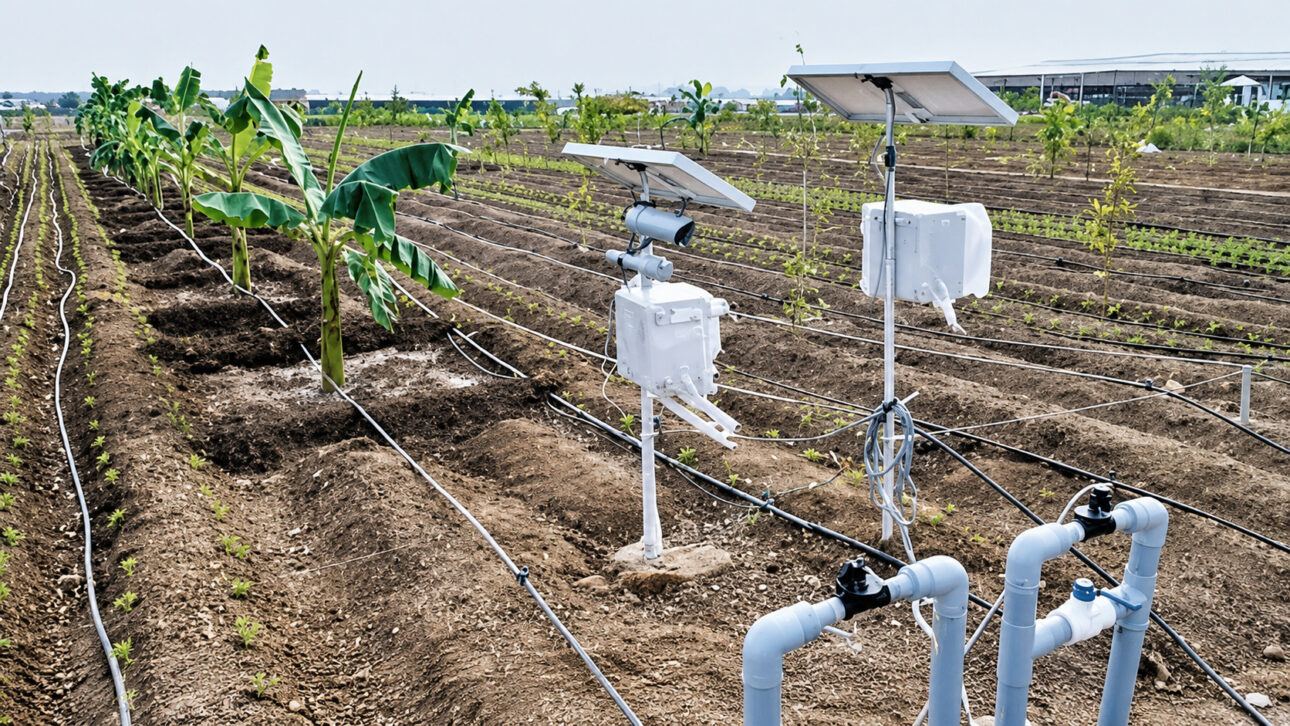
Reports also indicate that the equipment operates with solar energy, an important feature for rural areas where electricity supply can be unstable or limited. This enhances the technology’s usefulness and reduces dependence on conventional infrastructure for the system’s operation.
Thus, the proposal ceases to be just an experimental tool and approaches a practical model of accessible agriculture, where information reaches the producer continuously and adapted to their needs.
Automatic irrigation and soil moisture monitoring make inclusive agriculture more efficient
Another central point of the project is irrigation. According to The New Indian Express, the technology features a manual mode and an automatic mode, with the latter being able to supply water to plants even when the farmer is not present in the cultivation area.
The Better India also reports that the system automatically triggers irrigation when there is a drop in soil moisture, keeping the work going even in the absence of the producer. This automation means that the solution goes beyond accessibility and also enters the field of precision agriculture.
In practice, this means that the technology was designed to combine sound guidance, soil reading, and automatic response to variations affecting the plantation. The result is a system closer to autonomous crop management than a simple support device.
Project was born after visually impaired farmers leased their lands due to lack of adapted technology
The inspiration for the Blind Farming Technology came from a concrete situation observed by Girish Badragond in Vijayapura. The Better India reports that in 2018, he encountered two visually impaired farmers who had leased their lands because they could no longer cultivate them independently.
The New Indian Express reports the case of Sahadev Shinde, a resident of Uttnal in Vijayapura, who had two acres of land and used to lease the area for cultivation by others. With the new technology, he began to prepare to work on his own property.
This contact with farmers distanced from their own activity propelled the project. Instead of creating a generic solution, Badragond structured the technology based on a real limitation experienced in the field by people who wanted to continue producing but did not have the proper tools for it.
Inclusive agricultural technology created in India promises to save water and extend the engagement of blind people in rural activities
Besides accessibility, the Blind Farming Technology was presented as a tool for water efficiency. The New Indian Express states that the system can allow for a minimum of 60% water savings compared to conventional farming practices, thanks to soil monitoring and more precise irrigation activation.

The reports also link the technology to the prevention of problems in crops and the improvement of soil conditions, always focusing on providing more control to the farmer. This reinforces the idea that innovation not only acts on inclusion but also on the daily management of agricultural production.
In a country where agriculture remains a source of income for millions of families, the Indian experience shows that technologies such as sensors, audio, solar energy, and smart irrigation can open up a new frontier of inclusion in the field, allowing visually impaired farmers to maintain a productive connection with their own lands.