






 Portuguese
  Spanish


At the beginning of 2025, Talis, 9 years old, moved Brazil by selling brigadeiro on the street in Natal to help his family and grandfather with Parkinson’s. The sales barely covered the materials, and everyone’s dream was simple: to buy a candy-making machine to increase income.
While most 9-year-olds only think about the next game, Talis was thinking about how to help at home. At the beginning of 2025, this boy from Natal, in Rio Grande do Norte, decided to hit the streets to sell brigadeiro made by his stepmother, all to contribute to the family’s income. The heartbreaking detail is that, even with so much effort, the sales barely covered the materials.
The story was told by the site VOAA in January 2025 and went viral for its mix of sweetness and hardship. Talis wasn’t forced into anything: seeing the difficult situation at home, he himself offered to face the streets. The family’s dream was modest and concrete, to buy a candy-making machine to produce more and finally see the work pay off. The account is from that beginning of 2025.
At 9 years old, on the street instead of playing
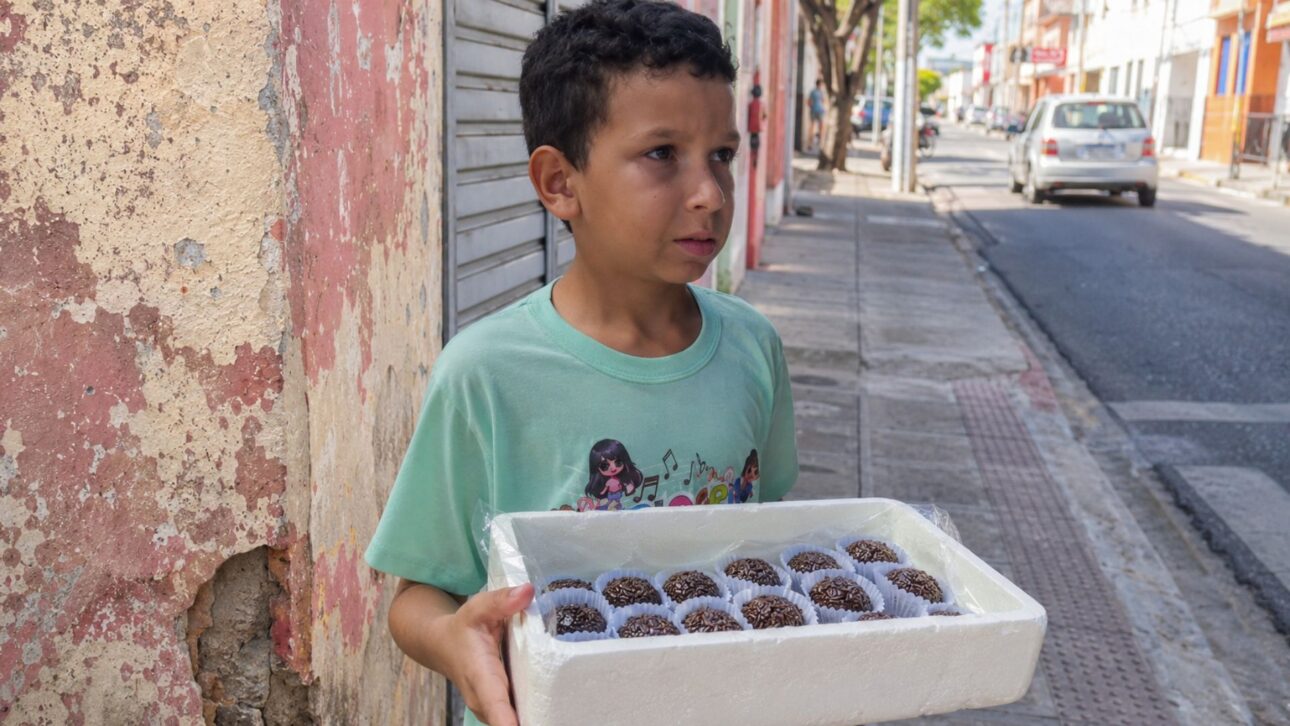
Instead of just studying and playing, as is typical for his age, Talis started selling brigadeiro on the streets of Natal, offering the sweets door to door and to passersby. He continued in school but found time to also help support the household, a burden too heavy for such small shoulders.
-
Man Disguises as His Own Mother to Collect €3,000 Monthly Pension, but Makeup and Beard Stubble Raise Suspicions at Registry Office

-
Brazilian Airport to Receive $2.8 Million Investment, Completion Expected Within a Year

-
UN Warns of AI’s Environmental Impact and Calls for Greater Corporate Transparency

-
Former Atacadão Employee Turns Online Cake-Baking Lessons into a Confectionery Brand with Factory, Store, Delivery, and Nearly $400,000 in Revenue




What drives the boy is not greed, it’s love. Talis saw the family’s financial struggle and, on his own, decided to do his part, turning his stepmother’s sweets into a chance for income. It was his choice, not an imposition, and perhaps that’s what makes the gesture even more touching.
The dual routine says a lot about the child’s character. Studying and then going to sell brigadeiro requires a maturity that many adults don’t have. In Natal, this boy became a symbol of a type of determination that arises too early when necessity presses, and it moves people precisely because it shouldn’t be necessary.
The grandfather with Parkinson’s and the family
Behind Talis’s effort, there is an entire family holding on. The boy lives in a simple house with his father, Tiago, his stepmother, who makes the brigadeiros, a brother, and his paternal grandfather, who has Parkinson’s. It is for this grandfather, among other reasons, that the boy decided to help.
Parkinson’s changes the life of any family. The disease, which affects movement and requires constant care, weighs on the budget and daily life of those who live with it. Seeing his grandfather sick and the cramped house was the push that made Talis swap playtime for the sidewalk, in a rare demonstration of affection for his age.
The presence of the grandfather with Parkinson’s gives the story its most sensitive layer. It’s not about a child selling sweets for fun, but a grandson trying, in his own way, to ease the burden that falls on everyone. The income from the brigadeiro was small, but the gesture behind it was enormous, and that’s what moved so many people.
The painful turnaround: the effort moves, but yields almost nothing
Here is the point that differentiates this story from so many other entrepreneurial child stories. Talis truly dedicated himself to selling brigadeiro, but the return was almost nothing. The sales of brigadeiro barely covered the cost of the materials, meaning that from all the boy’s work, little or nothing was left at the end of the day.
When some change was left over, its destination said everything about him. Instead of spending it on himself, Talis saved the little that remained to buy school supplies. A 9-year-old boy saving the profit of his own sweat for notebooks and pencils is the image that sums up the harshness and dignity of the situation.
This is the turnaround that hurts. Common sense imagines that effort always turns into reward, but Talis’s reality shows the opposite: it’s possible to dedicate a lot and still gain almost nothing. It’s not a financial success story, it’s a story of overcoming in the rawest sense, where the value lies in character, not in the cash register.
The simple dream: a candy-making machine
Faced with such little return, the family’s dream targeted exactly the bottleneck of the business. What they wanted was a candy-making machine, along with more raw materials and packaging, to be able to produce in larger quantities and with better quality. With a candy-making machine, the same effort would yield much more.
The size of this dream is what moves us. It wasn’t about asking for a mansion or a car, it was about asking for a work tool to unlock the income of a humble family. A candy-making machine, for many people a detail, for the Talis would mean getting out of trouble, turning the boy’s sacrifice into something sustainable.
It’s a reminder of how small things change lives at the grassroots. Equipment that a middle-class confectioner buys without thinking was, for this family, the difference between staying in a tight spot and breathing. The dream of the candy-making machine sums up the entire story, that of someone who works hard and just needs a chance to make ends meet.
The help that arrived at the beginning of 2025

The story reached influencer Leo Delega, who found Talis on the street, bought all the boy’s brigadeiros, and even shopped for the family. It was a gesture that relieved, at least at that moment, the household’s pressure.
At that time, an online crowdfunding campaign was also created to try to provide the missing equipment and raw materials. The stated goal was to help the family improve their income and, most importantly, allow Talis to return to being just a child, playing and studying without the burden of household expenses.
Why Talis’s story moves us so much
Talis’s case touches a deep place because it combines innocence and sacrifice. It’s the image of a child who should be playing but chose to help, and who, despite trying hard, reaped almost nothing. This gap between the effort made and the result achieved is what makes the story burn in the heart of the reader.
There is also the portrait of a Brazil that many people prefer not to see. Families where even children need to work, sick elderly without sufficient support networks, and dreams the size of a candy-making machine. Talis became the face of thousands of boys and girls who grow up too fast, and that’s why his name stayed in the memory of so many people.
In the end, what remains is dignity. Even with almost nothing yielding, the boy from Natal didn’t give up school or his grandfather, and saved the change for school supplies. It’s proof that character has no age, and that true overcoming sometimes lies not in the money that comes in, but in the greatness of those who insist on helping.
The journey of this boy from Natal shows the most human side of the word overcoming. At 9 years old, he gave up playing to sell brigadeiro, support part of the household, and help his grandfather with Parkinson’s, dreaming only of a machine to make sweets that would make the effort worthwhile. It’s a story that doesn’t fit in numbers, it fits in the heart.
And you, do you know any child or family that gets by like Talis, turning the little they have into an act of love? Share here in the comments the story of overcoming that touched you the most, those that prove dignity doesn’t depend on income size.





