Portuguese
  Spanish


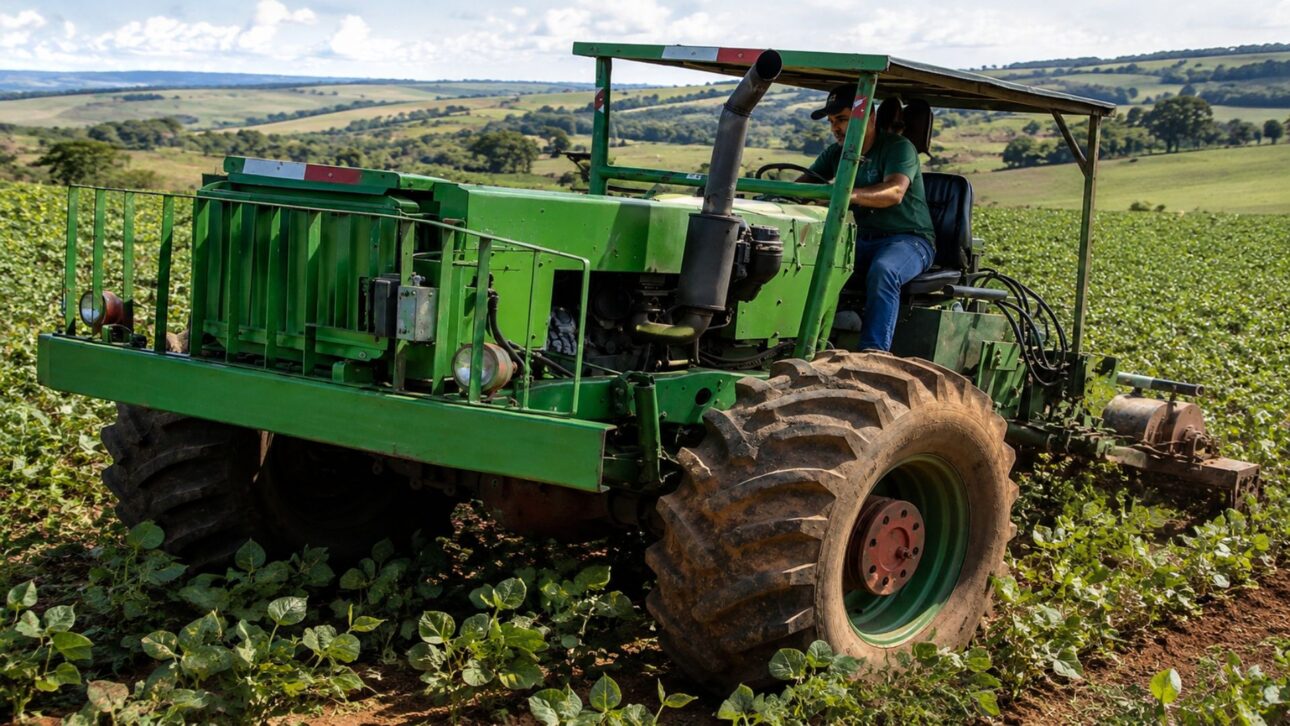
In the countryside of Seberi, in Rio Grande do Sul, the gaucho farmer Alexandre Anesi single-handedly assembled a homemade 8-ton tractor with an Army truck engine, and the machine has already helped plant more than 100 hectares of soybeans on the family farm.
Anyone who sees the machine cutting through the fields in the countryside of Seberi, in the north of Rio Grande do Sul, finds it hard to believe it didn’t come off an assembly line. It came from a backyard shed. Farmer Alexandre Anesi couldn’t afford a factory-made tractor large enough for the family’s rugged terrain, so he did what seemed impossible: he built his own. The result is a homemade 8-ton tractor, with an Army truck engine, which in June 2026 became a topic on social media and agro groups for the raw ingenuity of someone who solved the problem with his own hands.
The story was reported by Portal Diário on June 17, 2026, and spread quickly because it combines everything that makes a good field story: necessity, stubbornness, and a result that truly works. Anesi assembled, without an engineering course, an agricultural machine weighing nearly 8 tons, running on four articulated wheels, and has already tackled over 100 hectares of soybeans. It’s not a backyard miniature or a fair decoration. It’s a working tool that is in the field, planting.
The account that didn’t add up
To work on sloped areas and pull larger implements, Anesi needed a large machine. However, factory-made tractors are expensive, and the model he needed was beyond the family’s financial reality. Instead of giving up, he decided he would build what he couldn’t buy.
-
Brazilian Entrepreneur Turns Door-to-Door Jewelry Sales into a Family Business Empire with Over 70 Stores

-
$75 Million Bridge in Brazil Opens to Connect Cities, Create Jobs, and Cut Travel Time from 30 to 2 Minutes; Spanning 1.24 km, It’s Among the Country’s Largest and Ends Decades of Ferry Queues.

-
11-Year-Old Entrepreneur Turns Fear of Bees into Honey Lemonade, Wins $60,000 on Shark Tank, Secures Whole Foods Deal, and Expands Brand Across U.S. Stores
-
9-Year-Old in Brazil Sells Homemade Sweets to Support Grandfather with Parkinson’s, Family Dreams of Buying Candy-Making Machine




The market numbers help to understand the size of the problem. A new medium-sized tractor, in the range of 75 to 100 horsepower, costs today between R$ 250,000 and R$ 450,000 in Brazil. High-power machines, those that handle difficult terrain and heavy implements, exceed R$ 1 million and approach R$ 1.5 million. For a producer managing their own farm, buying a factory tractor of this size means committing years of harvest at once.
It was on a sleepless night, thinking about how to modernize work on the property, that the idea took shape, according to the farmer’s account. He began gathering used parts and designing a custom project for the terrain of the Seberi region, in northern Rio Grande do Sul. The logic was simple and bold at the same time: if the ready-made machine was unfeasible, he would build one from scratch, piece by piece, instead of the factory tractor that was out of budget.
The heart of the machine came from an Army truck
What gives the tractor its strength is precisely the most unusual part: an Army truck engine. It is an MWM six-cylinder, with about 125 to 126 horsepower, taken from a military vehicle and adapted for agricultural use. It’s an engine designed to withstand rough conditions, and it was this reputation for robustness that influenced the choice.
The structure was also born from reuse. Anesi used a chassis from a military-origin Ford F-600, a truck gearbox, a differential from an old tractor, and brakes adapted from a harvester. Each part came from a different vehicle and was adjusted to work together. It’s the literal definition of an agricultural machine assembled from useful scrap, where nothing is bought new if it can be salvaged from existing parts.
Reusing the Army truck engine was not an aesthetic choice; it was a strategy. Engines like the MWM series 229 are known in Brazil for their durability and the ease of finding replacement parts, making them a cheap and reliable base for builders. For a project without a manufacturer’s budget, starting with an Army truck engine already tested on the road is what makes the cost feasible. An Army truck engine costs a fraction of what a new factory set would cost.
Almost 8 tons that help, instead of hinder
It may sound exaggerated to talk about an 8-ton homemade tractor, but the weight here is intentional. On inclined terrain, a light machine skids and loses traction. The nearly 8 tons of Anesi’s project serve to anchor the machine to the ground and ensure grip where a common tractor would slip uphill.
The 8-ton homemade tractor also features optional 4×4 traction, low gear, hydraulic steering, and articulation on all four wheels. This setup allows the machine to turn sharply and work on slopes that would stall a conventional model. The articulation on all four wheels improves maneuverability in difficult areas, and the hydraulic steering removes the physical effort of driving such a large machine all day long.
It is not a homemade 8-ton tractor assembled by guesswork. Every design decision addresses a real farming problem: the weight for traction, the 4×4 for mud, the articulation for tight turns between rows. It’s field engineering, the kind that doesn’t come in a manual but solves problems.
More than 100 hectares of soybeans already planted
None of this would be news if the machine didn’t work. And it does. According to Anesi himself, the homemade 8-ton tractor has already participated in planting more than 100 hectares of soybeans, and it would still be used in more than 40 hectares of wheat afterward. This is the detail that separates the curious invention from a real tool.
To put it in perspective, 100 hectares is equivalent to about 100 football fields of planted area. Planting this extent requires a machine that cannot fail in the middle of the planting window, when every day of downtime is a loss. The fact that the homemade agricultural machine has handled more than 100 hectares of soybeans and is still lined up for wheat is proof that the project has moved from concept to production.
This is where Anesi’s work diverges from the mini tractor videos that flood the internet. It’s not a toy that runs in the backyard. It’s an agricultural machine that delivers crops, instead of a factory tractor that the family couldn’t afford.
Three months, few tools, and years of improvements
The first project took about three months to stand up, even with few tools available, the farmer recounted in the video published by the channel Clóvis Oeste Mania, which recorded the machine in operation and helped the story spread. Since then, Anesi has not stopped improving the tractor over the years, replacing parts, adjusting what failed, and refining what already worked.
Without an engineering degree, the farmer from Rio Grande do Sul learned through practice, by trial and error. Every problem turned into an improvised solution, and every solution taught the next one. It’s the kind of knowledge that doesn’t fit into a diploma, but that makes an Army truck engine work with the differential of an old tractor and the brakes of a harvester as if they were born together.
This years-long process explains why the machine is not a makeshift contraption that runs poorly. It has been refined crop after crop by the same farmer from Rio Grande do Sul who designed it, until it became the centerpiece of work on the property.
Why a homemade tractor becomes an internet sensation
It is not the first time that a farmer from Rio Grande do Sul, or from any corner of Brazil, improvises their own machine and wins over the public. There are those who build mini tractors with motorcycle engines, those who recover scrap to make backyard tractors, and those who adapt stationary engines to an old chassis. Anesi’s case stands out for its scale and function. It is not a small device, it is a homemade 8-ton tractor that actually plants.
The appeal of these stories has an explanation. They show a Brazil that makes do with what it has, that turns lack of money into creativity and scrap into tools. When the factory tractor becomes inaccessible, the producer’s ingenuity takes its place. It’s the same logic that makes the public stop to see an agricultural machine born from pieces of trucks, buses, and harvesters.
There is also a sense of identification. Many who watch have seen, in their neighborhood or family, someone who fixed what seemed unfixable, who found a way where the manual suggested replacing everything. The Army truck engine running in a soybean field is the grand version of this well-done improvisation culture.
The portrait of agriculture that makes do with what it has
Anesi’s machine is newsworthy, but even more so as a symbol. It shows that the price barrier, no matter how high, doesn’t always have the last word. Faced with a factory tractor costing over R$ 1 million, a farmer from Rio Grande do Sul responded with a screwdriver, welding, and persistence.
It’s worth an honest note: building an agricultural machine like this is not a recipe for everyone and involves risk. Adapting an Army truck engine, handling 8 tons in motion, and ensuring safety on sloped terrain requires knowledge that Anesi accumulated over years of trial. It’s not something done over a weekend, and not every improvisation succeeds. The merit lies precisely in having made it work, methodically, over time.
In the end, what remains is the image of an 8-ton homemade tractor, born out of necessity, crossing the field it helped to plant. More than 100 hectares of soybeans later, the bet of the farmer from Rio Grande do Sul proved that the best machine is sometimes the one you build because you couldn’t buy one.
And you, have you ever seen up close an improvised machine that worked better than many factory-made things? Do you know any farmer or backyard mechanic who built their own tractor because they couldn’t afford a factory-made one? Tell us in the comments about the best field gadget you’ve seen running for real.