Portuguese
  Spanish


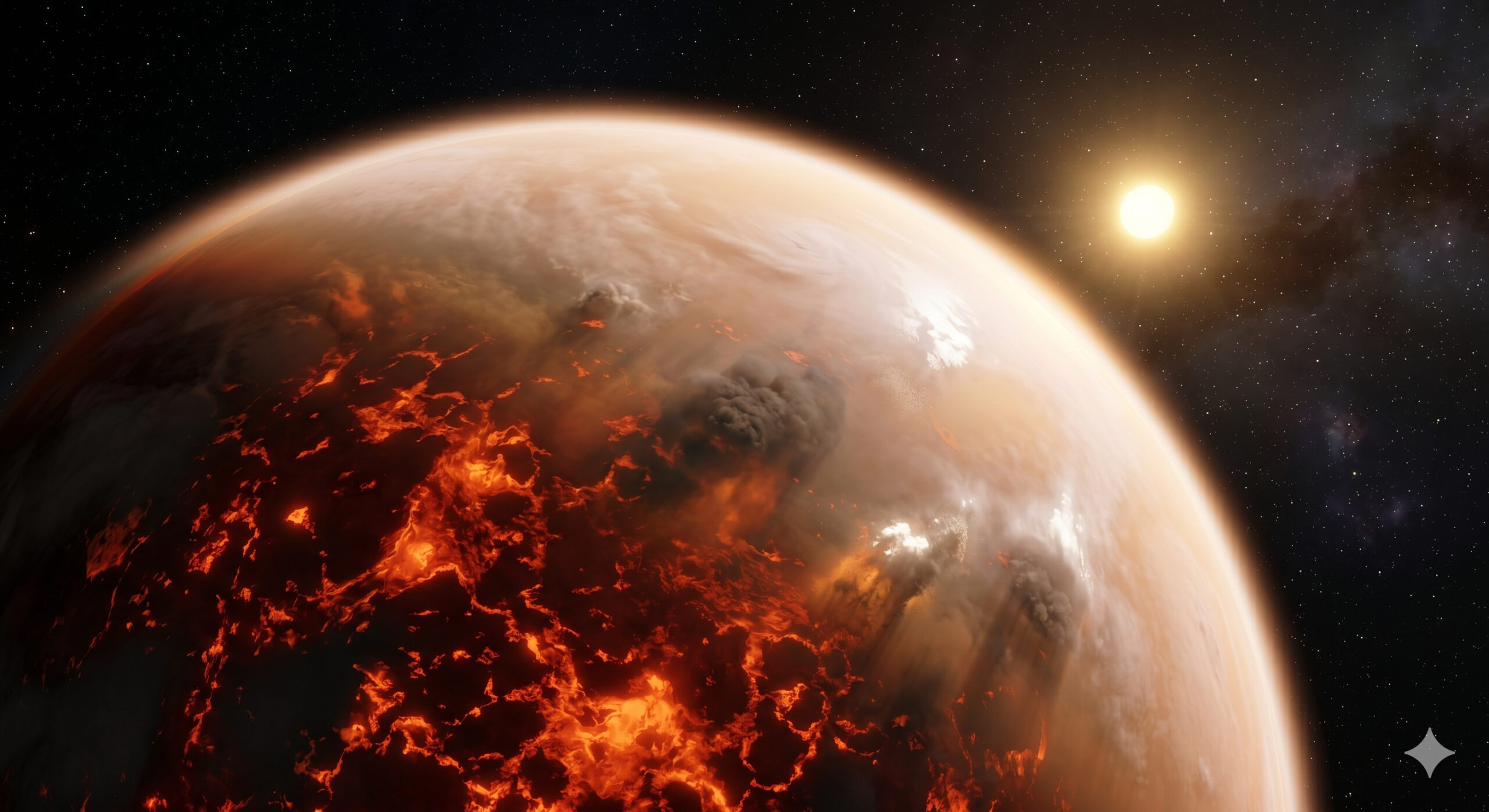

James Webb detects atmosphere on planet with over 2,000°C and magma ocean, challenging theories on atmospheric loss in extreme worlds.
In 2025, NASA announced on December 11 results obtained with the James Webb Space Telescope that placed the scientific community in front of one of the most extreme scenarios ever observed on a rocky planet outside the Solar System. The central object of the discovery is the exoplanet TOI-561 b, located about 280 light-years from Earth, in the constellation Sextans, whose infrared emission was measured by the NIRSpec instrument in observations made in May 2025. The planet is classified as an ultra-hot super-Earth with an ultra-short period, orbiting its star in less than 11 hours and less than 1 million miles from it, a distance equivalent to about one-fortieth of the separation between Mercury and the Sun.
This proximity creates extreme conditions: if it were a bare rock, the day side of the planet would approach 2,700°C, but Webb’s data indicated a lower temperature, around 1,800°C, still sufficient to sustain a global ocean of magma.
What makes the case even more intriguing is that, even under intense radiation and extreme heat, the data suggests that TOI-561 b may not be a bare rock. According to a study published in The Astrophysical Journal Letters in December 2025, the observations suggest the presence of a thick atmosphere rich in volatiles above the magma ocean, something that challenges the idea that rocky planets so close to their stars would completely lose their atmospheres over time.
-
Iraq floats and sinks under an arm of the Euphrates 10 giant concrete boxes of 46,000 tons and 125 meters each to assemble a 2.4 km submerged tunnel and open a new land route between Asia and Europe.

-
Scientists use more than 20,000 artificial birds and solar speakers to “trick” seabirds, reactivate nesting routes, and revive a colony on an island that seemed abandoned.

-
She spent 73 years breathing inside an iron lung, survived the aftereffects of polio, and became the last woman in the United States dependent on the equipment before dying at 78 years old.
-
Brazilian students created a $1 filter using pine bark, cotton, and 3D-printed parts to clean cassava wastewater, reduce the toxicity of a hazardous waste, and transform contaminated water into biofertilizer.




According to NASA, rocky planets so close to their stars should lose their atmospheres quickly, but TOI-561 b seems to challenge this rule.
TOI-561 b: a planet with permanent magma surface and extreme radiation
TOI-561 b belongs to a category of worlds known as lava planets, where temperatures are so high that rocks remain in a liquid state.

The extreme proximity to its star subjects the planet to:
- continuous intense radiation
- extreme surface heating
- evaporation of rocky materials
In this scenario, the planet’s surface does not have solid continents like Earth, but rather a global ocean of magma in constant agitation.
This type of environment creates unique conditions, where minerals can evaporate and form a kind of “mineral atmosphere,” composed of vaporized elements from the crust itself.
10.5-hour orbit places the planet among the most extreme ever detected
One of the most impressive data points about TOI-561 b is its extremely short orbital period. While Earth takes 365 days to complete one orbit around the Sun, this planet completes its orbit in just 10.5 hours.
This means that:
- a “year” on the planet lasts less than half a terrestrial day
- the proximity to the star is extremely reduced
- the flow of energy received is dozens of times greater than that of Earth
This type of orbit places the planet in a category known as “ultra-short period planets,” considered some of the most hostile environments in the universe.
Detected atmosphere challenges classical models of atmospheric loss on super-Earth TOI-561 b
The most relevant point of the discovery is the possible presence of a thick atmosphere. According to classical astrophysics models, planets so close to their stars should experience intense atmospheric escape, a process in which gas particles are stripped away by stellar radiation.
However, observations from the James Webb suggest that:
- there are signs consistent with an atmosphere
- this atmosphere may be continuously replenished
- the magma ocean itself may release gases
This indicates that the atmosphere is not static, but possibly renewed by extreme geological processes.

This phenomenon opens new hypotheses about how atmospheres can survive under conditions previously considered impossible until recently.
James Webb spectroscopy allows for the analysis of chemical composition
The discovery was made possible thanks to the James Webb’s ability to analyze the light that passes through the planet’s atmosphere during its transit in front of the star. This method, known as transmission spectroscopy, allows for the identification of the chemical composition of the atmosphere, the presence of specific gases, and thermal characteristics.
Although the exact composition is still under analysis, the data indicates that the atmosphere may contain:
- gases derived from vaporized rocks
- compounds rich in heavy elements
- possible traces of carbon dioxide or carbon monoxide
This level of detail represents a significant advancement in the observation of rocky planets outside the Solar System.
Planet challenges understanding of the evolution of rocky worlds
TOI-561 b is not only an extreme planet but also a natural laboratory for studying planetary evolution. Until recently, it was believed that:
- rocky planets close to stars would quickly lose their atmospheres
- melted surfaces would not sustain stable atmospheric cycles
- radiation would destroy any persistent gas layer
However, this planet presents evidence that contradicts these assumptions. This suggests that internal processes, such as intense geological activity, may play a more significant role in atmospheric maintenance than previously thought.
Comparisons with primitive Earth enhance the relevance of the discovery
Although TOI-561 b is extremely hotter than Earth, some scientists point out that it may help to understand the early phases of our own planet.
Primitive Earth also went through a period when its surface was partially melted, with intense volcanic activity.
Studying worlds like TOI-561 b may provide clues about how atmospheres form, evolve, and interact with rocky surfaces under extreme conditions. This connection increases the scientific interest in the discovery.
Lava planet category gains prominence with new observations
TOI-561 b is part of a growing class of exoplanets known as lava worlds. These worlds share common characteristics: temperatures exceeding 1,500°C, melted surfaces, and extreme proximity to their stars.

With the advancement of telescopes like the James Webb, the amount of data about these planets has been increasing rapidly. This is allowing scientists to test theories in environments that do not exist in the Solar System.
Discovery reinforces James Webb’s ability to investigate extreme worlds
The James Webb Space Telescope was designed to observe the universe in infrared, allowing it to detect signals that previous telescopes could not identify.
In the case of TOI-561 b, it was able to:
- capture subtle variations in starlight
- identify possible atmospheric signatures
- analyze an extremely hot planet
These capabilities position Webb as a central tool in the new era of exoplanet exploration.
What this discovery changes in the search for habitable planets
Although TOI-561 b is completely uninhabitable, it plays an important role in understanding how planets function under different conditions. By studying extremes, scientists can:
- refine planetary formation models
- understand atmospheric survival limits
- identify patterns that can be applied to other worlds
This helps improve the search for potentially habitable planets by better defining what makes a planet capable of sustaining a stable atmosphere.
Do you think we are still far from fully understanding planets outside the Solar System?
The discovery of TOI-561 b shows that the universe still holds phenomena that challenge established scientific models.
Even with advanced technologies like the James Webb, new observations continue to reveal unexpected scenarios. In light of this, an important question arises:
How many other extreme worlds still exist and could completely change what we know about the formation and evolution of planets?