Portuguese
  Spanish


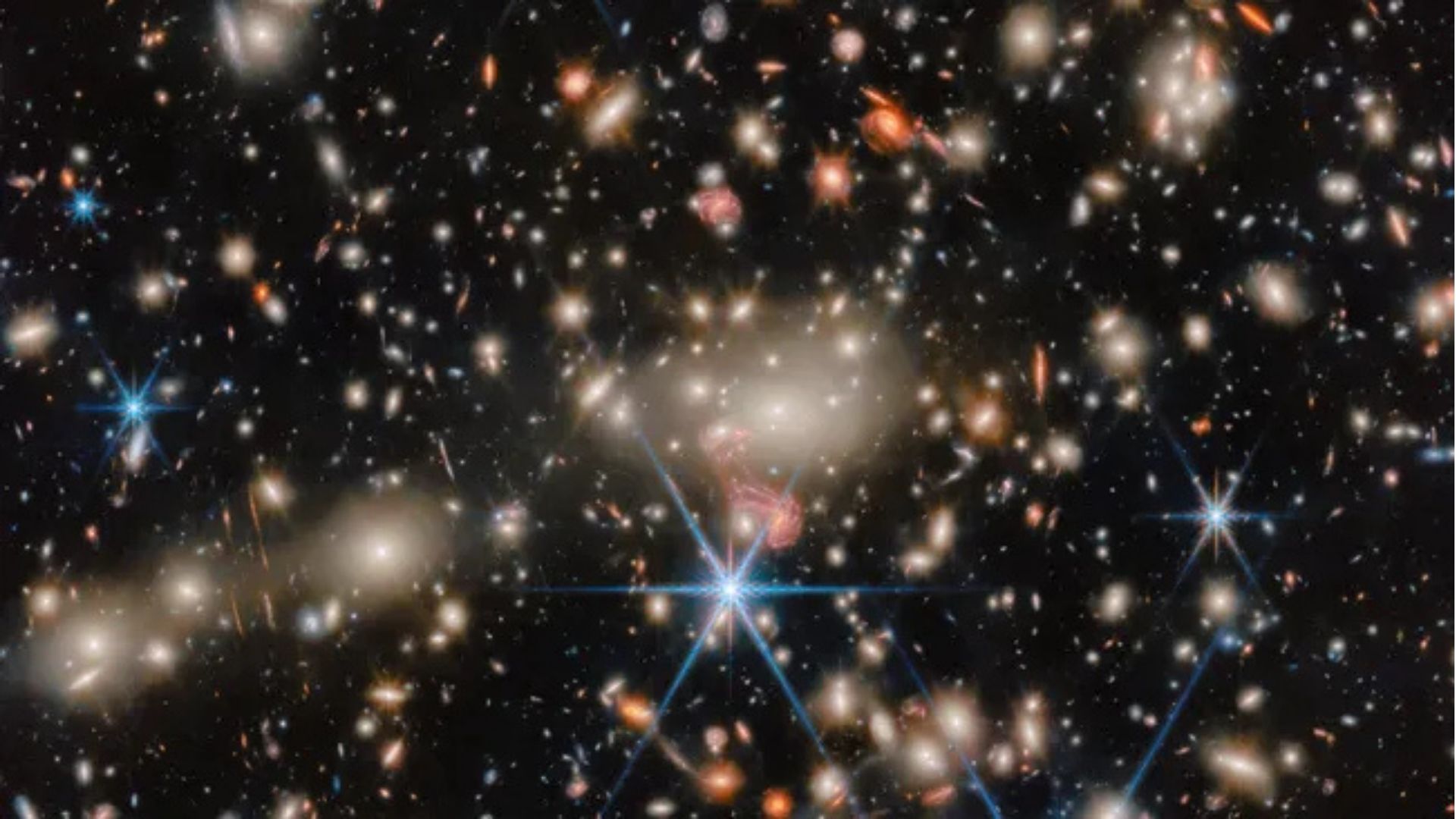

The discovery of the interacting system offers an unprecedented view of the origin and composition of compact red light sources in the primordial cosmos.
The James Webb Space Telescope (JWST) has made a groundbreaking observation of an interacting galaxy system, named “stingray” due to its unique shape, which may be key to understanding the small red dots.
These mysterious structures, previously detected by the telescope, appear as compact, reddish points in the primordial cosmos, intriguing astronomers about their composition and origin. The discovery of this specific system allows for a more detailed analysis of how these objects form and evolve in galactic merger environments.
The structure of the “stingray” system and the small red dots
The observed formation consists of three galaxies distinct galaxies that are in the process of colliding, creating a silhouette reminiscent of the anatomy of a stingray.
-
Humanoid Robots Begin Replacing Workers in Repetitive Roles as Companies Accelerate Industrial Automation

-
Humanoid Robots Begin Replacing Factory Workers in China, Working 64-Hour Shifts and Driving Industrial Automation Forward

-
Miniature Nuclear Reactor to Be Installed in South Wales, Powering 20,000 Homes and Reviving UK’s Nuclear Industry After Nearly 50 Years
-
San Andreas Fault Reaches “Highest Tension in 1,000 Years,” Raising Fears of the “Big One,” but New Study Identifies Key Zone Near Los Angeles Influencing Earthquake Impact





Within this complex system, researchers identified features that closely resemble the small red dots, suggesting that such objects may be extremely dense galactic nuclei. This spatial configuration offers a rare opportunity to observe the dynamics of gas and dust that feed these bright and distant points.
The light from this system traveled billions of years to reach the mirrors of James Webb, revealing the state of the universe in its infancy. Spectroscopic analysis indicates that the small red dots within the “stingray” have a massive concentration of stars and possibly actively growing supermassive black holes.
This interaction between the three galaxies seems to accelerate processes that make these points visible in the infrared frequencies captured by the equipment.
The role of black holes in the reddish coloration
One of the biggest current scientific debates involves whether the brightness of the small red dots is caused by dense stellar populations or by dust around black holes. In the “stingray” system, the data suggest a combination of both factors, where intense star formation activity is accompanied by obscuration caused by clouds of cosmic dust. This dust absorbs blue light and re-emits radiation at longer wavelengths, resulting in the characteristic red hue observed by James Webb.
The presence of a central black hole appears to be a fundamental component to explain the energy emitted by these small red dots detected in the system.
The flow of matter towards the galactic center during the merger of the “stingray” galaxies provides the necessary fuel for this extreme luminosity. Observing this process in real time, from a cosmological perspective, allows scientists to refine models of how massive galaxies organized themselves after the Big Bang.
Implications for the evolution of the primitive universe
The discovery of the “stingray” system reinforces the capability of James Webb to locate objects that were invisible to previous generations of telescopes.
By studying the small red dots in a context of galactic interaction, the research team is able to map the distribution of dark matter and visible matter at the dawn of time. This system serves as a natural laboratory to test theories about how quickly black holes can grow in the young universe.
The collected data indicate that the “stingray” system will continue to evolve into a single massive elliptical galaxy over hundreds of millions of years. This final destiny helps explain the transition of the small red dots into the large galactic structures we observe in the local universe today.
The detailed mapping of each component of the “stingray” is a crucial step in solving one of the most persistent mysteries of modern infrared astronomy.
The sensitivity of James Webb was decisive in isolating the light signatures that define the small red dots within the complexity of the merging system.
With new rounds of observations planned, the expectation is that more systems similar to the “stingray” will be found in deep regions of space. Solving the enigma of these compact sources will significantly alter the understanding of the timeline of structure formation in the cosmos.
With information from Live Science