






 Portuguese
  Spanish


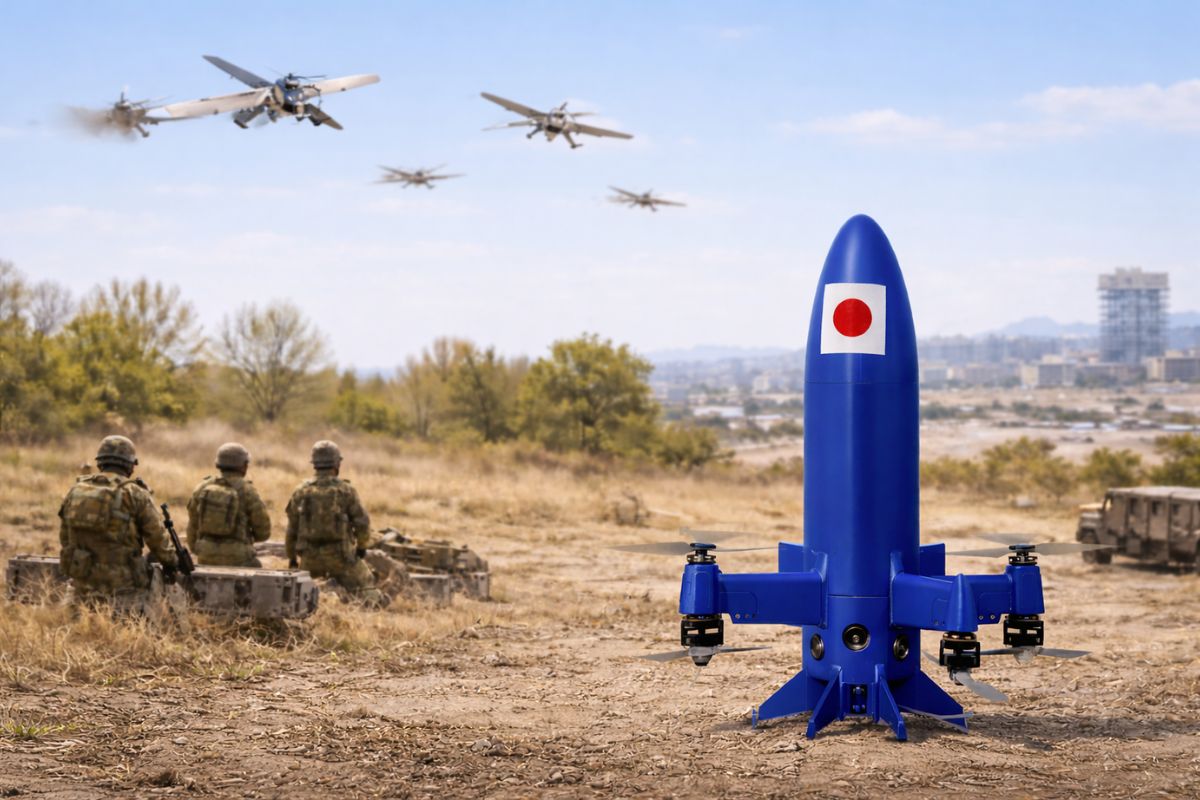

In Ukraine, Japan-supported Terra A1 drone tries to turn Putin’s bill by taking down swarms for a fraction of the cost.
Japan is said to have changed the game of drone warfare in Ukraine by supporting a low-cost solution to intercept swarms in the sky, according to a report that circulated after the escalation of drone attacks using Shahed-type drones and the financial pressure on Ukrainian defense.
The bet, described as silent and surgical, involves the Terra A1 interceptor drone, the result of a partnership between a Japanese company and a Ukrainian startup. The promise is simple to understand and hard to ignore: take down expensive drones at a much lower cost, turning the math that supported Vladimir Putin’s strategy upside down.
The “math war” that put the drone at the center of the conflict
The report indicates that, with the war fought in trenches, Russia has adopted an exhaustion strategy based on kamikaze drone swarms, citing Iranian-origin Shahed drones as part of the problem.
-
China Develops Custom 140-Ton Electric Mining Truck with 770 kWh Swappable Battery, Deploys 290 Units in Xinjiang’s Largest Zinc Mine

-
Meta to Launch Arena, a New Prediction App Targeting 3.56 Billion Users, Competing with Polymarket and Kalshi

-
Scientist Challenges Famous Human Evolution Theory, Argues Homo Sapiens Evolved Gradually Over Thousands of Years
-
15-Year-Old American Builds Ocean Generator with PVC Pipe and 3D-Printed Propeller for $12, Wins National Prize, Presents at White House, and Makes Forbes 30 Under 30 List




The trap would be economic. Traditional and billion-dollar air defense systems, such as Patriot missiles, are described as advanced technology but financially poor when used against a drone that is much cheaper. When the cost of defense is greater than the cost of attack, the math starts to break down, and that is exactly the point the text tries to explore.
What the Terra A1 promises to do in the sky of Ukraine

The presented turnaround comes with a name and price. The Terra A1 is described as an interceptor drone created with a single purpose: to hunt and destroy enemy drones before they reach their targets.
According to the same report, it would fly at 300 km/h, have a range of 35 km, and complete the hunting and destruction cycle in a 15-minute flight. It is also noted to be electric, silent, and capable of operating autonomously, reducing the dependence on trained human operators. The narrative is one of speed and efficiency, but the key word is another: cost. And that is where the text places the weight of the story.
The price that turned the conversation and why it affects the Russian strategy
The cited comparison is aggressive. The report states that a drone Terra A1 would cost about $2,000 to manufacture, while Russia would spend around $35,000 to send an attack drone, and an interceptor missile from the Patriot could reach $4 million.
With this reasoning, each attack would no longer be just a military threat but would turn into a financial problem for the attacker. If defense is cheap and attack is expensive, the wear and tear shifts sides. It seems abstract, but the consequence would be concrete: Russia would pay more to try to cause damage than Ukraine would pay to prevent it. And this, in war, tends to alter decisions at the top.
A Japan-Ukraine partnership behind the drone and what each side gains
The text states that a Japanese technology company, referred to as Terra Drone Corporation, has teamed up with the Ukrainian startup Amazing Drones to create the Terra A1. The reading is of a behind-the-scenes alliance, more focused on results than on rhetoric.
The motivation would not be “charity,” according to the report itself. Japan appears to be investing millions and offering capital at 2% interest because it seeks something that Ukraine has in abundance at this moment: real combat experience, learning under constant threat, and rapid validation of technology. In other words, the battlefield becomes a laboratory, and the laboratory accelerates drone innovation.
The geopolitical background that makes the drone a priority
The text connects the advancement of the drone to broader tensions, citing the Indo-Pacific and the sense that Japan is rearming, observing China and North Korea. The central idea is that what works today in Ukraine may influence what will be used tomorrow in another scenario.
This does not depend solely on machines or software. It depends on the production chain, industrial scale, training, and real-time adaptation. And when it comes to drones, the speed of evolution is almost always greater than the speed of politics. It is this mismatch that gives the story traction.
Why this type of drone can affect life beyond the front


Even for those far from the conflict, the debate does not stay solely on the war. When a drone that is cheap changes the cost of attacking and defending, it can influence the duration of the confrontation, the level of destruction, and the pressure for new investments in defense.
Furthermore, the text suggests that the shock of innovation may hit the arms industry and the reputation of traditional technologies. The implicit message is uncomfortable: if a low-cost drone undermines the prestige of extremely expensive systems, many strategies need to be rewritten. And this rewriting often reaches the market, diplomacy, and the news in waves.
The detail that keeps this story gripping until the end
The account tries to leave a question hanging: if Russia bet on the economic exhaustion of Ukraine with swarms of drones, what happens when the defense finds a cheap way to cut this cycle?
The answer is not yet settled, but the direction is clear: modern warfare, in the argument presented, is not just about brute power. It is about who can sustain the cost for longer. And when the topic is drones, this cost can change faster than many people imagine.
Do you think a cheap drone can really turn the tide of a war, or does this math always find another way to exact its price?





