






 Portuguese
  Spanish


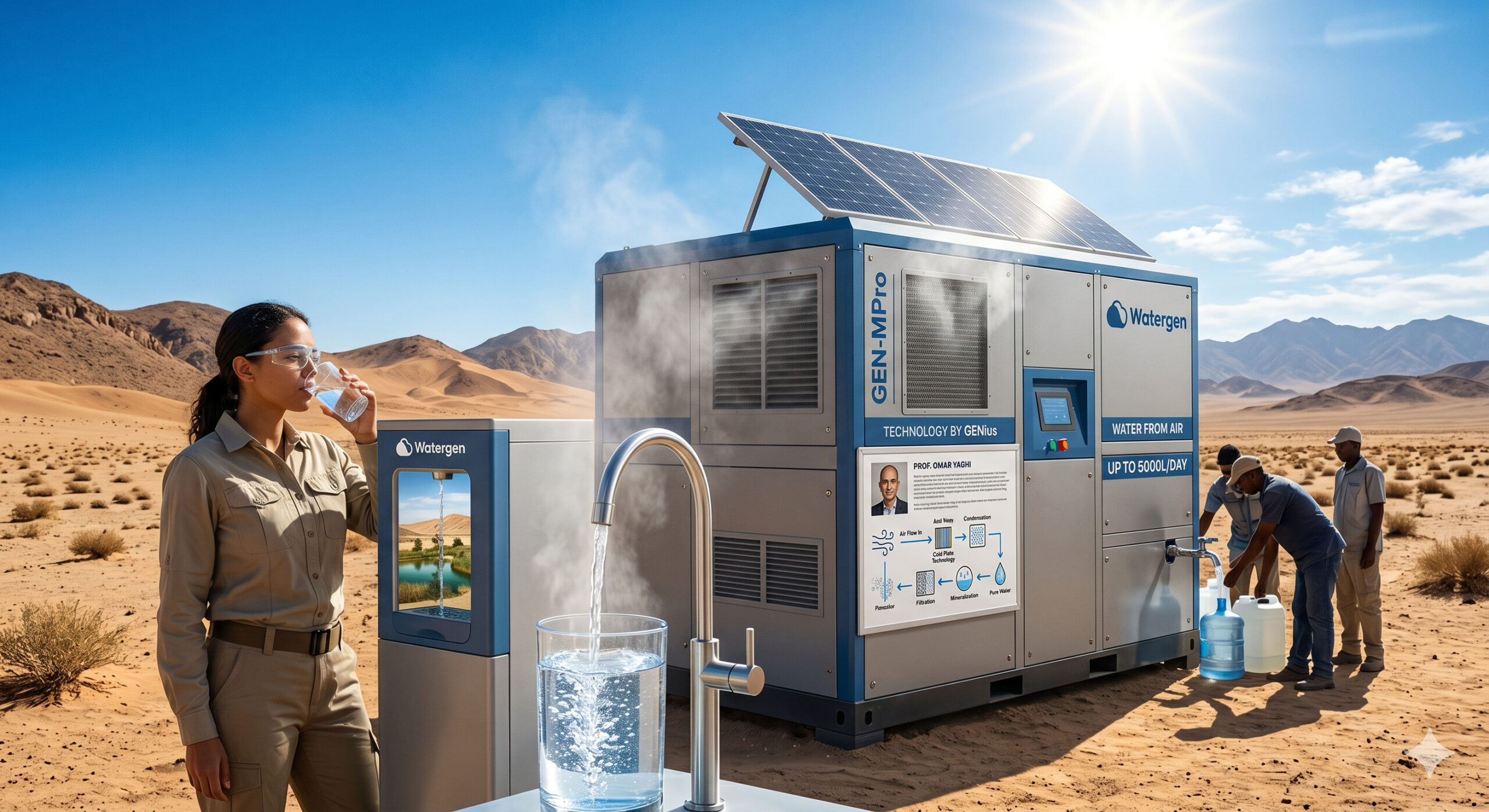


Watergen produces drinking water from the air with GENius technology, generators of up to 5,000 liters per day, and new collaboration with Omar Yaghi to operate in dry deserts.
According to Watergen, the Israeli company founded in 2009 by Arye Kohavi developed a patented technology called GENius, capable of extracting water from the air with a consumption of 250 Wh per liter. The system has become one of the most efficient atmospheric water generators available, using only electricity and air. The GEN-M Pro, the mid-range model in the current line, produces up to 1,000 liters of drinking water per day, without piping, without a well, and without a river. The large-scale system can reach 5,000 liters daily, a volume sufficient to serve hundreds of families, according to the company.
Watergen operates on six continents, with deployments in schools, hospitals, military bases, remote villages, and disaster zones. In December 2025, MIT Technology Review revealed conversations between Kohavi and Omar Yaghi, winner of the 2025 Nobel Prize in Chemistry, to combine GENius with MOFs capable of capturing vapor in deserts with less than 20% humidity.
GENius technology uses the air conditioning principle to produce drinking water from the air
The basic principle of Watergen technology is similar to that of an air conditioner: cooling the air below the dew point to condense water vapor into liquid droplets. The difference lies in the efficiency with which the system recovers energy and transforms this process into continuous production of drinking water.
-
The Trap of Modern Technology: How Screen Overload and Digital Connections Can Impact Your Mental Health and Well-being

-
Wyoming Couple Grows Tropical Fruits Year-Round in -40°C Using Geothermal Greenhouse, Demonstrating Earth’s Heat Can Produce Oranges and Lemons in Snow Without Traditional Heating

-
Ship Returns from Brazilian Coast with Thirty Newly Discovered Life Forms
-
Nigerian Professor Invents Electricity-Free Refrigerator Using Clay Pots and Wet Sand, Extending Shelf Life of Vegetables to 27 Days; 7,000 Units Distributed in Energy-Deprived Villages


The GENius module uses thin plastic sheets stacked alternately to create two counter-current airflows, forming a gradient heat exchanger. The air enters, is progressively cooled until humidity condenses, and the residual cold is reused to cool the next flow.


This reuse reduces energy consumption per liter produced. According to the cited data, the system reaches 250 Wh per liter, a value below what would be required by conventional refrigeration systems to condense the same amount of water.
Water from the air undergoes purification with UV-C, filters, and mineralization
After condensation, the water produced by the atmospheric generator goes through a multi-stage purification system. The process includes filtration, UV-C treatment, and mineralization to meet international drinking water standards.
The UV-C stage eliminates bacteria, viruses, and microorganisms, while mineralization improves taste and makes the water more suitable for human consumption. The goal is to deliver ready-to-drink water, without relying on public networks, wells, or surface sources.
In practice, the technology transforms atmospheric vapor into drinking water at the point of use. The proposal is to reduce logistics, transportation, plastic bottles, and dependence on traditional water infrastructure.
Watergen generators produce 27 to 5,000 liters of water per day
Watergen’s product line ranges from smaller models, producing about 27 liters per day for domestic use, to community and industrial systems capable of generating 5,000 liters per day. The GEN-M Pro, with a capacity of 1,000 liters daily, was developed for schools, hospitals, parks, and remote locations.
Installation is described as plug-and-drink, without plumbing and without a well. Maintenance focuses mainly on filter replacement, done periodically, which facilitates use in regions where technical infrastructure is limited.

To put the scale in context, the WHO recommends a minimum of 50 liters per person per day for drinking, cooking, and basic hygiene. A 5,000-liter per day system can meet the needs of over 100 people at this minimum standard or supply drinking and cooking water for hundreds of families.
Watergen’s atmospheric water has already been used in schools, hospitals, and disaster zones
Watergen is not just a laboratory promise. The company has been operating in the field for over a decade, with a track record of deployments in emergency situations, remote communities, and locations with insecure water supplies.
In 2017, it sent generators to Texas and Florida after Hurricanes Harvey and Irma, in partnership with the American Red Cross and FEMA. In 2018, a GEN-350 was used in response to the Camp Fire in California.
The company also supplied equipment to hospitals in Cambodia, Red Cross operations in different countries, and military bases of the UK Ministry of Defence. The common denominator of these applications is infrastructure independence: air and electricity are the main inputs.
Atmospheric water generators depend on air humidity to operate efficiently
The biggest operational limit of GENius is humidity. In regions with humidity above 50%, water production tends to be more efficient, and the cost per liter is lower.
As humidity drops, production decreases because there is less vapor available for condensation. In areas with humidity below 30%, conventional atmospheric generators become progressively less efficient.

This is where the collaboration with Omar Yaghi can change the technology. Current generators work best in humid air, while MOFs were created precisely to capture water in very dry environments.
Omar Yaghi’s MOFs can take Watergen to deserts with less than 20% humidity
MOFs, or Metal-Organic Frameworks, developed by Omar Yaghi at the University of California, Berkeley, are synthetic porous materials with an enormous internal surface area. A few grams can have an internal surface area equivalent to a football stadium.
These materials capture water molecules from the air even at very low humidity concentrations, including below 20% relative humidity. This range is precisely where the conventional GENius already faces significant operational limitations.
The idea of the collaboration, according to MIT Technology Review, is to use MOFs as an initial stage for capturing humidity in dry air and combine this process with the GENius condensation and purification system. The result could be a generator capable of producing drinking water in deserts with 10% to 15% humidity.
Atmospheric water generator market grows with water scarcity and solar energy
Watergen was founded in 2009 to solve a military problem: providing water to troops in the field without relying on resupply. In 2016, after the acquisition by billionaire Michael Mirilashvili, the focus expanded to include civilian water scarcity.
Between 2016 and 2025, the number of people living under severe water stress grew, according to UN data cited in the source text. At the same time, the cost of solar energy fell, making off-grid systems more viable in locations without conventional electricity grids.
The global market for atmospheric water generators grew from less than US$1 billion in 2016 to US$9.31 billion in 2022. Projections indicate continuous growth, driven by water crisis, climate disasters, and demand for decentralized solutions.
Watergen operates in over 40 countries but does not yet operate at scale in Brazil
Watergen currently operates in over 40 countries and is present on all inhabited continents. The company signed an agreement to build a factory in Hanoi, Vietnam, aimed at the Asian market.
In the United States, it maintains an R&D agreement with the EPA and operates in partnership with FEMA. In Latin America, it is present in Mexico and other South American countries, according to the source text.
In Brazil, the technology has not yet been implemented at scale. Nevertheless, the need profile is evident: communities in the semi-arid Northeast, Amazonian regions without water infrastructure, and areas affected by aquifer contamination fit the target audience for which the generators were designed.
Decentralized versions can combine Watergen, MOFs, and solar energy
The passive, electricity-free solution is the path developed by Yaghi at Atoco, his commercial MOF company. It would produce water more slowly and in smaller volume per unit, but without electrical operating cost.
The combination of the two approaches can expand the technology’s reach. Active systems, like Watergen’s, would be useful in schools, hospitals, bases, and villages with available power. Passive systems with MOFs could serve remote locations without an electrical grid.
While this technological convergence has not yet reached the market, Watergen continues to implement what already works where the need is urgent. One school, one hospital, one military base, or one displaced persons camp at a time, the company tries to transform vapor from the air into potable water.




Is this technology available Muslim countries?