






 Portuguese
  Spanish


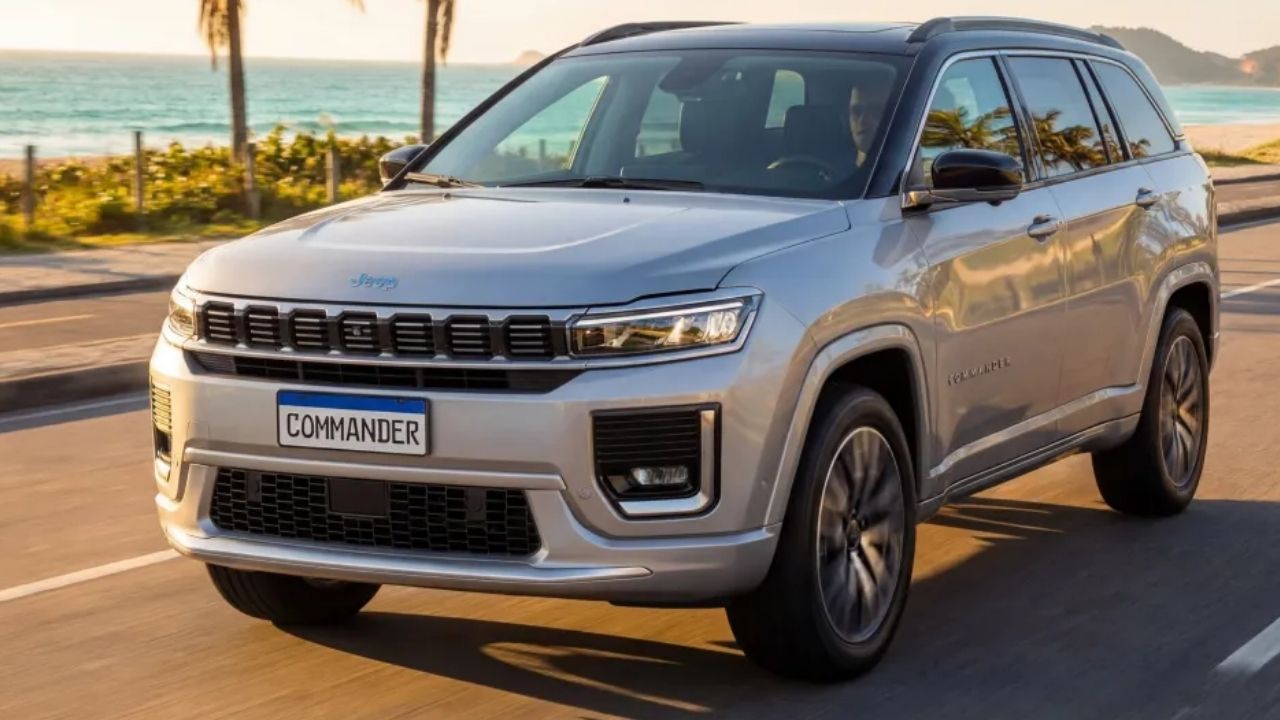

Jeep Commander arrives in the 2027 lineup with a 48V mild hybrid MHEV system in the Limited and Overland versions, maintains seven seats, features Blackhawk Hurricane flex with 272 hp, preserves much of the pricing and starts at R$ 228,790, reinforcing its position among large SUVs produced in Goiana, Pernambuco, Brazil.
The Jeep Commander 2027 was presented on March 30, 2026 with significant changes to the national range. The seven-seater SUV now offers a 48V mild hybrid system in the Limited and Overland versions with the T270 engine, in addition to a new Blackhawk Hurricane flex configuration with 272 hp.
According to information published on the CNN website, produced in Goiana, Pernambuco, the model launched in Brazil in 2021 maintains the proposal of a large family SUV, with up to 661 liters of trunk space when the third row is folded. Jeep’s strategy combines partial electrification, high-performance flex engine, and maintenance of much of the price list.
Jeep Commander 2027 gains mild electrification in intermediate versions
The main novelty of the lineup is the MHEV system, an acronym for Mild Hybrid Electric Vehicle. The technology was applied to the Limited and Overland versions equipped with the T270 turboflex engine, making the model the first national Jeep to receive this system.
-
2027 Toyota Corolla Cross Unveiled: New Design, Enhanced Fuel Efficiency, Reduced Maintenance Costs, Advanced Technology, Connected Services, and Up to 10-Year Warranty

-
Fiat Cronos Precision 2018: Affordable Sedan with Spacious Trunk and Reliable Maintenance
-
Volkswagen to Cut Production by 1 Million Cars by 2030, Reducing Jobs and Platforms, Focusing on More Profitable Models

-
Toyota Launches First 100% Electric Car in Brazil: bZ4X with 343 HP, All-Wheel Drive, 361 km Range, Priced at $419,990 BRL, Limited to 99 Units



The system works with a 48V electrical network in parallel with the vehicle’s conventional system. In practice, it recovers energy during decelerations, recharges the auxiliary battery, and provides support to the combustion engine during acceleration and recovery moments.
The system does not turn the SUV into a plug-in hybrid, as there is no external recharging or independent electric driving as in PHEV models. The proposal is to reduce consumption and emissions, as well as improve the car’s response in daily use.
According to Jeep, the average efficiency gain reaches 9.4% in fuel consumption, while the reduction in CO₂ emissions can reach up to 5% in the combined cycle.
Consumption improves in the city, but numbers vary depending on use

With the new light hybrid system, the Commander MHEV records a consumption of 7.6 km/l in the city and 8.1 km/l on the highway with ethanol. Fueled with gasoline, the numbers rise to 11 km/l in the urban cycle and 11.2 km/l on the highway.
Compared to the Commander 1.3 turbo without light electrification, the gain appears mainly in urban use. With gasoline, the city average goes from 10 km/l to 11 km/l. With ethanol, it rises from 6.9 km/l to 7.6 km/l.
On the highway, however, the disclosed numbers indicate a slight decrease. With gasoline, highway consumption goes from 11.5 km/l to 11.2 km/l. With ethanol, it goes from 8.3 km/l to 8.1 km/l.
This shows that the benefit of the MHEV system tends to be more relevant in urban routes, where there are more braking, deceleration, and acceleration, precisely the situations where light electrification can recover and reuse energy.
Blackhawk gains Hurricane flex engine of 272 hp

At the top of the line, the Jeep Commander Blackhawk now uses the Hurricane 2.0 turbo flex engine. The update allows fueling with ethanol or gasoline, maintaining the performance levels disclosed by the brand.
The set delivers 272 hp of power and 40.8 kgfm of torque. According to Jeep, this configuration takes the SUV from 0 to 100 km/h in 7 seconds, a strong number for a seven-seater family vehicle.
The Blackhawk version also uses a nine-speed automatic transmission and 4×4 all-wheel drive with the Jeep Active Drive Low system. The package includes a terrain selector and hill descent control.
The proposal of the Blackhawk is to occupy the space of the sportiest and most powerful version of the range, combining a high-performance flex engine, darkened visual, red brake calipers, and sporty driving information on the multimedia center.
Diesel remains in the catalog, but restricted to Overland
Despite the arrival of light electrification and the new Blackhawk flex, the diesel version remains available. The Commander Overland 2.2 Turbodiesel stays in the catalog as an option for those seeking high torque and 4×4 traction.
The Multijet 2.2 turbodiesel engine delivers 200 hp of power and 45.9 kgfm of torque. Like the Blackhawk, this version uses a nine-speed automatic transmission and an all-wheel-drive system.
The package retains features aimed at off-road use, such as terrain selector, hill descent control, and Jeep Off-Road Pages menu on the dashboard. The proposal is to cater to those who still value diesel in large SUVs.
With this, the 2027 lineup now covers three mechanical profiles: traditional turboflex, turboflex with mild hybrid, turbodiesel, and high-performance Hurricane flex.
Prices start at R$ 228,790 in the 2027 lineup
The Jeep Commander 2027 price list starts at R$ 228,790 for the Longitude T270 version. The Limited T270 MHEV starts at R$ 255,690, while the Overland T270 MHEV costs R$ 283,790.
The Overland 2.2 Turbodiesel version is priced at R$ 319,990. Meanwhile, the Blackhawk Hurricane Flex occupies the top of the line, priced at R$ 329,990.
According to CNN, Jeep maintained the price list for most of the range and applied a reduction of R$ 6,500 in the top-of-the-line configuration. This indicates an attempt to reinforce competitiveness without completely repositioning the model.
The strategy makes sense in a segment where large seven-seater SUVs typically compete for family audiences, higher-income clients, and consumers seeking a complete package of comfort, safety, and performance.
All versions come with level 2 ADAS
An important point of the 2027 lineup is the offer of level 2 semi-autonomous driving technologies in all versions. The package includes collision alert with automatic braking, lane centering and departure alert, adaptive cruise control, fatigue detector, and sign recognition.
The Longitude version, even being the entry-level configuration, already features 18-inch wheels, six airbags, a sound system with six speakers, seven black leather seats, a driver’s seat with electric adjustments, dual-zone air conditioning, and electric trunk opening.
In the Limited MHEV, items such as a seventh airbag for the driver’s knees, blind spot monitoring, cross-traffic alert, induction charger, and Harman Kardon sound system are included.
The Overland MHEV expands the package with a panoramic sunroof, 19-inch wheels, 360-degree camera, and more sophisticated finish, while diesel and Blackhawk add their own mechanical and visual features.
National SUV tries to reinforce space among large models
The Commander has established itself as one of the main national options among large seven-seater SUVs. Manufacturing in Goiana helps sustain the model’s presence in the Brazilian market since 2021.
The 2027 lineup attempts to update this position with a combination of mild electrification, maintenance of the diesel version, and the introduction of the Hurricane flex in the Blackhawk. The choice shows that Jeep did not bet on a breakthrough but on mechanical adjustments to enhance attractiveness.
The MHEV system caters to consumers seeking lower consumption and benefits linked to electrified vehicles. Meanwhile, the Blackhawk flex targets those who want performance, sporty looks, and 4×4 traction.
In the end, the Jeep Commander 2027 arrives with specific but relevant changes in an increasingly competitive segment.
Do you think the 48V mild hybrid is enough to keep the Commander competitive, or should large SUVs move faster towards plug-in and electric versions? Share your opinion.








