






 Portuguese
  Spanish


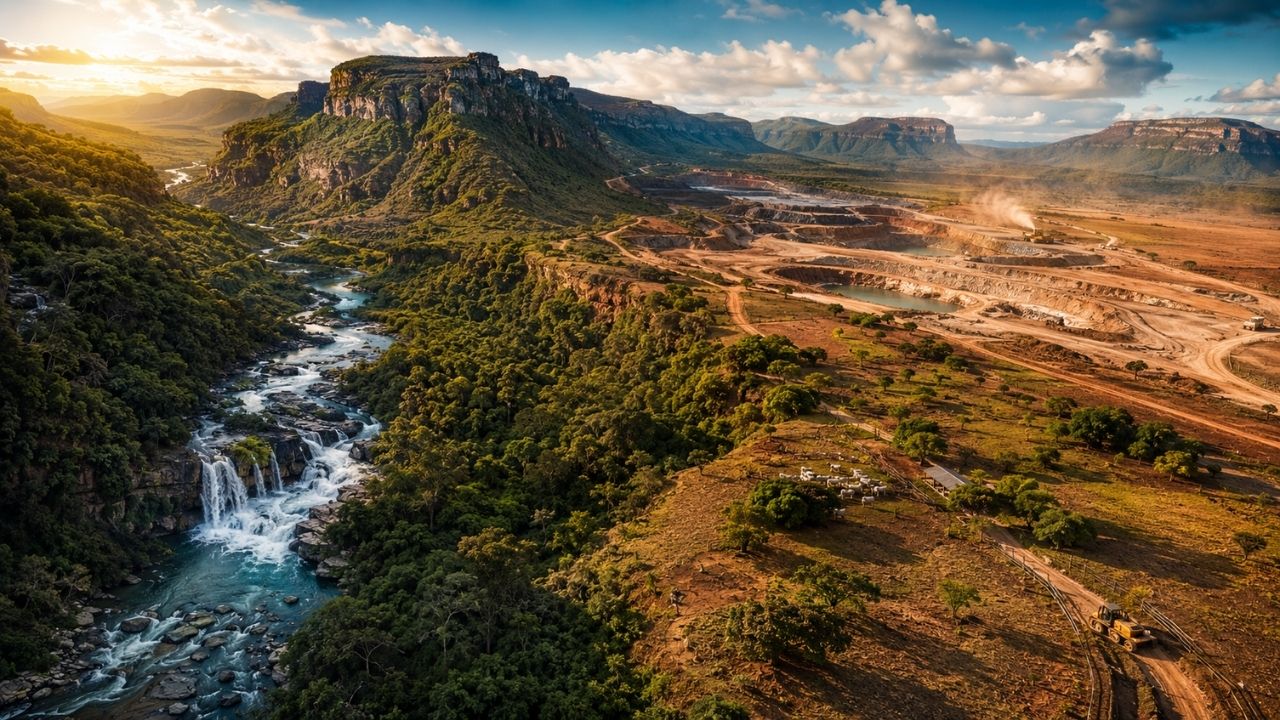

The Serra da Chapadinha, in Bahia, concentrates preserved areas, high-altitude peat bogs, and water recharge linked to the Paraguaçu River. In 2026, conflicts over mining, land grabbing, and farms increase pressure on the water that supplies Salvador and dozens of Bahian municipalities, while the debate on environmental conservation advances.
The water from Serra da Chapadinha became the center of an environmental dispute in Bahia in 2026, involving researchers, environmentalists, residents, farmers, mining companies, land grabbers, and the state government. The area is located in the south of Chapada Diamantina, between municipalities such as Itaetê, Mucugê, and Ibicoara, and is considered strategic for the water recharge of the Paraguaçu River.
According to information from the channel Jornal Correio, the tension intensified after an attack recorded on the 30th against the Toca do Lobo outpost, where environmentalists have lived since 2019, while the Bahia Environment Secretariat has been conducting studies since 2023 to create a conservation unit. A public consultation is scheduled for June 2026.
Serra da Chapadinha is considered the water tank of Bahia

Serra da Chapadinha is regarded by environmentalists and researchers as a kind of water tank of Bahia. The explanation lies in the combination of preserved forest, altitude, natural marshes, and peat bogs that accumulate a large amount of water.
-
China Develops Custom 140-Ton Electric Mining Truck with 770 kWh Swappable Battery, Deploys 290 Units in Xinjiang’s Largest Zinc Mine

-
Meta to Launch Arena, a New Prediction App Targeting 3.56 Billion Users, Competing with Polymarket and Kalshi

-
Scientist Challenges Famous Human Evolution Theory, Argues Homo Sapiens Evolved Gradually Over Thousands of Years
-
15-Year-Old American Builds Ocean Generator with PVC Pipe and 3D-Printed Propeller for $12, Wins National Prize, Presents at White House, and Makes Forbes 30 Under 30 List




These areas help in the water recharge of the Paraguaçu River before it flows through the semi-arid region of Bahia. The point is sensitive because the Paraguaçu supplies about 80 municipalities along its course and has a direct connection with the water security of Salvador and the metropolitan region.
According to the data presented in the report, about 60% of the water consumed in the metropolitan region of Salvador comes from the Pedra do Cavalo dam, built on the Paraguaçu River. Therefore, any pressure on Serra da Chapadinha is not limited to the local territory.
The risk is that degradation reduces the ecosystem’s ability to retain, filter, and gradually release water. In a region marked by semi-arid stretches, losing this natural function could increase supply problems in the future.
Paraguaçu River has already lost a significant part of its flow

One of the most concerning data is the loss of flow in the Paraguaçu River. According to the source, over 50 years, the river has lost about half of its flow, a warning sign for the entire basin.
This loss does not only mean less water running in the riverbed. It can affect human supply, economic activities, ecosystems, rural communities, and urban planning in areas that depend directly or indirectly on the river.
The problem becomes larger because Salvador seeks an important part of its water in a basin that crosses the semi-arid region. When the flow decreases and the pressure on the source increases, the water security margin decreases.
In this context, Serra da Chapadinha functions as a key protection area. If the region loses vegetation cover, suffers fragmentation, or has its peatlands degraded, the ability to regulate water may be compromised.
Mining, land grabbing, and farms increase pressure on the area
In recent years, Serra da Chapadinha has come under pressure from different economic interests. The source cites conflicts linked to the actions of land grabbers, farmers, and mining companies interested in exploiting the region’s natural resources.
The area covers about 18,000 hectares and includes remote sections, difficult to access, with preserved vegetation. Precisely for this reason, it has become a target of dispute between environmental conservation and the advancement of economic activities.
The conflict does not only involve land use. It also affects water, biodiversity, and the future of communities that depend on the ecosystem’s balance. When a water recharge region is altered, the impact can appear kilometers away.
Mining and the opening of new productive areas can lead to forest fragmentation, alteration of watercourses, increased erosion, and loss of habitats. In a territory that functions as a natural corridor, these effects accumulate.
Attack on environmentalists exposed climate of tension

The attack on the Toca do Lobo outpost increased concern around the dispute. Armed men invaded the site, held a couple of environmentalists hostage, and destroyed communication and solar energy equipment.
The victims, Aice Corrêa and Marcos Fantini, have lived in the region since 2019. The area is part of a biosphere reserve of the Atlantic Forest recognized by UNESCO and hosts researchers and scholars of the Chapada Diamantina biome.
The suspicion raised by environmentalists is that the attack is related to economic interests in the area. According to the source’s account, the invaders questioned whether they were “hindering the progress” of Chapadinha.
This episode shows that the dispute is not just technical or environmental. It also involves security, intimidation, the presence of armed groups, and the difficulty of protecting those who work in the defense of preserved areas.
Biodiversity also at risk
Besides water, the Chapadinha Mountain Range is home to native and endemic species of the Chapada Diamantina. The source mentions the presence of the caatinga howler monkey, a medium-sized primate, as well as predators like the jaguar and the puma.
These species depend on continuous and balanced areas to survive. When the forest is fragmented, animals lose routes, food, shelter, and the ability to maintain healthy populations.
Forest fragmentation breaks the network of interactions that sustain the ecosystem. This can lead to population decline and even local extinction of more sensitive species.
Therefore, the discussion about the Chapadinha Mountain Range goes beyond supply. The region includes water, fauna, flora, carbon stored in peatlands, and a natural landscape that still preserves important ecological functions.
Conservation unit under review since 2023


Since 2023, a process has been underway to create a conservation unit in the Chapadinha Mountain Range, led by the Bahia Environmental Department. In the last three years, technical studies and public hearings with local residents have been conducted.
According to the source, the analyses are in the final phase, and a public consultation is scheduled for June 2026. The next step will be to define the category of the conservation unit and its boundaries.
Environmentalists advocate for stricter protection, capable of preventing the exploitation of natural resources in the most sensitive area. The idea is to preserve the mountain’s water function, biodiversity, and ecological corridors that still persist in the region.
One of the possibilities mentioned is the wildlife refuge, a category that can involve public and private areas. In this model, existing activities could remain, as long as they are compatible with conservation objectives.
What’s at stake for Salvador and Bahia
The dispute over the Chapadinha Mountain Range shows that the water consumed in large cities may depend on distant, little-known areas pressured by local interests. Salvador and dozens of municipalities in Bahia are directly or indirectly linked to the balance of the Paraguaçu River basin.
When a water recharge region loses protection, the impact is not only seen in the forest. It can reach the faucets, the dams, agriculture, fauna, and the environmental security of an important part of Bahia.
The challenge now is to decide what importance the Chapadinha Mountain Range will have in the state’s planning. The area can be seen only as a territory for economic exploitation or as essential natural infrastructure to maintain water, biodiversity, and regional climate stability.
Do you think the Chapadinha Mountain Range should become a full conservation unit, or do you believe it is possible to reconcile water protection with mining, farms, and other economic activities? Leave your opinion in the comments.





