






 Portuguese
  Spanish


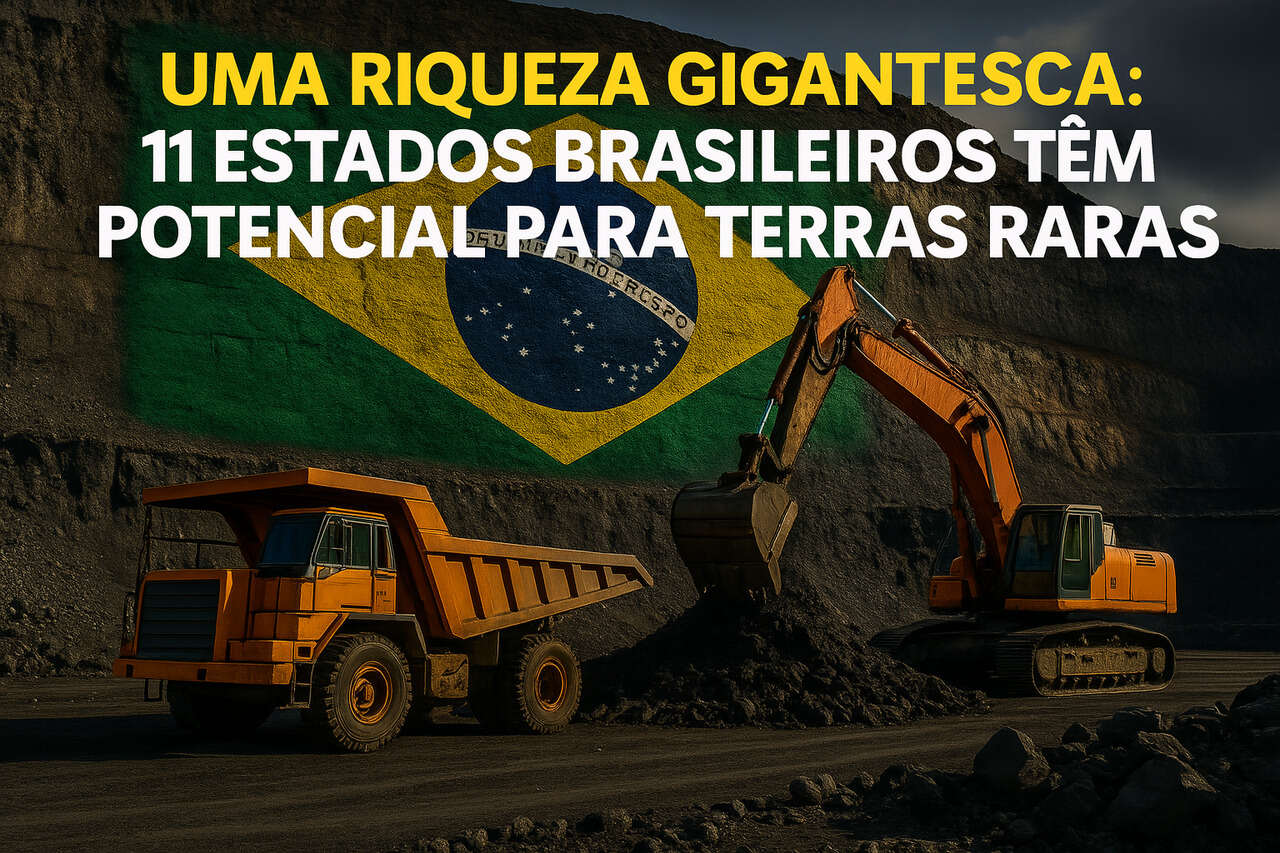


Brazil May Have 21 Million Tons of Rare Earths, But Still Depends on Other Countries to Process and Generate Strategic Value
Brazil may be sitting on one of the largest mineral wealth reserves in the world. A survey conducted by the Geological Service of Brazil (SGB) points out that 12 states in the country have potential for the presence of rare earths in the subsoil. These chemical elements are strategic for modern technologies and high-value industrial sectors.
Rare earths form a group of 17 chemical elements. They are found mixed with other ores and are difficult to extract with high purity.
Therefore, despite the name, they are not necessarily rare, but rather complex and expensive to isolate. They are essential for the production of wind turbines, electric cars, chips, medical equipment, satellites, missiles, and cell phones.
-
Family Quietly Transforms Old Sawmill into $700 Million Business, Opens 25 Stores in Two Years Across 22 Brazilian States

-
Couple Sold Their Home to Save Business, Now Run Platform Handling $180 Million Monthly and Managing Over 51 Million Listings
-
Brazil’s 2026 Tax Refund: Record 9.58 Million Filers in Largest Payout Ever, But a Key Detail on Priority Recipients Draws Nationwide Attention

-
Itaú Alters Hybrid Work Model, Increasing Office Days from 2028, Prompting Employees to Adjust to New Routine



The SGB study identifies that the states with potential to contain these elements are: Goiás, Tocantins, Minas Gerais, Bahia, Paraná, São Paulo, Santa Catarina, Pará, Rondônia, Roraima, Amazonas, and Piauí. In some locations, such as Goiás and Minas Gerais, deposits have already been confirmed.
According to the SGB, most of the known reserves are associated with alkaline-carbonate rocks. The main mapped points so far are Araxá (MG), Tapira (MG), Catalão (GO), and Poços de Caldas (MG).
There is also an important deposit in Seis Lagos, Amazonas. Additionally, there are ongoing studies in southern Bahia, in areas with monazite rocks and ionic clay, and in the Mata da Corda Group in Minas Gerais.
If the research is confirmed by more detailed studies, Brazil could play a more prominent role in the global rare earth market.
Currently, this market is dominated by a few countries, with a clear lead from China.
These minerals have strategic value. They are directly linked to the production of clean energy, cutting-edge technology, and defense equipment.
This means that, in addition to economic opportunities, there is also geopolitical relevance. The confirmation of large reserves could attract investments and reduce Brazil’s external dependence in this sector.
Today, the biggest obstacle lies above ground. Brazil has raw materials but still lacks the industrial capacity to refine the ores at scale.
This assessment comes from Fernando Landgraf, a professor at the Polytechnic School of USP. In an interview with g1, he explained that Brazil primarily exports raw materials. As a result, it loses value in the production chain.
The comparison with China is unavoidable. The Asian country strategically moved decades ago to dominate the entire production chain of rare earths. In addition to extraction, it also holds the technologies for processing and refining.
According to the U.S. Geological Survey, Brazil has about 21 million tons of rare earths. It is the second-largest global holder, behind only China itself.
The latest relevant information is that if the country wants to take advantage of this wealth of rare minerals, it will need to invest not only in exploring the subsoil, but primarily in building a complete industrial chain.
With information from Panorâmica News.







Os políticos não deixam,o pais crescer,eles atrasam o pais,por isso roubam tanto só pensam neles.ta na hora de virar fazer igual a china,chega de depender de outros o pais tem muita riqueza chega de ser explorados por gente de fora.
Prá variar temos a matéria, mas, Não devemos o domínio da industrialização.
Não sei porquê o Pará estar fora, em Parauapebas tem muito minério de terras raras. Comprovadas em análises