






 Portuguese
  Spanish




Experts from LNA Warned About the Growing Impact of Space Junk, Which Has Already Surpassed 11 Thousand Tons and Threatens Both Astronomical Observations and the Safety of Satellites in Orbit
The accumulation of space junk around Earth is becoming one of the greatest challenges for astronomy and orbital operations. Millions of fragments from satellites, rockets, and collisions are harming both the observation of the universe and the functioning of active equipment in space.
Space Junk: A Pollution That Goes Beyond Earth
During the program Olhar Espacial on October 31, host Marcelo Zurita welcomed Wagner José Corradi Barbosa, director of the National Astrophysics Laboratory (LNA/MCTI), and Éder Martioli, a researcher at LNA and the Institute of Astrophysics in Paris.
They explained how space junk interferes with sky visibility and scientific studies.
-
James Webb Telescope Uncovers Unexpected Clues on Mysterious Moon, Potentially Redefining Planetary Origins

-
$1.5 Billion Sleipnir Vessel Transforms Ocean into Floating Construction Site with 12 Hybrid Engines and Capacity to Lift 20,000 Tons

-
23 Years After Tragedy, Brazil’s Alcântara Space Center to Launch New Suborbital Rocket in 2026 with South Korean SEBIT Project Targeting Near-Space Tests
-
Entrepreneur Turns Neighbor’s Coffee Grounds Waste into Eco-Friendly Pellets, Earning Up to $40,000 Monthly in Brazil


Although most objects burn up upon re-entering the atmosphere, the disintegration process creates another problem.
The small particles that shine during burning confuse telescopes and make it difficult to identify truly relevant phenomena. This effect causes direct harm to observatories and research missions.
Rising Risks and Alarming Numbers
“Monitoring this space junk is essential to ensure the safety of our equipment in space,” Éder stated.
According to him, the danger is not in potential falls to Earth, but in possible orbital collisions. “There will come a moment when there will be so many objects in space that it will be difficult to keep a large satellite in orbit without collisions occurring,” the researcher added.
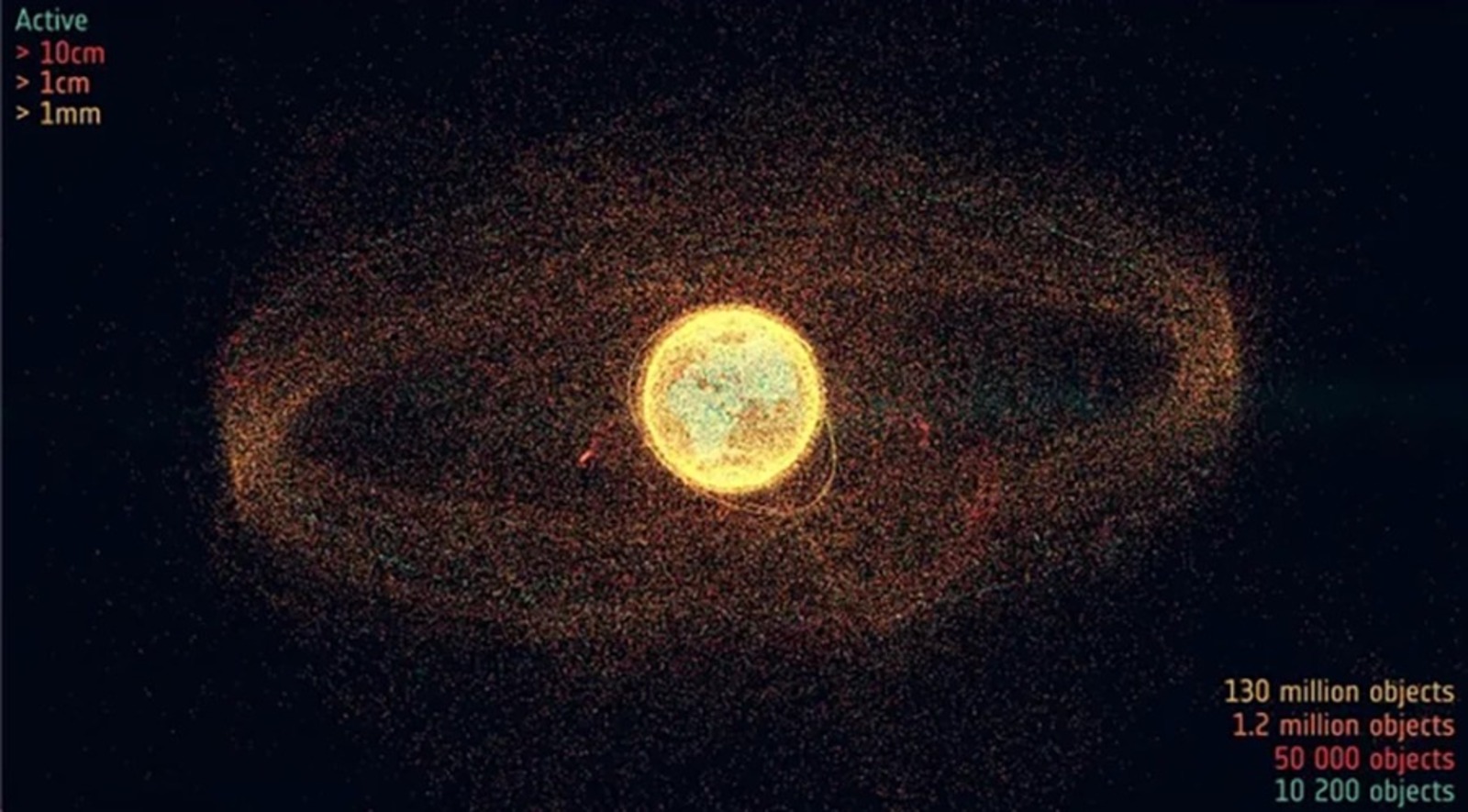
The European Space Agency (ESA) estimates that more than 36 thousand debris larger than 10 centimeters orbit the planet, totaling about 11 thousand tons of material.
These are remnants of rockets, decommissioned satellites, and pieces of collisions traveling at very high speeds.
Additionally, there are millions of smaller fragments that do not appear in monitoring systems. Wagner Barbosa highlighted that if objects smaller than 10 centimeters are included, the number exceeds one million.
And if we include particles as small as 1 millimeter, the total could reach 130 million pieces of debris orbiting Earth.
Polluted Sky and Compromised Observations Due to Space Junk
In recent years, it has become common to see astronomical images streaked with bright trails. This occurs because sunlight reflects off the fragments and structures orbiting the planet.
The phenomenon resembles the light pollution of large cities, which obstructs the visibility of stars.
According to Éder, the problem is expected to worsen. “It could reach a point where we will no longer have a sky to study,” he warned.
For him, the excess light reflected by artificial objects may hinder detailed astronomical observations.
Artificial Constellations Amplify the Challenge
Wagner Barbosa noted that satellite constellation projects, like Starlink’s “train,” worsen the situation.
These artificial constellations occupy large areas of space and visually compete with natural stars.
As a result, celestial phenomena end up being overshadowed by human structures, making scientists’ work more difficult.
The outcome is an increasingly congested sky — and an urgent warning about the limits of space exploration.
With information from Olhar Digital.


