






 Portuguese
  Spanish


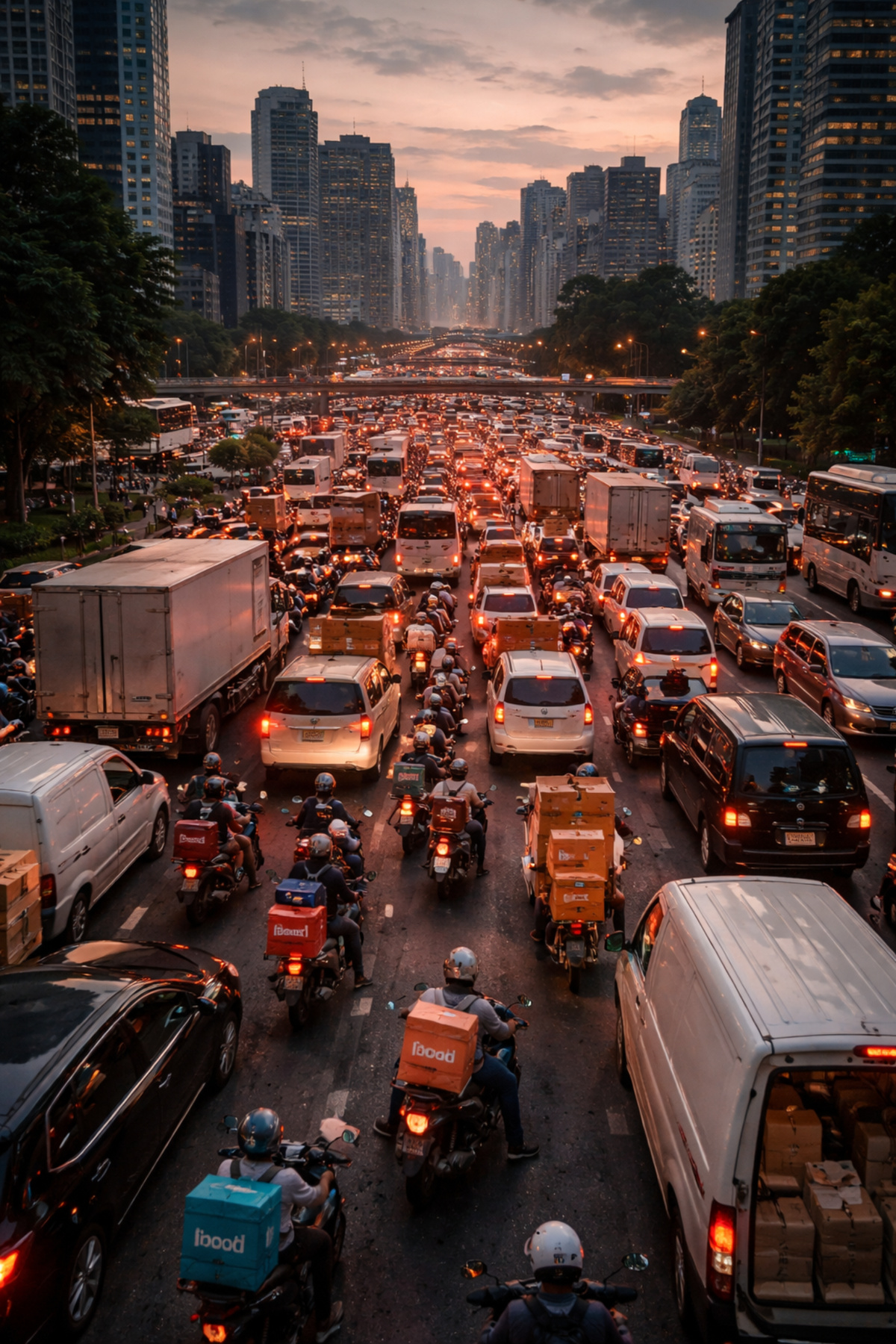


Understand How the Advance of Deliveries, the Return to In-Person Work, and the Use of Artificial Intelligence in Logistics Impact Traffic, Quality of Life, and Urban Mobility in 2025 and 2026.
First of all, traffic in São Paulo reached a historic record in early December 2025.
According to the Traffic Engineering Company (CET), more than 1,400 kilometers of congestion were recorded in the São Paulo capital.
Moreover, the scenario was driven by the combination of return to in-person work and the growth of e-commerce deliveries.
-
$142 Million Bridge Funded by Brazil Only Used by Empty Trucks at Night, While 43,000 Vehicles Face 2-Hour Queues and Annual Losses Could Reach $600 Million at the Border.

-
Man Crafts $10,000 Hammer with 24-Karat Gold and Diamonds

-
Adventurer Solo Climbs 20-Meter Giant Fig Tree in Costa Rica, Camped in Canopy, Explains Tree’s Unique Growth Strategy
-
Underground Fire Burns for Over 100 Years in New Zealand Forest Without Wood, Smoke, or Human Intervention




Consequently, urban mobility began to be pressured by two simultaneous flows.
On one hand, workers returned to the offices.
On the other hand, motorcyclists, vans, and trucks increased daily circulation to meet digital demand.
Currently, according to data consolidated by CET in December 2025, residents of São Paulo spend, on average, 1h40 per commute.
Thus, the challenge has shifted from merely transporting people.
Now, it has also become essential to move millions of goods without paralyzing the cities.
Growth of In-Person Work and Structural Pressure
Since the pandemic in 2020, according to industry experts, the culture of online shopping has intensified continuously.
As a result, new structural pressure has been created on urban infrastructure.
According to Álvaro Echeverría, CEO of SimpliRoute, a company specializing in logistics software using artificial intelligence, the current scenario reflects this transformation.
He states that the traffic observed in 2025 is a consequence of both the return to in-person work and the expansion of deliveries.
Meanwhile, a study by Insper, released in 2025, indicates that Brazilians work, on average, 2.7 days per week in the office.
Additionally, according to the institute, there is a trend of gradual increase in physical presence in companies.
Therefore, this movement returns a flow to cities greater than the period immediately post-pandemic.
At the same time, the consolidation of express deliveries occurs.
Artificial Intelligence and Logistics Efficiency
In this context, Echeverría states that the answer lies in smarter logistics operations.
In this sense, technologies based on artificial intelligence analyze data in real time.
As a result, routes are optimized.
Moreover, the number of vehicles needed can be adjusted with greater accuracy.
Consequently, delays tend to be reduced.
Similarly, unnecessary kilometers driven can be eliminated.
According to the executive, routing platforms with AI free up thousands of hours of work.
Additionally, delivery capacity can be increased with the same fleet.
Thus, positive impacts are generated on people’s time, business costs, and CO₂ emissions in cities.
Therefore, logistics is treated as part of urban infrastructure.
Logistics as a Strategic Axis in 2026
For 2026, according to the projection of the CEO of SimpliRoute, the efficiency of the last mile is expected to achieve relevance comparable to public transport.
If cities do not integrate technology, companies, and urban planning, new records of congestion may be registered.
On the other hand, according to the executive, the technology already available can reverse this situation.
Thus, the debate on urban mobility moves beyond being exclusively roadway-focused.
In addition, it now includes innovation, data integration, and intelligent fleet management.
In summary, the record traffic in December 2025 exposed a critical point in Brazilian mobility.
Therefore, as in-person work advances and e-commerce consolidates, logistics assumes a central role in urban quality of life.


