Portuguese
  Spanish


On the other side of a valley, a colossal tree emerged above the forest. It was this tree that adventurer Noah Kane decided to climb alone: a giant strangler fig, in the midst of the lush nature of Costa Rica, as he showed on the Noah Kane channel. The plan was to climb to the canopy and spend the night up there.
The feat impresses with its technique and respect for the tree. According to a report on the specialized site Explorersweb, Noah Kane is considered one of the pioneers of fig tree climbing in the cloud forest of Monteverde, in Costa Rica, where the activity began as a form of deep connection with nature.
The chosen strangler fig was a true giant. Estimated by him to be over 20 meters tall, the tree stood out above the rest of the forest, with a canopy of intertwined branches that Noah Kane described as one of the most incredible he had ever seen in his entire climbing life.
-
Underground Fire Burns for Over 100 Years in New Zealand Forest Without Wood, Smoke, or Human Intervention

-
Brazilian Town Known for Its Steady Winds Impresses with Cutting-Edge Hospitals, Clean Air, and Peaceful Living Just Three Hours from São Paulo
-
Animal Thought Extinct for 130 Years Reappears in Brazil, Exciting Scientists with Rare Comeback
-
German Sailor Found Mummified on His Boat in the Philippines, Leaving Scientists Puzzled by an Unbelievable Detail


Next, see who the adventurer is, how the solitary climb by rope was, what a strangler fig is and why it “strangles” another tree, how it was to sleep in the canopy, and why this adventure in the nature of Costa Rica also speaks to Brazil.
Who is Noah Kane, the adventurer who climbed the giant tree
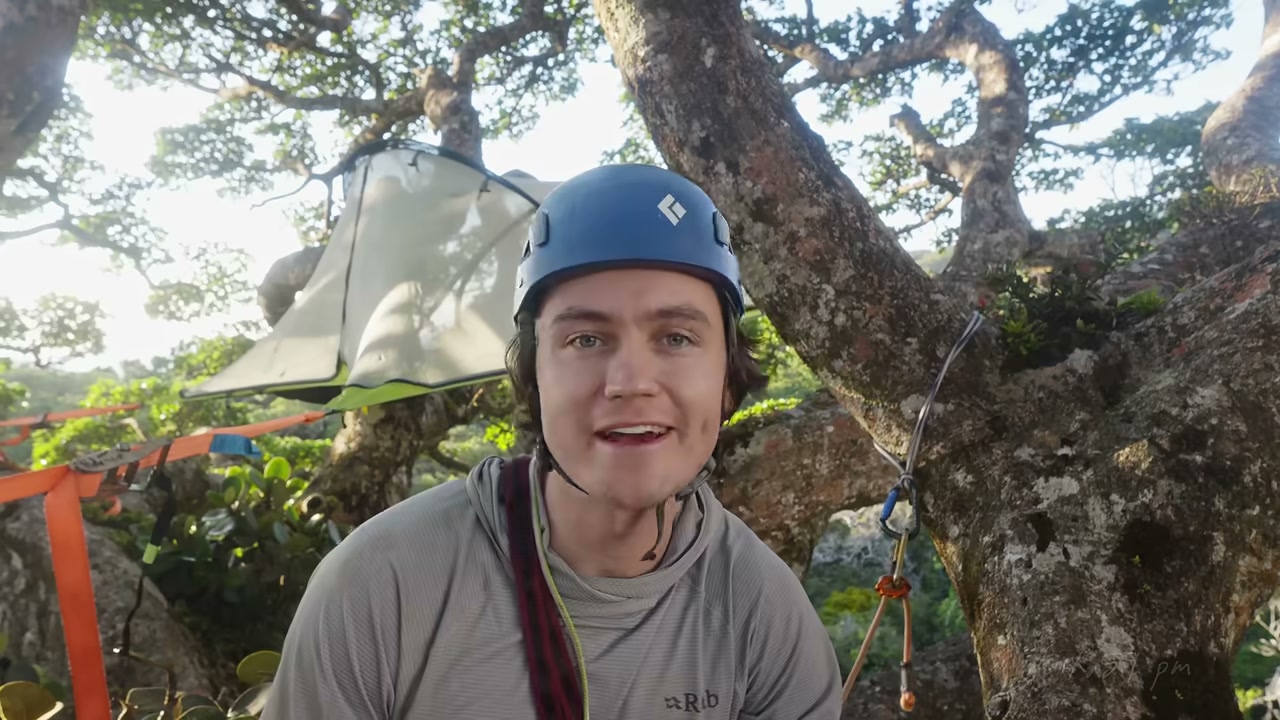
The person responsible for the feat is Noah Kane, a content creator who grew up in contact with the nature of Costa Rica. He became known for climbing huge trees and is considered one of the pioneers of fig tree climbing in the country’s cloud forest.
The story of this climb began with a sighting. From afar, on the other side of a valley, Noah Kane spotted a colossal strangler fig standing out above the forest, and became obsessed with the idea of climbing to the canopy of that giant of nature.
Before tackling the strangler fig, he did his homework. Noah Kane confirmed the tree through satellite and drone images, studied the best climbing route, and only then returned with all the equipment to climb alone to the canopy, in the middle of the cloud forest of Costa Rica.
What drives him is neither money nor sponsorship. According to Noah Kane himself, he tackled the strangler fig out of pure passion for climbing and nature, the kind of motivation that turns climbing a tree into an almost spiritual experience in Costa Rica.
How he climbed alone, only with a rope, a face without supports
The most impressive part is that Noah Kane climbed entirely alone. In solo climbing, he set up his own safety system, anchoring at the base of the strangler fig and using equipment that protected him in case he slipped during the ascent to the canopy.
The technique resembles rock climbing. Instead of driving nails into the tree, he placed protections in the cracks of the strangler fig trunk, advancing slowly and ensuring his own safety with each movement, in a slow and careful journey towards the canopy, surrounded by the nature of Costa Rica.
Not everything went as planned. At one point, Noah Kane realized that part of the wood was fragile and “rotten,” and even abandoned a first climbing route, choosing another safer path to continue climbing the strangler fig towards the top.
The chosen face had few supports. There were sections where he was far from the last protection, with no margin for error, which requires a lot of calm and climbing experience to overcome such a smooth trunk of the strangler fig in the heart of Costa Rica’s nature.
After reaching the canopy, another stage began. Noah Kane fixed the rope, returned to the ground, and hoisted the backpacks with a pulley system, gradually bringing all the camping equipment to the top of the strangler fig, in a process that shows how much tree climbing requires planning and patience.
What is a strangler fig and why does it “strangle” another tree
Behind the curious name lies fascinating biology. The strangler fig belongs to the group of fig trees, and its life begins in a different way from most plants: at the top of the canopy of another tree, not on the forest floor.
It all starts with a seed up there. Carried by birds or monkeys, the seed of the strangler fig germinates on the branches of a host tree, taking advantage of the moisture and nutrients that accumulate in the canopy, right in the middle of Costa Rica’s nature.
Then, it sends roots towards the ground. The strangler fig sends aerial roots down the host tree until they reach the soil, and when they get there, these roots thicken and intertwine, forming a lattice-like trunk that envelops the original plant, which gives rise to the nickname “strangler fig.”
But there is an important caveat. Despite the frightening name, evidence indicates that the strangler fig does not necessarily accelerate the death of the host tree; often it just uses it as support to grow, in an arrangement that is part of the natural balance of nature.
The result is a unique trunk in the world. What remains is a hollow cylinder of fused roots and stems, so dense and resistant that it can support the weight of a climber, making the strangler fig one of the favorite targets for those who practice tree climbing in search of adventure in Costa Rica.
The tent suspended in the canopy, more than 20 meters above the ground
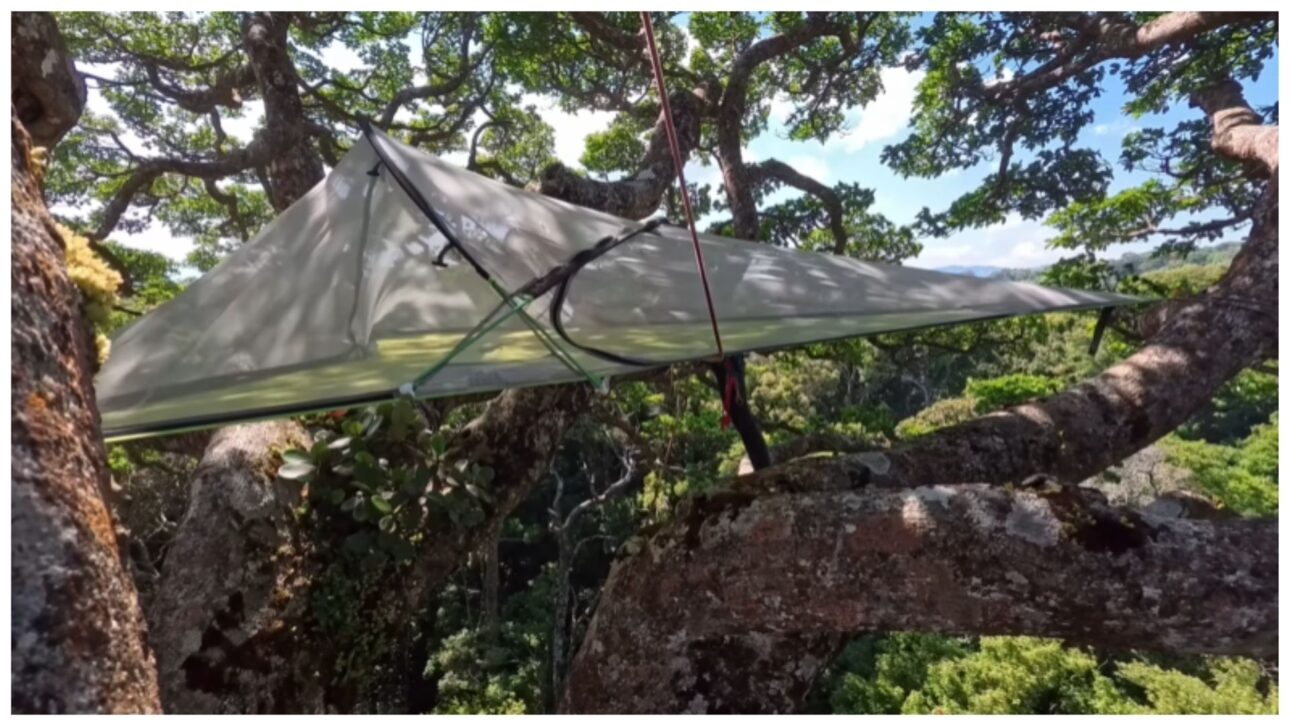
Reaching the top was only half the challenge. Up there, in the canopy of the strangler fig, Noah Kane had to set up a suspended camp to spend the night, more than 20 meters high, surrounded only by the silent nature of Costa Rica’s cloud forest.
The star of the camp was a tree tent. Triangular in shape, it is anchored at three points, and Noah Kane fixed it on chosen branches in a more open part of the canopy, creating a kind of floating room in the middle of the strangler fig.
Every detail was thought for the height. He organized a corner to sleep and another to store equipment, all secured with ropes, so that nothing would fall from the canopy during the night, a typical care of someone who masters climbing and respects the dangers of nature.
Sleeping there required heightened security. Even inside the tent, Noah Kane kept the climbing gear connected to an anchor point as a backup, ensuring that if the structure gave way during sleep, he would remain attached to the strangler fig and not fall from the canopy.
The reward came at dusk. From the top of the strangler fig, he dined watching the sunset over the forest and claimed to have had one of the best nights of his life in trees, a moment of total connection with nature that sums up the charm of climbing in Costa Rica.
Costa Rica, Monteverde and the cloud forest of the giant
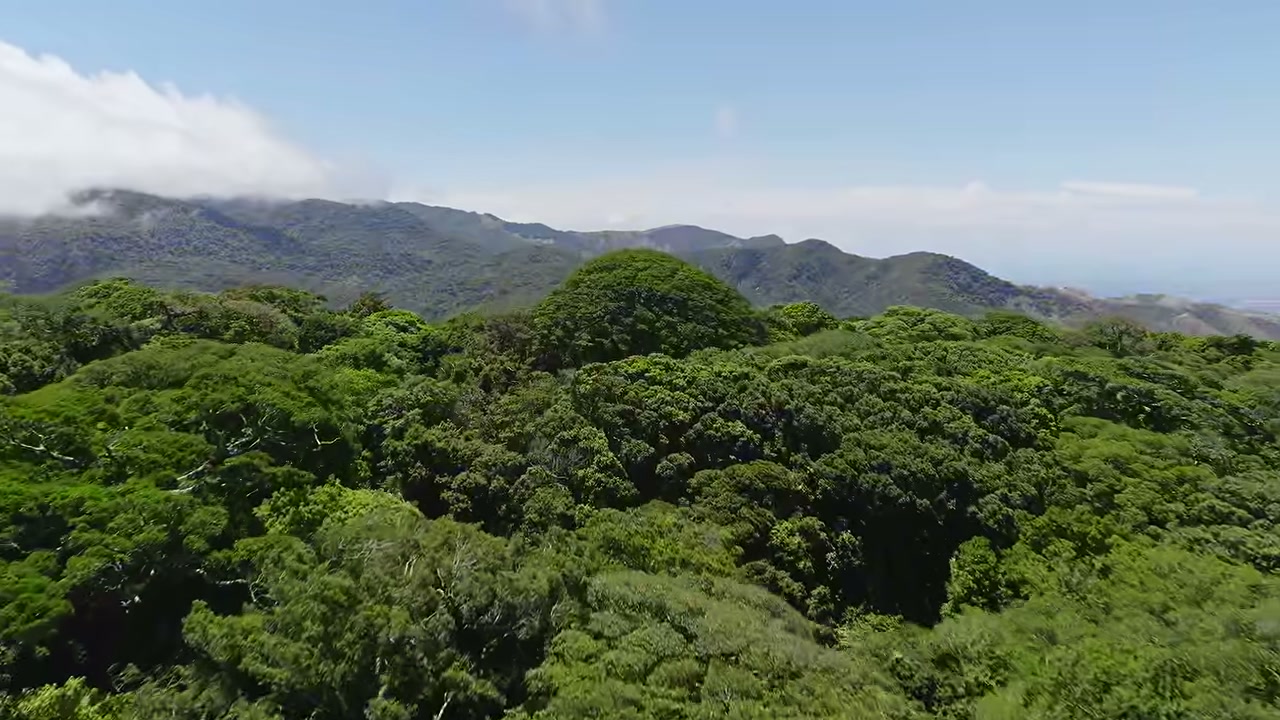
The setting of the adventure is one of the richest on the planet. The strangler fig climbed by Noah Kane is in a cloud forest in Costa Rica, in the Monteverde region, a place famous for its biodiversity and preserved nature.
Clues to the location appear in the video itself. Noah Kane mentions being in the mountains of Costa Rica and cites points in the San Luis region, which helps to locate the strangler fig in that area of cloud forest, although he does not reveal the exact location to protect the tree.
Keeping the address secret is intentional. Disclosing the exact location of the strangler fig could attract curiosity seekers and put the tree at risk, so hiding the coordinates is a way to preserve both the giant and the surrounding nature in Costa Rica.
The cloud forest is the perfect habitat for these trees. The humid climate and constant clouds favor the growth of enormous figs, and that’s why climbing a strangler fig of this size is possible right there, in the green heart of Costa Rica.
It was in this environment that Noah Kane’s passion was born. According to him, tree climbing began in that region years ago, making the cloud forest of Costa Rica not only the stage for this adventure but the birthplace of his entire relationship with nature and the canopy of giant figs.
Climbing without harm: the ethics behind the adventure
One detail sets this climb apart from so many others: respect for the tree. Before climbing, Noah Kane asked permission from the landowner where the strangler fig was located, in a gesture that shows concern for not invading or harming the nature of Costa Rica.
The care continues in the technique. According to the report about his group, these climbers usually climb barefoot and avoid nails or pieces that could harm the trunk, precisely to preserve the strangler fig and allow the climb to happen without leaving marks on the canopy.
There is also respect for the animals. During the climb, Noah Kane speaks loudly the entire time to alert the animals of his arrival, as he does not know which creatures live in the strangler fig, in a gesture of coexistence with nature that avoids scares for both sides in Costa Rica.
This attitude turns the adventure into an example. More than a climbing feat, the ascent of the strangler fig becomes a lesson on how humans can explore nature with respect, enjoying the canopy of trees without destroying them in the process.
In the end, the tree is the true star. The entire climb exists to highlight the strangler fig and showcase its grandeur, not to display bravery, which brings the audience closer to the beauty of nature and inspires the desire to protect giants like this in Costa Rica.
Are there strangler figs in Brazil?
Anyone watching the video soon wonders if this type of tree exists here. The answer is yes: the strangler fig is part of the Brazilian flora and can be found in practically all biomes of the country, from the Amazon to the Atlantic Forest.
Brazilians have probably seen one without knowing it. In squares, roadsides, and forests, it is common to find a strangler fig embracing the trunk of another tree, with that visual of intertwined roots that impresses anyone who pays attention to the nature around.
The size is also comparable. In Brazil, adult specimens of strangler fig reach 15 or 30 meters in height, in the same order of magnitude as the giant climbed by Noah Kane in Costa Rica, which shows that we have trees worthy of climbing here.
These figs have an important ecological role. The strangler fig provides shelter and food for various animals and is a key piece in many Brazilian ecosystems, reinforcing why it is worthwhile to know and preserve these giants of nature that grow so close to us.
What this climb in Costa Rica has to do with Brazil
Noah Kane’s adventure speaks directly to the Brazilian audience. Besides having strangler fig trees all over the country, Brazil has an exuberant nature that could inspire more people to practice tree climbing in a safe and responsible way.
There is enormous tourism potential. Just as Costa Rica has turned its cloud forest into an attraction, Brazil could value its giant trees and its canopy rich in life, creating nature experiences that combine adventure and environmental education around the strangler fig.
The case also reinforces the importance of preservation. Seeing someone respectfully climb a strangler fig in Costa Rica reminds us how much we need to protect our own giant trees, often threatened by deforestation, so that Brazilian nature remains standing.
Finally, it serves as inspiration to look at trees with new eyes. Noah Kane’s climbing shows that a simple strangler fig can be a world apart, full of life in the canopy, and that Brazil’s nature holds similar giants waiting to be admired and cared for.


Noah Kane’s adventure proves that a tree can be the stage for quite a feat. By climbing alone a strangler fig over 20 meters tall in Costa Rica and sleeping in the canopy, he combined climbing technique, courage, and a deep respect for nature.
More than the feat, the lesson about the tree remained. Understanding how the strangler fig grows by strangling another plant and forms a trunk capable of supporting a human being is to rediscover nature in a way that few imagine, even having one of these giants near home.
And you, would you have the courage to face the climbing of a strangler fig and sleep in the canopy, more than 20 meters above the ground, in the middle of nature? Tell us in the comments if you would take on this adventure and share it with that friend who loves trees and outdoor life.