






 Portuguese
  Spanish


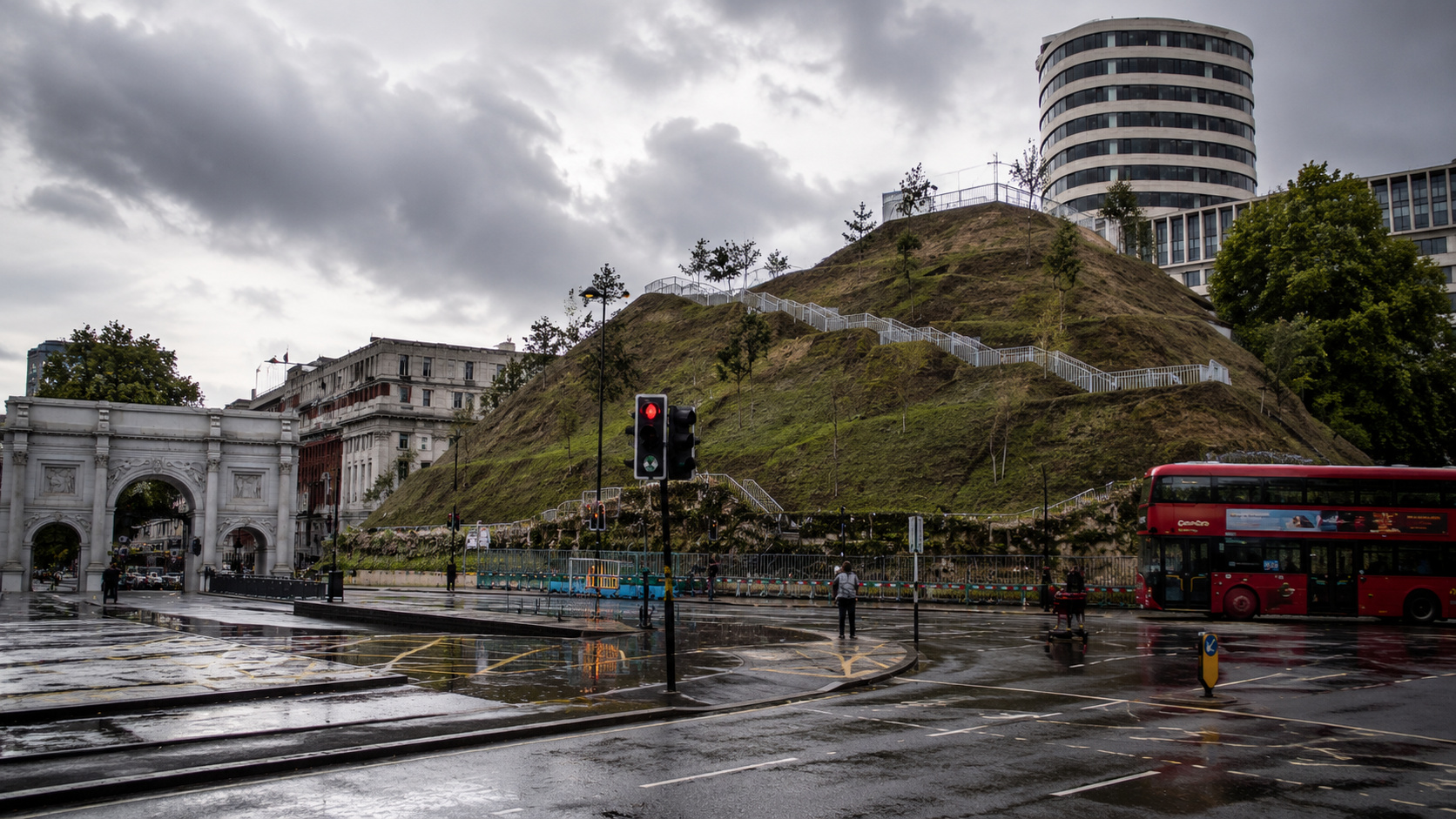

The temporary attraction created to recover visitors after the pandemic promised views of Hyde Park, greenery, and activity in the West End, but the Marble Arch Mound became a meme, led to refunds, exposed public waste, and joined the list of London’s biggest recent urban fiascos
The Marble Arch Mound was created in London to attract tourists back to the West End, but the artificial hill opened with an unfinished appearance and quickly became a national joke.
The investigation was published by The Guardian, a British newspaper. The case involved a cost of about 6 million pounds, public refunds, and the resignation of the local council’s deputy leader after the crisis.
The proposal seemed simple and appealing. A temporary hill, covered with greenery, with views of Hyde Park and the power to boost an important tourist area. However, the public found small trees, sparse plants, and a landscape far from what was promised.
-
Award-Winning Japanese Restaurant Reveals It Has Preserved Part of the Same Frying Oil for 66 Years

-
American Youth Transforms from Severe Obesity to U.S. Air Force Enlistment, Losing 90 Kilograms in Two Years
-
11-Year-Old Entrepreneur Sells 60 Homemade Sweets Daily, Mastering Cost Calculation, Social Media Promotion, and Client Negotiation Since Age 7

-
Peruvian Mountain’s 5,200 Aligned Holes May Unveil Ancient Indigenous Market for Corn and Cotton


The artificial hill in London was born to revive tourism in the West End
The project emerged at a time of attempted recovery after the pandemic. The West End needed to welcome visitors again, boost commerce, and reinforce London’s image as a tourist destination.


The idea was to create a temporary attraction with visual appeal. The artificial hill was supposed to offer a new urban experience, with greenery and views of one of the city’s most well-known areas.
In practice, the opening revealed a fragile scenario. What was supposed to look like a green and modern attraction ended up being seen as a structure with an incomplete construction appearance.
The Marble Arch Mound promised views of Hyde Park, but delivered frustration
The view of Hyde Park was one of the project’s main promises. The expectation was that visitors would find an interesting landscape, capable of justifying the visit and the attraction’s promotion.
The result was quite different. Many visitors complained about the experience, the appearance of the site, and the sparse vegetation. The artificial hill seemed less impactful than in the images used to sell the idea.
This contrast became the central point of public shame. The Marble Arch Mound came to symbolize a common situation in poorly received projects: beautiful image in promotion, disappointing delivery in real life.
The Guardian, British newspaper, recorded the cost of about 6 million pounds and the resignation after the crisis
The Guardian, a British newspaper, reported the figures and political effects of the case. The cost reached about 6 million pounds, while negative reactions grew shortly after the opening.
The attraction temporarily closed and began offering refunds. This reaction showed that visitor frustration was not limited to social media, as it directly impacted the project’s operation.
The wear and tear also reached local politics. The local council’s deputy leader, Melvyn Caplan, resigned after the crisis, which turned the artificial hill into a bigger problem than a poorly finished attraction.
The artificial hill became a meme because it looked like a tourist promise gone wrong
The case gained traction because it had all the elements of an absurd story. A fake mountain was created to attract tourists, but ended up attracting criticism, memes, and public demands.
The joke spread because the difference between the proposal and the delivery was easy to understand. The public expected a green, beautiful, and well-planned attraction. What they found was a temporary structure with sparse plants and an unfinished appearance.
Therefore, the Marble Arch Mound came to be remembered as a symbol of waste. The phrase summarizing the case became clear to many: beautiful rendering, sad reality.
Public waste weighed more than the attraction’s appearance itself
The appearance of the place attracted attention, but the cost increased the size of the crisis. A project of about £6 million needed to deliver more than visual curiosity.
When the attraction became a joke in a few days, the criticism changed tone. The discussion was no longer just about aesthetics and began to involve the use of public money, planning, and responsibility.
The resignation of Melvyn Caplan reinforced this interpretation. The artificial mountain went from a tourist bet to an example of how a temporary work can generate real wear and tear for public managers.
Dismantling marked the end of an attraction that became famous for the wrong reason
The Marble Arch Mound was temporary and was eventually dismantled. Nevertheless, the mark left by the project remained strong, as the case became a reference when talking about expensive work, exaggerated promises, and frustrating delivery.

The attraction was created to bring movement to the West End, but ended up associated with refunds, political crisis, and public embarrassment. The goal was to attract visitors. The result was to draw global attention to a planning error.
The story shows that a work does not only fail when it collapses or stops working. It also fails when the public understands that the delivery does not match the cost, the propaganda, and the expectation created.
The Marble Arch Mound, an artificial mountain, entered the list of London’s most curious urban cases because it combined tourism, public money, memes, and political crisis in a few days. A scenic hill turned into an avalanche of public shame.
The episode also leaves an uncomfortable question: when a city bets millions on an attraction to revive tourism, is the biggest problem the work turning out ugly, or the public authority insisting on selling a promise it cannot deliver? Comment your opinion and share this story with those who enjoy real-life cases where a great idea turned into a great embarrassment.


