Portuguese
  Spanish


During An Avalanche, Bright Blue Lights Mysteriously Appeared On The Mountain, Leaving Witnesses Perplexed And Scientists With No Clear Answers To Explain The Disturbing Phenomenon.
Recently, astrophotographer Shengyu Li positioned his camera to capture the stars on Mount Xiannairi, in Sichuan province, China. However, he captured something very rare and spectacular. An unexpected avalanche occurred in front of his lens, and as tons of ice descended the mountain, mysterious flashes of blue light were recorded in his footage.
The astrophotographer, who was at a safe distance, described the event as “exciting and intriguing.”
The phenomenon was not visible to the naked eye, but the camera’s records revealed a rare spectacle. The scene left scientists and enthusiasts perplexed, raising hypotheses about what could have caused the strange flashes of light.
-
Former Merchant Marine Captain Invents Fuel-Free Barrier, Removes 20,000 Tons of Trash from Chennai Rivers

-
14-Year-Old Maxim Harris Turns School Project into Anti-Rage Gaming Accessory, Sells 1,000 Units Across 46 U.S. States, Donates 20% of Profits to Charity
-
Brazilian Health Agency Approves First Oral Medication for Cancer Patients
-
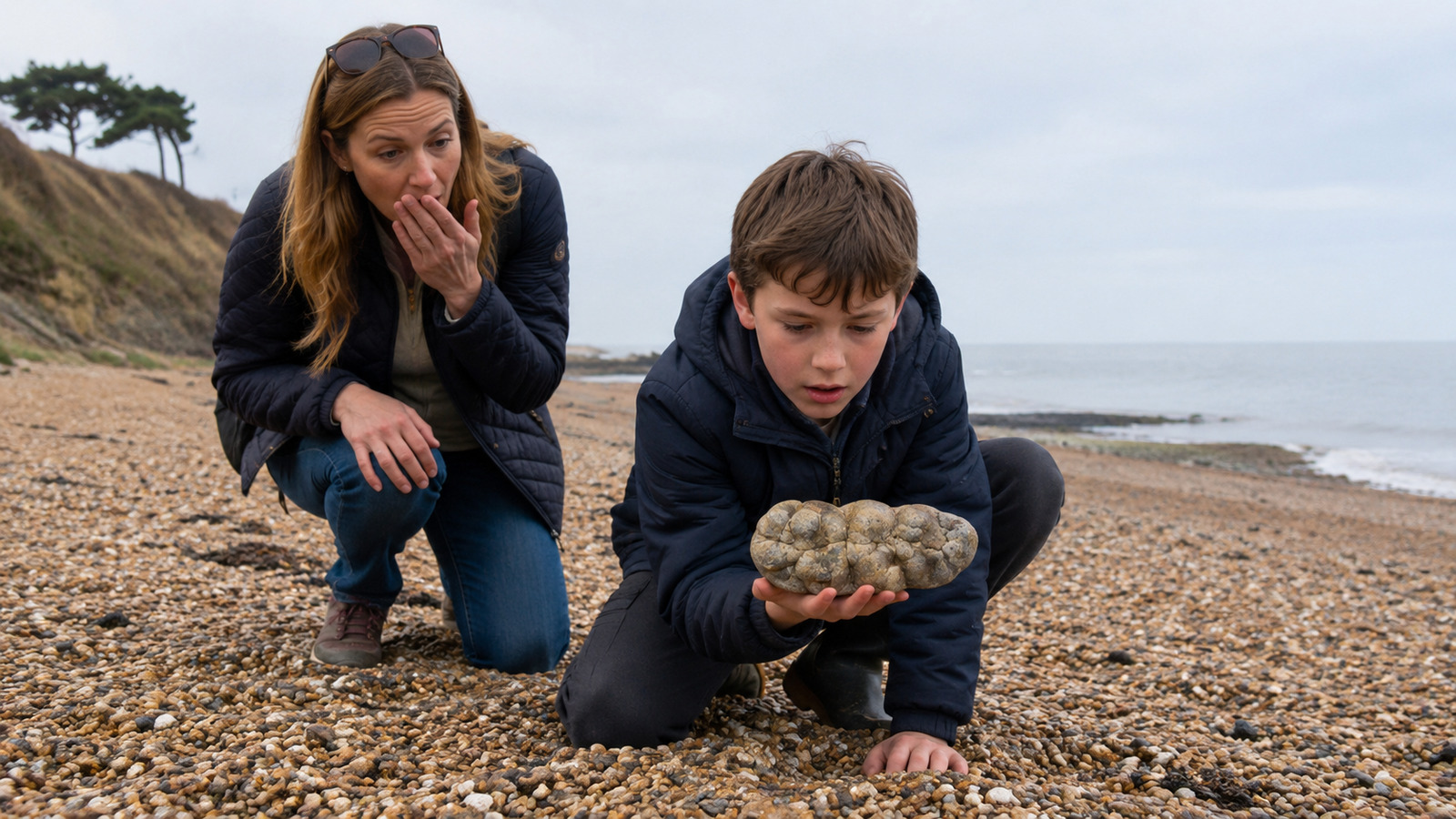
11-Year-Old Boy and His Mother Discover 1.8-Million-Year-Old Elephant Tooth on English Beach Eroded by the Sea





The Science Behind The Light On The Mountain
The main theory points to triboluminescence, a phenomenon where certain materials emit light when crushed, scratched, or fractured.
According to mountaineer Carson Reid, who analyzed the images, the flashes were concentrated at points where the ice collided with the mountain. “The serac fractured upon hitting natural obstacles, creating conditions for triboluminescence,” Reid explained.
Triboluminescence is not something entirely new to science.
The appearance is documented in crystals like sugar, which emits small flashes of blue light when crushed in the dark.
However, its manifestation on a large scale, involving massive ice structures, is unprecedented.
Flashes Visible Only In The Footage
Li’s footage is not an isolated case. Three weeks earlier, astrophotographer Lu Miao captured similar flashes during another avalanche, this time on Muztagh Ata, a mountain in the Xinjiang region of China.
Once again, the manifestations were detected only after analyzing the time-lapse images.
These observations suggest that we are just beginning to understand how triboluminescence may occur in extreme natural environments. So far, scientists have only documented the characteristics of laboratory conditions, making Li’s discovery even more remarkable.
A Challenging Physical Enigma
Triboluminescence occurs due to the breaking of chemical bonds or the surface separation of surfaces, generating electric charges that ionize the air or excite the material, resulting in light emissions. However, the exact details of the process remain poorly understood.
Science communicator Erika, in a post on X, explained: “The exact cause of triboluminescence is still a mystery. It is generally related to charge separation and rapid recombination that creates bursts of light. In avalanches, the friction and shocks between ice blocks appear to be the triggers for the observed flashes.”
Renowned physicist Richard Feynman criticized and explained that he did not promote practical experimentation. In a lecture in Brazil, he illustrated how a concept like triboluminescence could be better understood with tangible examples: “If you crush a sugar cube in the dark, you will see a blue flash. No one knows exactly why this happens, but that is the result.”
The Next Step For Science
Based on recent evidence, scientists are more inclined to explore triboluminescence in natural conditions. Observing phenomena like the flashes captured by Li and Miao could open new doors for the research of physical interactions in extreme environments.
For now, the blue flashes in avalanches remain an enigma. However, events like this reinforce the importance of scientific curiosity and careful recording of nature in action.
As new footage emerges, it may be good to finally fully unravel the secret of these mysterious lights that illuminate the ice.