Portuguese
  Spanish


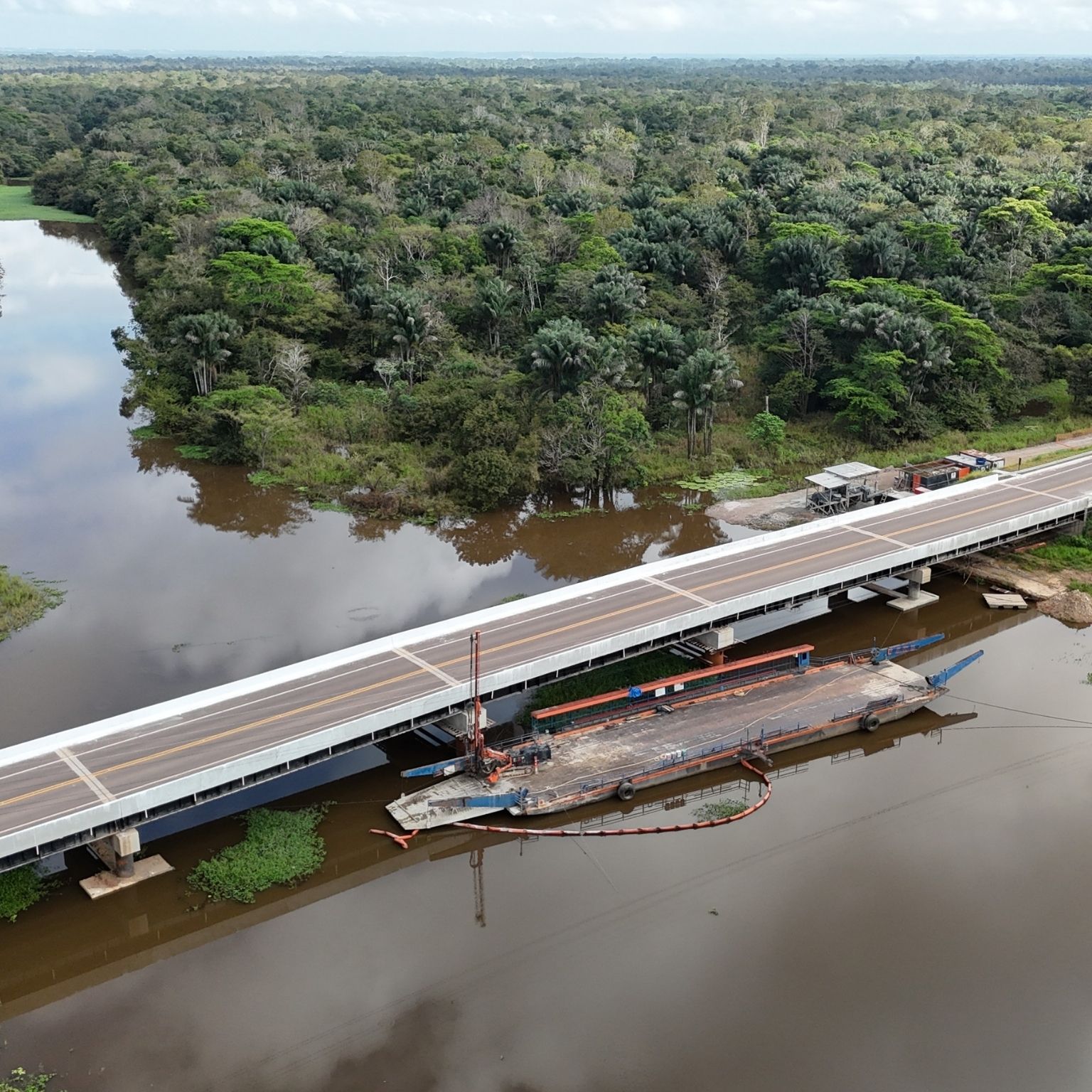

On BR-319, the bridge over the Altas Mirim river enters its final phase with load testing on Thursday and Friday and a promise of traffic liberation on Monday, the 27th, to end the ferry and kilometer-long queues.
DNIT will conduct a two-day load test on the bridge over the Altas Mirim river, at km 24 of BR-319, as the final safety step before traffic is released. The tests, according to the department itself, will be divided between Thursday and Friday, preparing the structure for vehicle flow to be released on Monday, the 27th.
The reopening is treated as an awaited moment because it changes the dynamics of traffic in the region, especially for those who depend on the stretch daily. Today, the crossing on BR-319 happens in an improvised way, with access via gravel, mud, and a bit of concrete structures leading to a ferry on the Altas Mirim river, which becomes a frequent bottleneck, especially for heavy vehicles.
BR-319: why the liberation of the bridge at km 24 is so awaited
BR-319 concentrates an intense flow of vehicles linked to supply, with constant traffic throughout the day and night. The liberation of the bridge at km 24 is seen as a relief for transport drivers and residents of the region, who need to travel for daily activities, such as taking children to school and seeking supplies.
-
Brazilian Fishing Couple Spends 4 Years Building Solar-Powered Floating Home on the Paraguay River, Now a Navy-Approved Vessel with Leisure Area and Tour Demand

-
While the World Opens New Airports and High-Speed Trains, Brazil Rushes to Complete Projects Stalled for 40 Years
-
Brazil Invests in Massive Waterway to Transport Soybeans by Barge, Reducing Costly Truck Reliance
-
Bridge Rebuilt in Just One Year Reconnects Two Brazilian States


In addition to the direct impact on routine, normalization is expected because the stretch has not operated stably since 2022, when the previous bridge collapsed. There were no fatalities, because the structure had already been interdicted by the Federal Highway Police and DNIT itself, but the collapse generated a sequence of problems for those who need to cross the river.
What is a load test and why does it happen over two days

The load test is the final test to verify if the bridge safely supports the predicted flow, especially of heavy vehicles. DNIT informed that the tests will be carried out over two days, on Thursday and Friday, as part of the last stages before the full release of traffic.
In practice, the idea is to close the safety cycle and confirm that the passage is ready to return to normality. The bridge should only be released for all vehicles after this check, with the expectation of liberation on Monday, the 27th.
The numbers of the new bridge: 244.6 meters long and 11 meters wide
The new bridge over the Altas Mirim river is 244.6 meters long and approximately 11 meters wide. The highlighted information in the update is that the structure was built to support the load of heavy vehicles circulating on BR-319, responding to a practical demand that worsened with the current provisional system.
With these dimensions, the expectation is for a more direct and predictable crossing, reducing the interruptions that currently block traffic and generate congestion.
How the crossing works today: gravel, mud, concrete, and a ferry on the Altas Mirim river
Currently, vehicle passage occurs via an improvised arrangement. Types of bridges were made with gravel, mud, and a bit of concrete leading to a ferry, which supports the longest part of the crossing on the Altas Mirim river.
The problem is that, every now and then, the gravel material gives way due to excessive weight. When this happens, the consequence is immediate: kilometer-long queues of vehicles prevented from passing, extending crossing time and making travel a test of patience.
What changes in practice: end of the ferry, fewer queues, and more predictable traffic on BR-319


With the bridge open, the expectation is to end dependence on the ferry and reduce the risk of blockages caused by gravel subsidence. For drivers, especially those transporting cargo, the gain is predictability: fewer unexpected stops, less time lost, and fewer traffic jams on the stretch.
For residents of the region, the opening promises to ease the hardship described by those who live the routine of BR-319’s km 24, where any interruption affects travel, shopping, and access to services.
Why this is important: impact on supply and even product prices
The report points out that the situation since 2022 has become a headache for drivers and affected logistics, including repercussions on the cost of some products, as increased crossing time interferes with supply.
With traffic normalized, the trend is to reduce this ripple effect caused by delays and blockages, especially in a stretch where the transport flow is described as intense and essential for supply.
A wait since 2022: the bridge collapse and the sequence of disruptions

The problem has dragged on since 2022, when the previous bridge collapsed after already being interdited. Since then, the region has lived with improvisations, queues, and uncertainty, in a scenario that worsens when there is more traffic difficulty and when the crossing becomes a bottleneck.
Therefore, the release date on Monday, the 27th, is treated as desired and symbolic, representing the resumption of a normality that has not been consolidated since the collapse of the old structure.
The next steps: testing on Thursday and Friday, and release on Monday, the 27th
The presented schedule is straightforward: first, the load test over two days, on Thursday and Friday. Then, with the final safety steps concluded, traffic on the Altas Mirim river bridge, at km 24 of BR-319, is expected to be released on Monday, the 27th.
If you travel on BR-319 or depend on this stretch for work and commuting, do you think the bridge’s opening will truly end the queues and the daily ferry struggle?