






 Portuguese
  Spanish
  4 min of reading
  1 comment


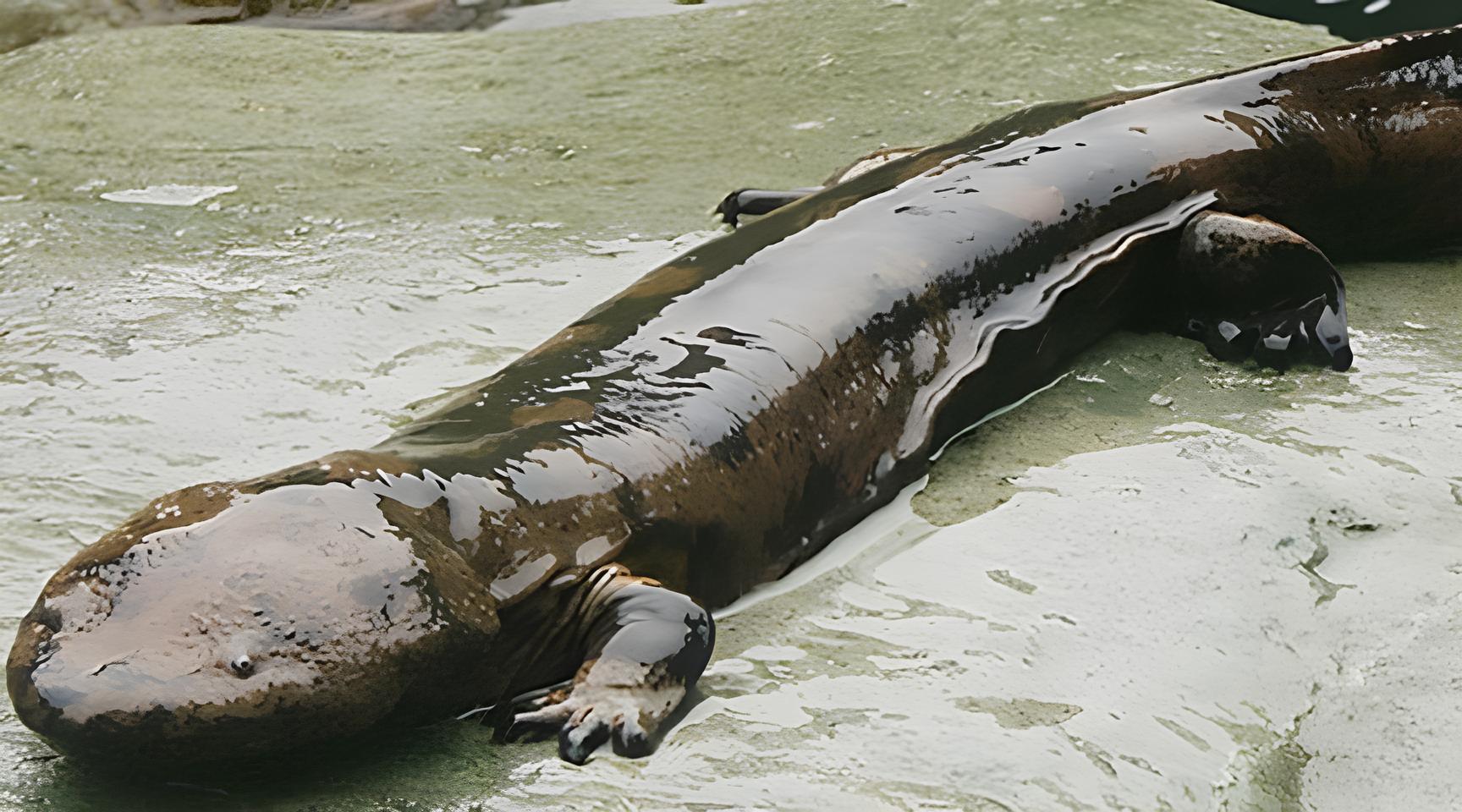


Largest Living Amphibian in the World, the Chinese Giant Salamander Can Exceed 1.8 Meters, Weigh More Than 60 Kg and Represents a Living Lineage with Millions of Years of Evolution.
Among the most impressive living animals on the planet, few cause as much astonishment as the Chinese giant salamander (Andrias davidianus). With a prehistoric appearance, flattened body, wrinkled skin, and slow movements, it holds an absolute title: it is the largest living amphibian in the world, surpassing in size any frog, toad, or salamander documented today.
More than a biological record, the species is considered a true “living fossil”, a survivor of a lineage that predates modern dinosaurs and has traversed millions of years practically without structural changes.
The Size That Redefines What Is Understood by Amphibian
The largest recorded specimens of the Chinese giant salamander exceed 1.8 meters in length and can weigh more than 60 kilograms, dimensions comparable to those of an average adult human. Historical and scientific records report exceptionally large individuals captured in the early 20th century, solidifying the species as the largest known amphibian still alive.
-
At 10 years old, a prodigy boy who claims to have learned to read as a baby is already explaining how the brain works to over a million followers and left the famous Dr. Sanjay Gupta speechless.

-
Hidden in a secret laboratory in Tokyo for over 25 years, an impossible lens made of 2,500 microlenses that saw like insect eyes promised to blow the minds of those watching TV.
-
NASA separated two identical twin brothers for 340 days and turned one of them into a human laboratory in space: the experiment revealed changes in genes, immune system, microbiome, and cognition, as well as a surprising “rejuvenation” effect that exposed the impact of living away from Earth.

-
China and Japan create a brain implant thinner than a hair, with 128 channels and data density ten times greater than any previous hydrogel, which operated for 550 days in rabbits without causing inflammation or scarring.




Unlike extinct animals, such as large amphibians from the Permian period, Andrias davidianus is still alive, making its gigantism even more extraordinary.
A Body Shaped for Aquatic Life
The anatomy of the Chinese giant salamander completely deviates from the standard popularly associated with amphibians. Its body is dorsoventrally flattened, with a broad head, small eyes, and short limbs, adapted for slow movement in rivers and streams with moderate currents.
The wrinkled skin is not just an aesthetic feature. It increases the body surface area and allows for cutaneous respiration, essential for an animal that spends practically its entire life submerged. Even though it is an amphibian, the use of lungs is secondary—the majority of gas exchange occurs directly through the skin.
A Silent Predator of Mountain Rivers
Despite its almost harmless appearance, the Chinese giant salamander is an efficient predator. It feeds on fish, crustaceans, aquatic insects, and even small vertebrates, using an ambush strategy.
With quick movements and an extremely wide mouth, the animal creates a suction effect that pulls prey inside. This method is highly effective in murky and cold waters, where visibility is limited.

Evolutively speaking, the Chinese giant salamander belongs to a lineage that has existed for over 170 million years. This means that its ancestors already inhabited Asian rivers when dinosaurs dominated the continents.
Few current species present such evolutionary continuity. For this reason, scientists classify the giant salamander as a living fossil, essential for understanding the evolution of amphibians and the transition between aquatic and terrestrial environments.
Restricted Distribution and Specific Habitat
The species is native to China, where it inhabits mountain rivers and streams with cold, well-oxygenated waters and rocky bottoms. This is an extremely specific environment, which makes the salamander highly sensitive to environmental changes.
Any change in water quality, river flow, or temperature directly affects its survival.
The Paradox of Gigantism: Size Does Not Guarantee Protection
Despite its colossal size, the Chinese giant salamander faces an alarming scenario. The species is critically endangered. Habitat destruction, river pollution, and, especially, hunting for consumption and use in traditional Chinese medicine have drastically reduced its natural populations.
Ironically, the impressive size that should guarantee an evolutionary advantage has made the animal an even more valuable target over time.
The Largest Living Amphibian, But For a Little Time?
Today, the Chinese giant salamander remains the largest living amphibian on the planet. However, biologists warn that without consistent conservation efforts, this title may disappear not due to being surpassed, but because of extinction.


Captive breeding programs exist, but successful reintroduction into the wild still faces enormous challenges, especially due to genetic fragmentation and the loss of original habitats.
The Chinese giant salamander not only impresses by its size. It symbolizes the resilience of life throughout geological eras, a reminder that some creatures have survived climate changes, mass extinctions, and planetary transformations, but may not withstand modern human actions.
Preserving this animal is more than saving a species. It is protecting a living fragment of Earth’s history.







Well done! Yet another victim to the selfishness of humankind.