






 Portuguese
  Spanish


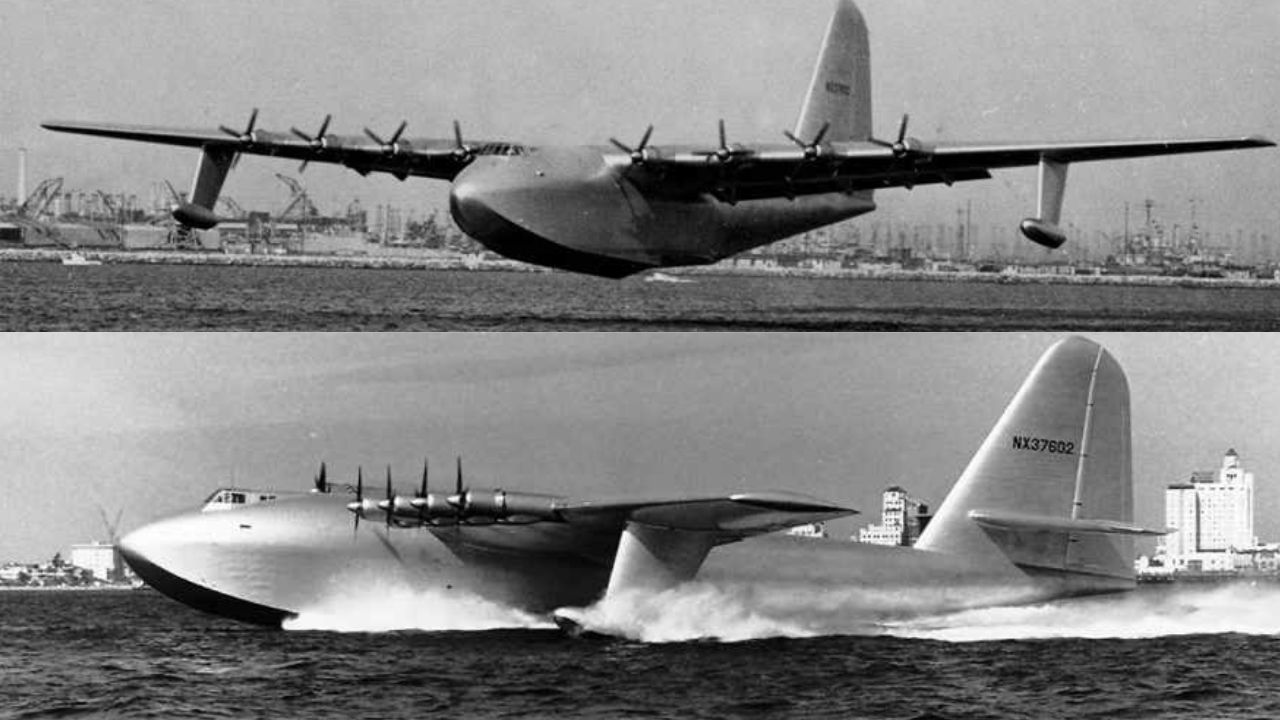


The Largest Wooden Airplane In History Was Created In The Middle Of World War II To Solve A Real And Brutal Problem: Transporting Troops And Cargo Across The Atlantic Without Becoming An Easy Target For Submarines. The Solution Seemed Impossible, But It Took Shape In The Gigantic H4 Hercules, The Famous Spruce Goose.
However, the promise of crossing oceans with tanks and hundreds of soldiers ran into delays, political pressure, and an unlikely fate. In the end, the largest wooden airplane in history flew just once for seconds, but that was enough to enter the imagination of world aviation.
The War That Pushed The Boldest Aviation Idea
During World War II, the Atlantic became a silent battlefield, with submarines sinking Allied ships and threatening the logistics of the United States heading to Europe.
The proposal was to build a “flying boat” so large that it would cross the ocean carrying cargo all at once, without relying on airports capable of accommodating such a large airplane.
-
Lenovo Unveils Legion Y700 Tablet with RGB Backlighting, 5G, and SIM Card Support
-
Lenovo Unveils Legion Y700 Tablet with RGB Backlighting, 5G, and SIM Card Support
-
Northern Brazilian City Prepares Task Force to Mitigate El Niño Impacts with Stockpiled Fish, Drone Monitoring, Firefighting, and Water Supply Reinforcement in Remote Areas

-
Brazil to Issue “Panda Bonds” in China, Aiming to Raise Up to 5 Billion Yuan at Lower Interest Rates Than Dollar Debt

The ambition was straightforward: to transport something in the range of several tens of tons, with estimated space for hundreds of soldiers and even heavy vehicles, using the water as a natural runway. It was a project designed to overcome the risks of the sea with sheer size.
Kaiser And Howard Hughes: The Duo Behind The HK 1


In 1942, Henry Kaiser, a shipbuilding magnate known for Liberty ships, partnered with engineer and visionary Howard Hughes to develop the HK 1 project, an acronym combining the initials of both. The mission was to create a colossal seaplane capable of carrying unprecedented cargo.
The partnership, however, was not smooth. Hughes was obsessed with perfection and delays mounted, straining the relationship and leading Kaiser to abandon the project. Hughes forged ahead alone and renamed the aircraft the H4 Hercules, consolidating the personal and almost “authorial” character of the airplane.
Why It Was Made Of Wood And What Was The Duramold Technique
The wartime context imposed a decisive obstacle: restrictions on the use of strategic materials like aluminum. To get around this, the project embraced an unusual engineering solution: building the aircraft almost entirely of wood using the Duramold technique.
The idea was to bond very thin layers of wood with resin, under heat and pressure, creating a lightweight, strong, and extremely complex structure. The “wooden airplane” was not a makeshift solution: it was advanced technology for the time, applied on a monumental scale.
A Giant Outside The Standard: Dimensions And Power That Terrified
The H4 Hercules was born to be enormous. The wingspan reached nearly 98 meters, making it larger than many airplanes that would come decades later in terms of wingspan.
The height was about 24 meters, and the length was around 66 meters, figures that placed the project almost beyond belief for the 1940s.
To lift that weight off the water, eight Pratt & Whitney R 4360 Wasp Major engines were chosen, each with 28 cylinders, generating about 3,000 HP per engine. Combined, they produced approximately 24,000 HP to overcome the drag of the water during takeoff. It was brute force applied with aeronautical precision.
The Original Plan: To Cross Oceans On Logistical Mission
The planning envisioned the H4 Hercules reaching a cruising speed of about 400 km/h, an approximate range of 4,800 km, and an operational ceiling around 20,900 feet.
The logic was simple: there were no airports ready for an airplane of that weight, so the sea would serve as the runway, and the aircraft would be the air bridge.
However, time did not wait. The war ended before the airplane was completed, and the project began to be questioned as public spending on something that had yet to fly. The military urgency became a political demand.
The Public Trial And Hughes’ Promise
With the end of the war, criticism increased and the case reached the American Senate. Howard Hughes was called to testify and put his own reputation on the line, claiming he had dedicated everything to the project and that he would prove the aircraft could fly.
The crux was that, at that moment, the H4 Hercules was no longer merely engineering. It had become a symbol: of stubbornness, ambition, and the boundary between genius and excess. And Hughes needed a fact, not an argument.
The 26-Second Flight That Entered History

On November 2, 1947, at the port of Long Beach, thousands of people gathered to witness the tests. Hughes took the controls with co-pilot and crew aboard.
After attempts on the water, he pulled the control yoke, and the impossible happened: the largest wooden airplane in history took off.
The H4 Hercules flew in ground effect, at about 217 km/h, reaching around 21 meters in height, covering about 1.6 km, and staying aloft for approximately 26 seconds.
It may seem brief, but it was enough to prove that the project could indeed fly. It was a short flight, but a long message.
Why It Never Flew Again And Became A Preserved Myth
After that day, the H4 Hercules never flew again. The estimated performance was not confirmed in flight tests, and the airplane remained a promise that stopped halfway.
Even so, Hughes kept the aircraft in a climate-controlled hangar and under constant care, with a dedicated team, preserving the airplane as if it could fly again at any moment. The obsession turned into conservation, and conservation became a legacy.
From Attraction In Long Beach To The Museum In Oregon
In the 1980s, the aircraft was finally exhibited to the public, gaining attraction status. Later, with changes in the complex’s management, a new solution emerged: the Evergreen Aviation and Space Museum in Oregon offered a permanent home.
The transfer, in 1992 and 1993, was a gigantic operation: the aircraft was disassembled, transported by water and then by train and trucks to McMinnville.
The journey took 138 days and covered more than 1,600 km. In 2001, the museum officially opened, and since then, many people have visited the largest wooden airplane in history as a time capsule of human ambition.
In 2024, the H4 Hercules was officially included in the National Register of Historic Places in the United States, reinforcing that its story will be preserved permanently. The airplane flew little, but it has crossed decades.
And now the quick question: if you could go back to 1947 and see the largest wooden airplane in history take off, would you think Hughes proved a real advance or just won a personal bet against the world?







