





 Portuguese
  English
  Spanish
  5 min of reading
  0 comments


Seemingly clean water can carry invisible pesticides and fertilizers near crops, and the AirJernih project draws attention for proposing a cheap filtration for agricultural areas, rural rivers, canals, and communities that depend on local supply sources
The water may look clean in the glass, but still carry pesticides and fertilizers used in agricultural areas. It was this invisible risk that led students from Malaysia to create AirJernih, a cheap filter designed to remove harmful residues from water.
The information was published by The Earth Prize, an environmental competition and idea incubator for young people. The project appears among the 35 teenage teams selected in 2026 with impactful environmental solutions.
The case draws attention because it does not only talk about muddy water or visible dirt. The problem lies in what the human eye cannot see: chemical contamination of water in regions close to crops, canals, rivers, and wells.
-
12-year-old boy who has already published two books creates a project to take young writers from Ceará to the São Paulo Book Biennial and inspire a new generation of authors

-
Two teenagers from Pennsylvania put microalgae in the exhaust of a regular car and create a $50 filter that they claim reduces emissions by more than 74% in tests.
-
While common machines get stuck in wet terrains, young people from Egypt create a fish-inspired robot that crawls through mud to monitor degraded soil and plant seeds in difficult areas.
-
China performs the first simultaneous transplant of two kidneys and a liver from a pig into a single person.


How pesticides and fertilizers can end up in the water used near crops
Pesticides and fertilizers are applied in agricultural areas to protect crops and improve crop growth. The risk begins when part of these products does not remain only in the soil or on the plants.
Rain can carry residues to canals, rivers, streams, and other water sources. In rural areas, this path is concerning because many communities depend on local sources for daily use.
The situation becomes more delicate because contamination does not always change the appearance of the water. Transparent water may continue to look safe, even when there is some type of invisible agricultural residue.
Therefore, the topic is significant for the Brazilian public. In many regions of the country, crops, small rivers, springs, and wells are part of the same rural landscape, and water quality becomes a direct concern for families and communities.
What Malaysian students propose with the cheap AirJernih filter
The AirJernih was introduced as a low-cost filtration system to remove harmful pesticides and fertilizers from water. The proposal originated in Malaysia and was selected for the international edition 2026.
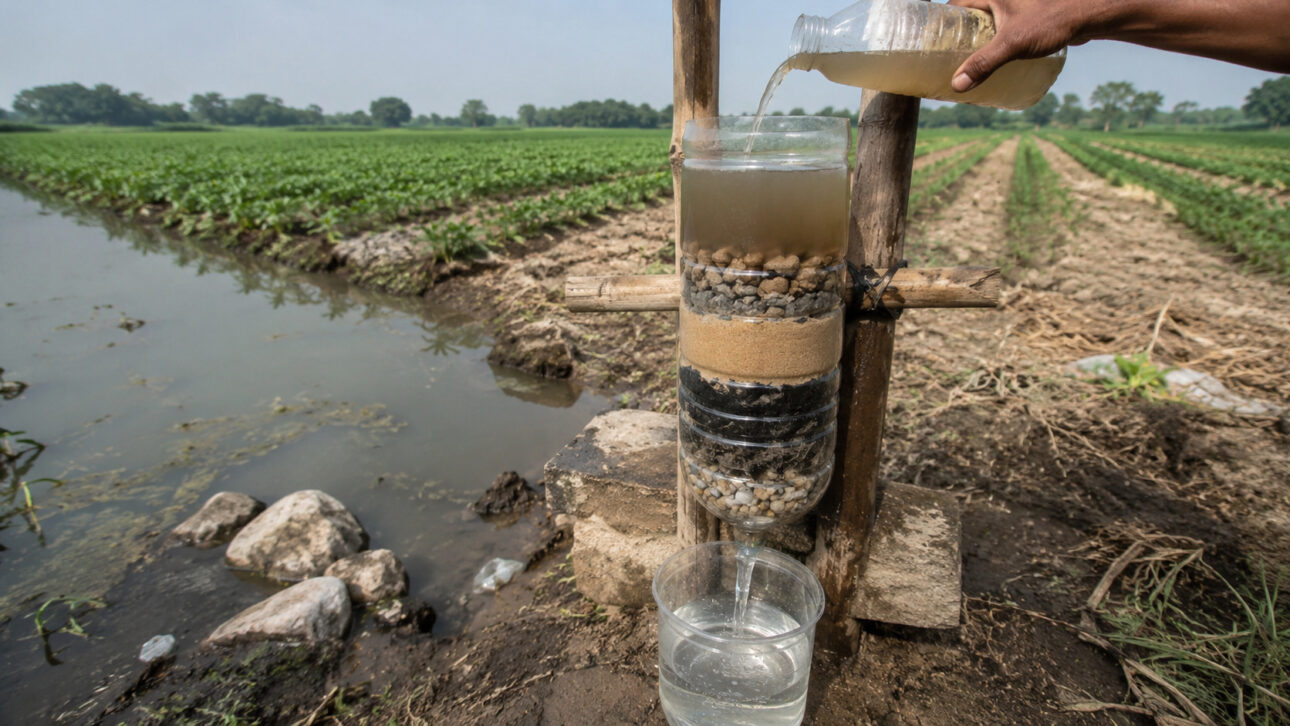
The difference in the project lies in its focus. It does not just aim to hold back mud, leaves, or particles that are easily visible. The idea is to target chemical residues linked to agricultural use, which may go unnoticed in a simple visual analysis.
The Earth Prize, an environmental competition and incubator of ideas for youth, detailed AirJernih as a cheap filtration solution to remove harmful pesticides and fertilizers from water. The public description, however, does not present all the technical data on materials, tests, and usage limits.
This makes the proposal interesting, but still calls for caution. The idea may be promising, but the real effectiveness needs to be evaluated with more complete information about performance, filter duration, and operating conditions.
Why invisible water contamination is more concerning than it seems
When water is dirty with mud, trash, or leaves, the problem appears quickly. People look and become suspicious. Chemical residues, however, can be present without altering color, smell, or appearance.
This is the point that makes contamination by pesticides and fertilizers so concerning for agricultural areas. The risk can exist even when the water looks clean, making it difficult for those who use the source daily to perceive the problem.
A common filter can help with some types of visible dirt, but that doesn’t mean it removes chemical substances. Filtering large particles is different from reducing agricultural residues dissolved in water.
That’s why projects like AirJernih draw attention. They focus on a silent problem and show that water safety doesn’t depend solely on appearance.
Cheap filters can change the reality of rural communities
A cheap filter can make a difference because not every rural community has easy access to large water treatment facilities. In many places, simple and accessible solutions can be the first step to reducing risks.
The low cost also increases the chance of use in schools, small properties, and remote areas. When technology is too expensive, it may exist but remains out of reach for those who need it most.
AirJernih draws attention precisely for combining low cost, environmental focus, and practical application in agricultural areas. This combination is important because it brings innovation closer to real problems in the field.
Even so, it is necessary to separate proposal from proof. A project selected in an environmental competition may point to a good path, but it needs to show consistent results before being treated as a definitive solution.
What is still unknown about the effectiveness of AirJernih
The available information does not provide all the necessary details to evaluate the filter in depth. Data on the materials used, operating time, amount of water filtered, and types of residues removed are still missing.
It would also be important to know about tests conducted under different conditions. The water in one agricultural region may have different characteristics from the water in another, and this can influence the performance of any filtration system.
This care is essential because the topic involves health, supply, and water security. When it comes to water, a promise only gains real strength when accompanied by clear and verifiable data.
The founder of The Earth Foundation, Peter McGarry, summed up the spirit of the selection by stating that “age is no barrier to tackling complex environmental challenges with creativity and purpose.”
Why this Malaysian project resonates with Brazil’s reality
The project was born in Malaysia, but the problem is easy to understand in Brazil. Many Brazilian communities live near farms, rivers, canals, and wells, and depend on water quality for their daily routine.
The AirJernih proposal sparks interest because it shows a solution created by young people for a common risk in agricultural areas. It is not a distant topic, nor restricted to laboratories. It touches on a simple point: clean-looking water does not always mean contamination-free water.
The main lesson is in the warning. The appearance of water does not reveal everything. In agricultural regions, invisible residues can be as serious a concern as visible dirt.
AirJernih still needs more complete technical data to confirm its effectiveness on a large scale. Even so, the idea shows how young students can transform a silent problem into a practical, affordable proposal with potential impact on rural communities.
If water can hide risks that no one sees, do you believe agricultural communities should have access to cheap tests and filters before the problem appears in people’s health? Leave your opinion in the comments and share this post.


Be the first to react!