






 Portuguese
  Spanish


Exhaust filter with microalgae created by 18-year-olds draws attention for the cost of US$ 50, for tests with emission reduction, and for the alert on technical limits.
An exhaust filter attached to a regular car made headlines for a curious promise: using microalgae to try to reduce pollution coming out of the vehicle’s pipe. The creation is by teenagers Rohan Kapoor and Jack Reichert from Pennsylvania, both 18 years old.
The prototype was named Go Green filter. The young inventors claim that the piece costs US$ 50 and reduced emissions by more than 74% in repeated tests. The idea draws attention because it tries to tackle a huge problem with a small, inexpensive, and visually easy-to-understand solution.
The information was published by Chester County Press, a local newspaper covering communities in Pennsylvania. The project also earned the teenagers recognition in the 2024 Gloria Barron Prize for Young Heroes, aimed at youth initiatives with social and environmental impact.
-
House Left Isolated in the Middle of New Chinese Highway as Owner Refuses Compensation Deal, Construction Continues Around the Property

-
Venetian Factory Luigi Bevilacqua Crafts Velvet by Hand on 18th-Century Looms, Producing Just 30 Centimeters a Day

-
From Customer Service to Pipeline Welding: She Becomes the Second Female Welder in Utility’s History, Now Leading a Team in San Diego
-
Controversial 262-Meter Skyscraper in New York Blocks Empire State Building View, Offers 26 Luxury Apartments Priced Up to $18 Million




Microalgae in the exhaust transformed a regular car into a showcase for an idea against pollution
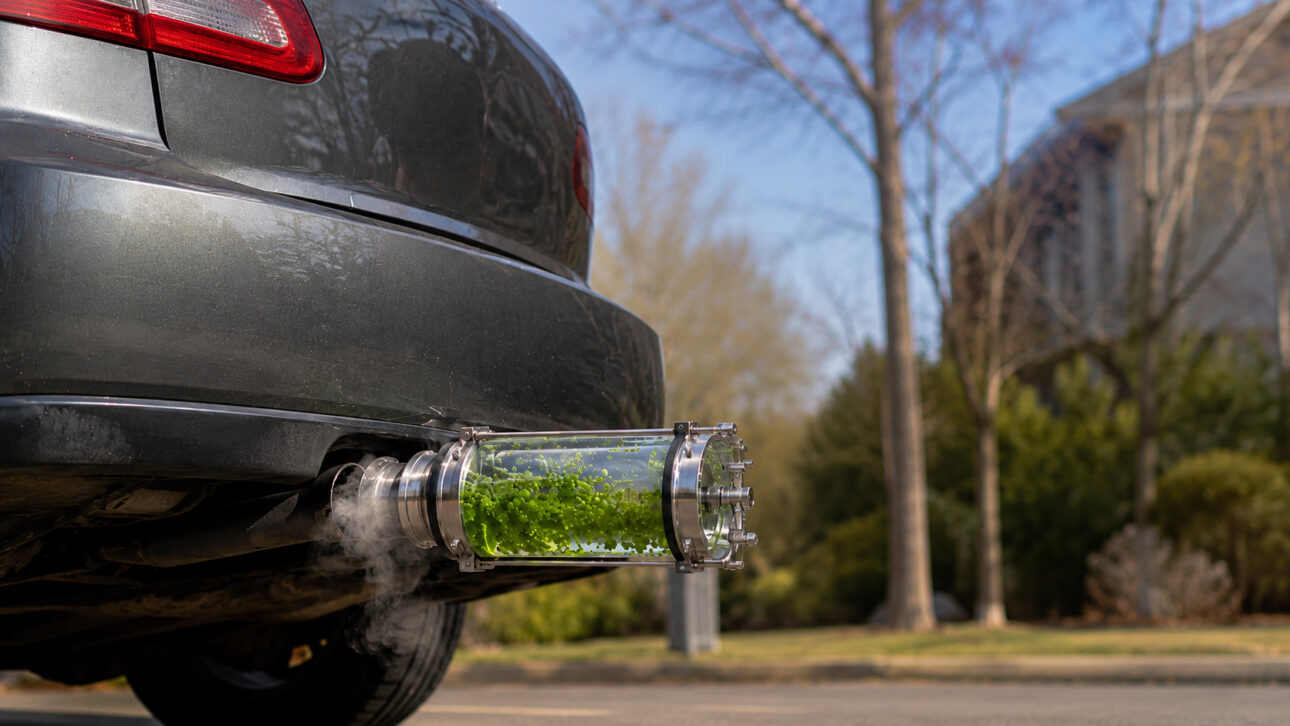
The scene seems simple: a filter fitted to a car’s exhaust. The difference lies in the material used inside the piece. Instead of relying solely on metals, sensors, or expensive systems, the young inventors bet on microalgae, very small organisms that live in water.
The microalgae appear in the project as an attempt to reduce some of the gases released by the vehicle. In simple terms, the proposal is to place this material in the path of the smoke before it fully exits through the exhaust.
The idea was born after the teenagers learned about the work of a professor at MIT. Later, they obtained algae from a local botanist and created the filter with 3D printing, a technique that forms objects layer by layer.
This detail helps explain why the project draws attention. It combines school science, simple manufacturing, and a direct application in cars, something anyone understands when looking at an exhaust.
Young inventors say US$ 50 filter reduced emissions by more than 74% in tests
The strongest point of the project is the reduction of more than 74% in emissions during repeated tests. This number was presented by the creators and appears in local coverage, but still needs to be read with caution.
There is no peer-reviewed academic study available proving the result on a large scale. Therefore, the Go Green filter should be treated as a promising prototype, not as a ready solution for all cars.
The cost of US$ 50 also weighs in the strength of the story. In a sector where environmental solutions can be expensive, a cheap exhaust part arouses curiosity, especially in countries where old vehicles continue to circulate for many years.
Even so, an automotive technology needs to undergo tough tests. Heat, vibration, dirt, daily use, different types of engines, and various fuels can completely change the performance of a filter.
Youth recognition put the Go Green filter in the spotlight in the United States
Rohan Kapoor and Jack Reichert were finalists for the 2024 Gloria Barron Prize for Young Heroes. The award recognizes young people who develop actions with a positive impact on people, communities, and the environment.
Chester County Press, a local newspaper covering communities in Pennsylvania, detailed that the finalists that year were chosen from nearly 500 candidates from the United States and Canada.
The award was created in 2001 by author T. A. Barron and has already honored 600 young people. This context helps to show why the project gained visibility, even while still in the development phase.
The recognition does not mean that the filter is ready to become a mandatory item in cars. It shows that the proposal attracted attention for combining creativity, environmental concern, and an attempt to reduce vehicle emissions.
Alternative filters gain strength because combustion cars still dominate many streets
Car pollution remains a visible problem in cities. Even with the advancement of electric vehicles, gasoline and diesel engines are still part of the daily routine for millions of people.
Therefore, an exhaust filter with microalgae arouses interest. The proposal attempts to act at the final point of the process, when the gases are exiting through the vehicle’s pipe.
The logic is easy for the public to understand. Instead of replacing the entire car, the idea is to install an additional part to reduce part of the environmental impact. This simplicity makes the project strong for dissemination.
However, cars do not all work the same way. A filter that shows good results in an initial test needs to prove performance in different models, roads, temperatures, and usage conditions.
Technical limits still need to be checked before considering widespread use
The biggest point of attention is independent validation. For the filter to advance, the results need to be measured by external experts, with clear and comparable methods.
It is also necessary to understand how the microalgae behave inside a real exhaust. This environment receives hot gases, undergoes constant vibration, and accumulates residues from engine operation.
Another point involves maintenance. A cheap part may lose its advantage if it requires frequent replacement, difficult care, or constant cleaning. The value of US$ 50 would only be truly strong if it came with durability and safety.
The reduction of more than 74% draws attention, but it does not end the discussion. It raises an important question: can the result be repeated outside the creators’ tests and in cars used daily?
Project shows creativity, but still depends on proof outside the laboratory
The Go Green filter became a good story because it brings together young characters, low cost, microalgae, and a problem known to any driver. The image of a living organism trying to reduce the smoke of a common car has immediate strength.
At the same time, caution is necessary. The project can inspire new research and new solutions, but it still needs independent tests before being treated as a definitive answer to vehicle emissions.
If a US$ 50 part could really reduce part of car pollution, it would change the way we think about old engines. But how far can a simple solution go without the industry and science confirming its results?


