Portuguese
  Spanish


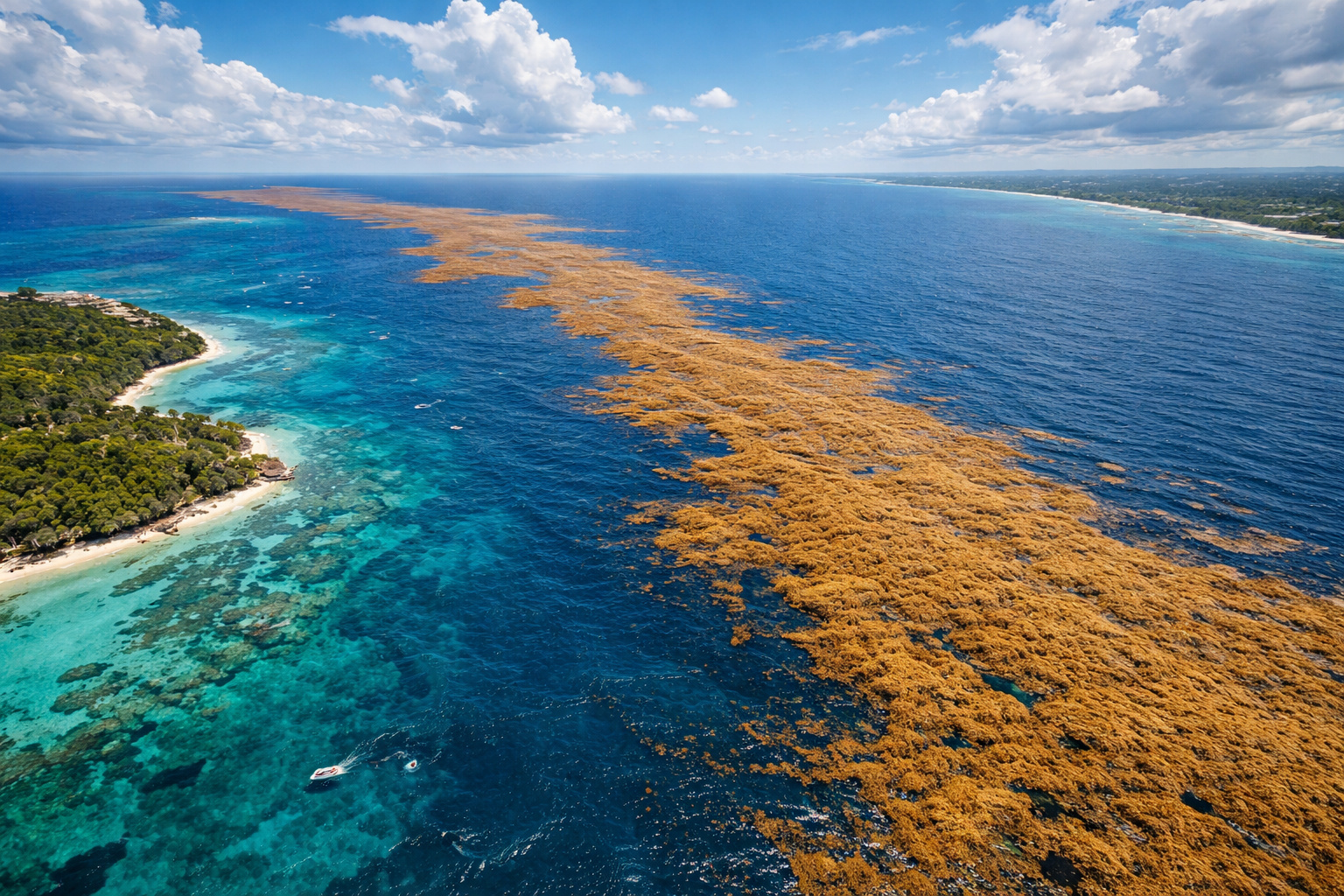


Giant Sargassum Belt Visible from Space Grows Since 2011, Sets Record in 2025, and Increases Environmental Impacts in the Tropical Atlantic
A large-scale environmental discovery has again caught the attention of the international scientific community. Millions of tons of sargassum have reappeared in the Atlantic Ocean, forming an extensive floating belt observed by satellites. From January to March, small masses of these algae begin to emerge every year. However, with the arrival of spring in the Northern Hemisphere, this volume rapidly increases and takes on continental proportions.
According to monitoring by NASA, the phenomenon shows accelerated growth, along with increasingly significant environmental impacts. Therefore, researchers have begun to address the event as one of the new global environmental challenges of the past decade.
Great Sargassum Belt Connects Distant Oceans and Ecosystems
The phenomenon is known as the Great Atlantic Sargassum Belt. It is, therefore, a macroalgal bloom that can extend from the west coast of Africa to the Gulf of Mexico. According to official data, this structure creates a true floating biological corridor, connecting oceanic regions separated by thousands of kilometers.
-
Researchers want to change the way of producing rare earth magnets, reducing purification steps and making better use of the elements found in Swedish deposits.

-
5.5 tons pulled from the seabed: a ‘living carpet’ of invasive coral was suffocating the Baía de Todos-os-Santos until the Brazilian Navy descended with divers, steel brushes, and acid salt to carry out the largest eradication operation of the species ever conducted in the country.

-
A Brazilian project dumped 5,500 concrete blocks and 2 barges into the ocean to block trawling in Paraná, and 25 years later what seemed like a risky intervention turned into an underwater nursery, a diving spot, and a refuge for endangered species.
-
Micron invested $9.3 billion in a factory in Hiroshima to produce the memory that powers the brain of global artificial intelligence.

This belt began to be identified through satellite images in 2011. Since then, it has reemerged every year, especially between late spring and summer, consolidating a pattern that worries scientists and environmental authorities.
March 2025 Records the Largest Volume Ever Observed
The most recent monitoring brought unprecedented numbers. In March 2025, the belt reached between 37 and 38 million metric tons of biomass. Thus, it comfortably exceeded the previous record of approximately 22 million tons, recorded in 2022.
Additionally, satellite images revealed that, in parts of the Caribbean, layers of algae exceeded 1 kilometer in width. Consequently, environmental authorities and the tourism sector began issuing alerts about potential economic and ecological damages.
Floating Species Explain Rapid Expansion
The predominant species are Sargassum natans and Sargassum fluitans. Both are classified as holopelagic macroalgae. That is, they live floating in the ocean, without the need to attach to the seafloor.
The accelerated growth is associated with ocean currents, which transport large quantities of nutrients from the North Atlantic to the Tropical Atlantic. Among the main sources, the Amazons River stands out, releasing nitrogen and phosphorus during the rainy season, and the Congo River, responsible for dumping nutrients on the west coast of Africa. In this way, these elements act as true natural fertilizers.
Global Warming Intensifies the Advancement of the Phenomenon
Research conducted by U.S. universities, with support from NASA data, indicates that global warming plays a decisive role. With rising water temperatures, combined with human activities that increase nutrient loads in the oceans, ideal conditions for algal proliferation are created.
According to the space agency, the pattern observed since 2011 shows that the phenomenon not only persists, but intensifies over the years, reinforcing the need for continuous monitoring.
When Sargassum Stops Being an Ally and Becomes a Threat
In open water, the belt can serve a positive ecological role. For example, it provides shelter for fish, turtles, birds, and marine invertebrates. However, the scenario changes when large volumes approach the coasts.
In these situations, suffocation of natural habitats occurs, damage to coral reefs, reduction of light and oxygen in coastal waters, and increased erosion. Additionally, during decomposition, the algae release hydrogen sulfide, a gas associated with intense odor and risks to human health and local wildlife.
Scientific Alert for the Coming Years
At the peak of activity, the belt reaches beaches in the Caribbean, Florida, and Mexico. For scientists, the phenomenon represents a recent and complex environmental challenge. NASA highlights that there are still uncertainties about its future behavior. Therefore, experts advocate for constant monitoring and international mitigation strategies, before the impacts become irreversible.
In light of this scenario, do you believe the world is prepared to deal with the continuous expansion of sargassum in the oceans?