





 Portuguese
  English
  Spanish
  4 min of reading
  1 comment


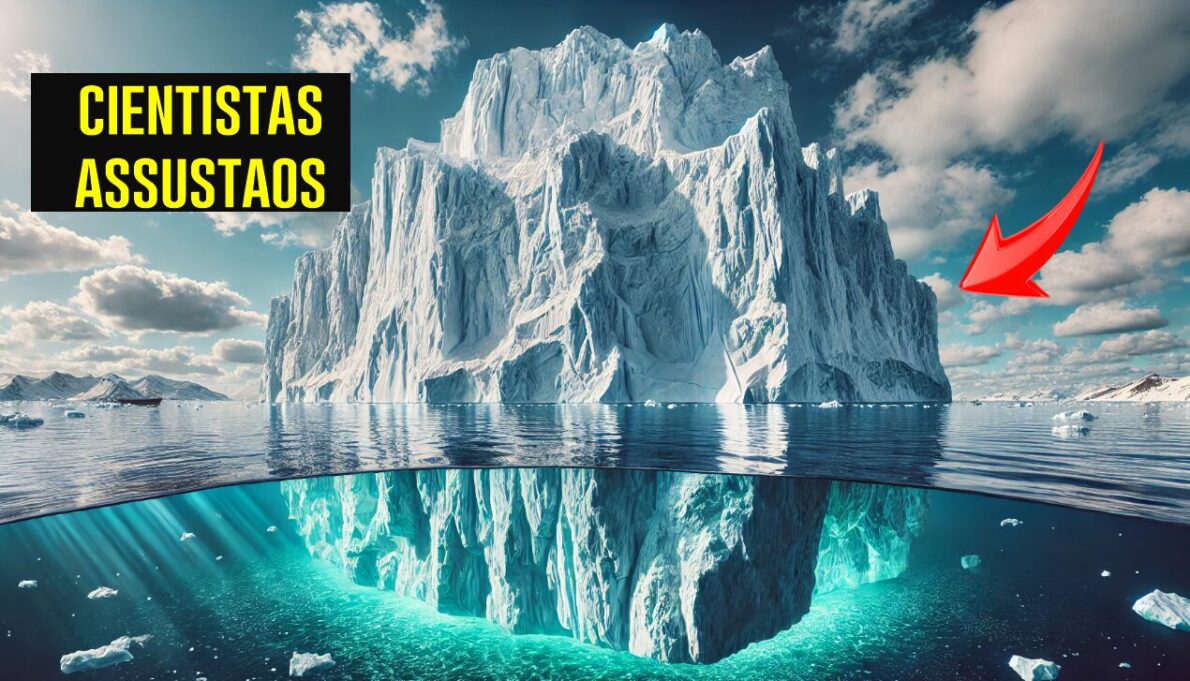

The Largest Iceberg In The World Is Transforming In Extraordinary Ways, Intriguing Researchers Around The Globe. Discover The Impact Of This Change And What It Can Teach Us About The Future Of The Environment!
The A23a, the largest iceberg in the world, is undergoing an impressive and rare transformation. Unlike other icebergs that disintegrate quickly after breaking away from Antarctica, the A23a has a unique history that began in 1986 when it separated from the Antarctic ice shelves.
Instead of following the common path of drifting and dissolving, this massive iceberg has remained stationary in the Weddell Sea for over three decades, transforming into a “ice island“.
With an area equivalent to twice that of Greater London, the prolonged stability of the A23a in the Weddell Sea has allowed for the development of a unique ecosystem. It is believed that various forms of marine life have adapted to this extreme environment, creating a mini frozen habitat.
-
China confirms the existence of a never-before-seen mineral, found in a deposit with a concentration 80 times above the global standard, which promises to reshape the battery industry and the global competition for strategic minerals.

-
Drone technology that lights up Alok’s shows will be used to launch 67 species of seeds from above and reforest two degraded areas of the Atlantic Forest in Barra Bonita.

-
Scientists believe they have discovered the origin of the river from the ‘Garden of Eden’: study reveals that the Euphrates emerged from the union of two giant rivers over 5 million years ago, including one larger than the Nile.
-
The grass for the 2026 World Cup did not come about by chance: U.S. universities spent 8 years creating an almost surgical turf, with pink lights, synthetic fibers, and agricultural technology to keep 104 games at the same standard.



However, in 2020, the A23a finally began to move northward toward warmer waters, which typically marks the beginning of the end for icebergs of this magnitude.
Iceberg A23a: Trapped In The Dance Of The Currents
What seemed to be the beginning of its disintegration has taken an unexpected twist. Since April, the A23a has been trapped in a current formation known as the Taylor column.
This natural trap was formed due to an underwater outcrop called Pirie Bank, located north of the South Orkney Islands. This underwater structure creates a vortex powerful enough to capture giant icebergs like the A23a, disrupting their trajectory.
Currently, the iceberg is rotating 15° per day, caught in a perpetual dance with the ocean currents. This unusual phenomenon offers scientists a rare opportunity to study the long-term behavior of massive icebergs and their impacts on the surrounding environment.
The ongoing presence of the A23a in this region may influence local marine biodiversity, ocean circulation patterns, and consequently, climate research in Antarctica.
The Antarctic Circumpolar Current
Before being captured by the Taylor column, the A23a was swept along by the Antarctic Circumpolar Current (ACC), one of the most powerful currents on the planet. The ACC transports 100 times more water than all the rivers on Earth combined, playing a vital role in global ocean circulation and climate regulation.
The interaction between the A23a and the ACC provided scientists with a window to better understand the complex dynamics of polar waters. As glacier melting accelerates due to global warming, analyzing these movements becomes even more crucial for predicting possible future scenarios.
The behavior of icebergs like A23a is directly linked to climate change, and their interactions with major ocean currents offer valuable insights into melting processes and the redistribution of freshwater in the global ocean.
Implications For Climate And Global Biodiversity
The extraordinary journey of the A23a reflects the drastic changes occurring in the polar regions of the Earth. With rising global temperatures, scientists observe that the behavior of icebergs and ice shelves is becoming increasingly unpredictable, challenging climate modeling. This affects not only the poles but also ecosystems and climate patterns around the world.
In addition to climate issues, the A23a may also alter local ecosystem dynamics. Its rotational movement within the vortex may affect the circulation of nutrients and water temperatures around it, directly impacting marine life that relies on these currents for feeding and migration.
Changes in local ocean currents and species migration patterns may be observed as the iceberg continues trapped in its “aquatic prison.”
For the scientific community, the prolonged presence of the A23a in the Weddell Sea also offers a unique opportunity to observe how local marine biodiversity responds to such an extreme and dynamic environment. And by studying the iceberg’s journey, scientists may obtain new data on the impact of melting in Antarctica and its implications for the rest of the world.
The largest iceberg in the world, the A23a, is showing us how the polar regions of the Earth are changing and how these changes may have global repercussions.
Its unique story, which began in 1986, is far from over, and scientists will continue to monitor its transformation in the coming years, hoping to better understand the impacts of global warming and its consequences for the future of our planet.





Eu acho que 2025 os oceanos deverá subir mais de 30 cm.