Portuguese
  Spanish


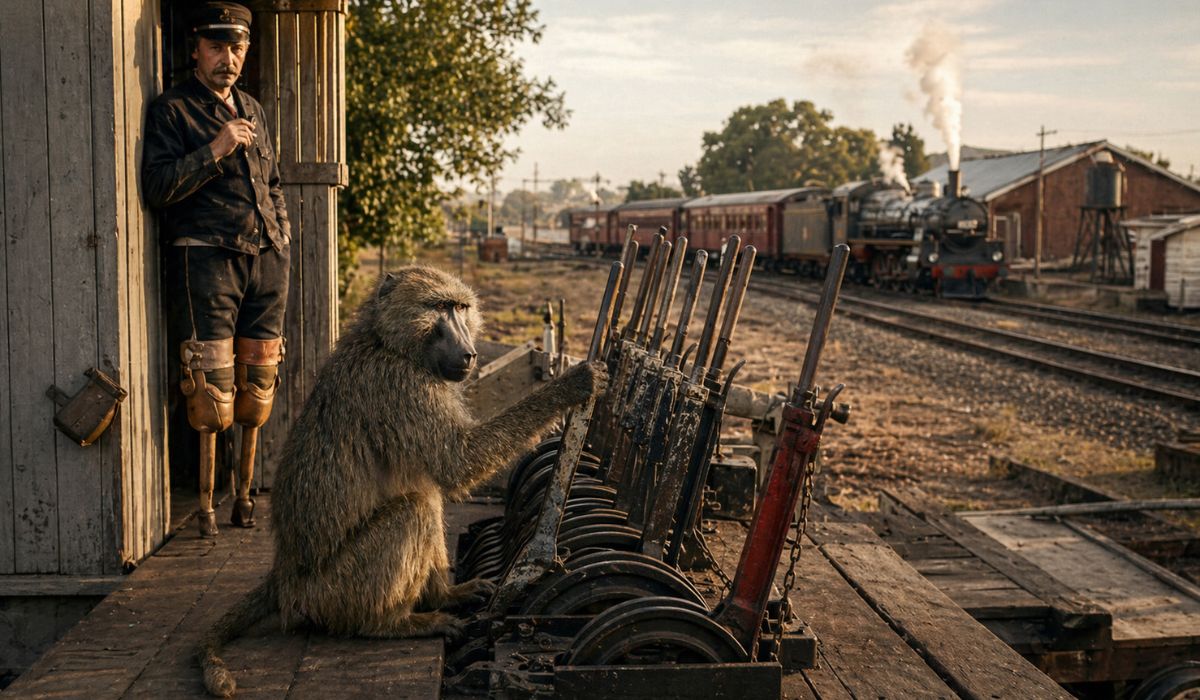

Jack’s trajectory unites railway history, animal behavior, and local memory by recounting how a chacma baboon trained by James Wide became a signalman’s assistant in old Uitenhage in the 19th century.
A chacma baboon named Jack became associated with one of the most documented stories about animals trained for human functions in the 19th-century railway system.
According to historical accounts, he worked for about nine years as a signalman’s assistant at the old Uitenhage station, in the Eastern Cape, South Africa, alongside James Edwin Wide, a railway employee who had lost both legs in a work accident.
The case is cited in publications on railway history and animal behavior because Jack reportedly learned to push Wide’s cart, perform support tasks, and operate signals used to guide trains.
-
Son of Poor Farmers Fled Home Four Times Seeking Work, Founded Hyundai, and Transformed It into a Global Industrial Giant in Over 190 Countries

-
13-Year-Old Raises Funds to Build Well, Transforming Lives in Cambodian Community Lacking Clean Water

-
Man with Metal Detector Finds Medieval Silver Seal in England, Uncovers 2,000-Year-Old Roman Gem with ‘Richard’s Secret’

-
Thailand Converts 8 Tons of PET Bottles into 3,500 School Backpacks, Showcasing Circular Economy with Over 40 Factories Involved





The best-known versions state that the baboon worked between 1881 and 1890 with no record of operational error.
The city where the story took place was called Uitenhage during the period Jack lived.
In 2021, the South African government formalized the name change to Kariega, as part of a broader process of renaming localities in the Eastern Cape.
In this text, the reference to Uitenhage is maintained because it is the historical name of the station in the 19th century.
James Wide’s accident changed the railway routine
James Edwin Wide worked on the railway service between Cape Town and Port Elizabeth and was nicknamed “Jumper” for jumping between wagons.
During one of these movements, he suffered a serious accident and lost both legs.
After the amputation, he started using wooden prostheses and a small cart to get around.
His new physical condition made the routine at the station more difficult.
As a signalman, Wide needed to move to specific points and operate levers responsible for indicating the correct path to trains.
The role required regularity, attention to signals, and quick response to commands used in railway operation.
It was in this context that Jack entered the railway worker’s life.
According to preserved accounts of the case, Wide saw the baboon driving an ox cart in a local market and decided to acquire it to assist with daily tasks.
The animal was named Jack and was initially trained to push his owner’s cart.

Jack’s training began with support tasks
The training began with activities related to Wide’s mobility.
Jack learned to take the employee to the station and accompany him on the way home.
In some versions of the story, simple support tasks also appear, such as small domestic chores, always described as part of the cohabitation between the railway worker and the animal.
Over time, the baboon began to observe the signaling routine.
In railway operation, engineers used whistles with specific patterns, which indicated the need to activate certain levers.
Jack reportedly learned to associate these sounds with the movements made by Wide, repeating the commands within the station’s routine.
The activity did not depend solely on strength or mechanical repetition.
The signalman needed to recognize the received command and activate the correct mechanism.
Therefore, the story is often cited as an example of associative learning and repetitive training in animals, without implying that the baboon had human understanding of the complete functioning of a railway.
From the perspective of animal behavior, Jack’s species also helps to contextualize the episode.
The chacma baboon is a social primate, with communication based on vocalizations, facial expressions, body postures, and physical contact.
These characteristics are described by scientific institutions as part of the species’ social organization.

Complaint led railway to evaluate the baboon
The presence of a baboon next to the signaling levers caught the attention of passengers.
According to historical accounts, a complaint reached the railway administration after a person saw Jack working at the station.
The situation led officials to verify if the animal was indeed executing the commands properly.
Instead of immediately removing Wide, the administration reportedly subjected Jack to a practical evaluation.
Published versions of the case state that the baboon responded to signals correctly and demonstrated knowledge of the sequence of levers used in the post’s routine.
After that, he began to be recognized as a railway employee in records cited by authors and specialized publications.
There are discrepancies in the details about the compensation Jack received.
Some sources state that he earned 20 cents a day and half a bottle of beer a week.
Other versions mention the provision of feed or payment in cash.
As these records appear with variations, the safest way is to treat the remuneration as data reported by historical sources, not as information proven by a publicly available primary document.
Superintendent’s account reinforced Jack’s story
Jack’s story also gained circulation due to accounts attributed to George B. Howe, a railway superintendent who visited the site in the late 19th century.
In one of the reproduced quotes about the case, Howe wrote that Jack knew the signal whistle “as well” as he did and identified the levers used at the station.
The same account describes the closeness between the baboon and James Wide.
Howe claimed to have seen Jack with his arms around his guardian’s neck, while caressing his face.
The quote is maintained because it appears associated with the historical account attributed to the superintendent, without the addition of undocumented statements.
Jack died in 1890, according to sources, after contracting tuberculosis.
Publications about the case state that the skull attributed to the baboon was preserved in the collection of the Albany Museum, in Grahamstown, a city now known as Makhanda.
His trajectory remained linked to the railway memory of Uitenhage and the figure of James Wide.


Animal learning explains part of Jack’s case
Jack’s story is often presented as a historical curiosity, but it also allows for an interpretation linked to behavioral science.
The episode shows an animal subjected to a repetitive routine, with sound commands, observable gestures, and trained responses.
This set of factors favors associative learning, especially in social species capable of observing and repeating behaviors.
Analyzing the case requires caution because some of the information has been circulating for over a century, and not all details appear in accessible primary documents.
Even so, there is convergence among sources on the central points: Jack belonged to James Wide, assisted the signalman on the railway, was trained to operate signals, and died in 1890.
The story’s persistence is explained by the convergence of railway records, local memory, and scientific interest in primate behavior.
At the heart of the episode is an animal that, according to historical accounts, performed a specialized human task through repetition, training, and daily coexistence with its guardian.