Portuguese
  Spanish


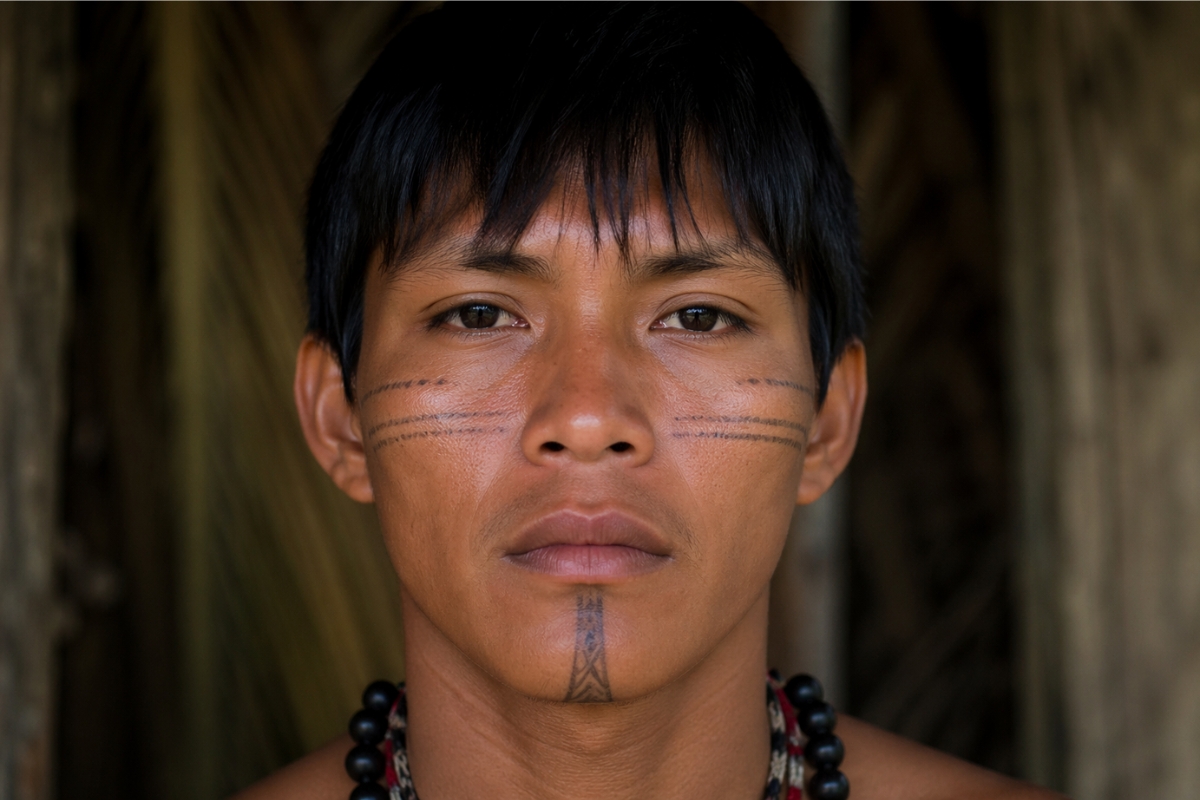

Sparse beards in many indigenous peoples reveal an ancient connection between genetics, migrations through Asia, and the peopling of the Americas, with the EDAR gene helping to explain physical traits preserved for thousands of years
The beard that doesn’t grow full on the faces of many indigenous men is not by chance. Nor is it related to strength, masculinity, or lack of hormones.
The explanation may be hidden in a much older genetic history: an evolutionary mark of about 30,000 years, linked to ancestral populations of East Asia and carried by many indigenous American peoples to this day.
Sparse beards became a clue to a much larger story
Many indigenous Americans may have beards. But, in several populations, they tend to be thinner, less dense, and more irregular than in Europeans, Middle Eastern peoples, or some African groups.
-
Brazil’s Largest Grain Port Faces Delays in the Hinterlands, Missing Rail Link Costs Agribusiness Billions

-
Astronomers Detect Excess Alcohol on Interstellar Comet 3I/ATLAS, Revealing Unique Chemical Signature from Another Star System
-
13-Year-Old Californian Girl Wins $25,000 Prize for Creating Low-Cost Water Filter from Discarded Animal Bones

-
Entrepreneur Secures $15 Million to Transform Steel Mill Waste into Concrete Material, Builds Demo Plant in the U.S. with a Goal of 10,000 Tons Annually



This trait does not appear alone. It usually comes with other well-known characteristics: straight hair, thicker strands, less body hair, and certain dental differences.
Science points to a name that stands out: EDAR.
The EDAR gene entered the center of the discussion

The EDAR gene, especially the variant known as EDARV370A or rs3827760, is one of the strongest clues in this story.
This variant is common in East Asian populations and also appears with high frequency in indigenous American peoples. In Europeans and Africans, it is rare or almost absent, according to comparative genetic records.
Studies associate this variant with changes in structures formed from the skin, such as hair, sweat glands, teeth, and follicles. In tests with mice, researchers observed changes in hair diameter, sweat glands, and other tissues.
A mutation about 30,000 years old
The most striking data is the age of this variant.
Researchers estimated that EDARV370A emerged in the central China region approximately 30,000 years ago. Later, this genetic marker spread through Asian populations and reached the ancestors of indigenous American peoples.
This means that the sparse beard in many indigenous people may carry the signature of an ancient migration, predating the arrival of these groups on the American continent.
The link with ancestors who crossed into the Americas
Before populating the Americas, the ancestors of many indigenous peoples lived connected to populations in Northeast Asia and the Beringia region.
From this large ancestral trunk came several physical traits still visible today. Among them, straight and thick hair, less facial hair in many men, and differences in teeth and the shape of facial structures.
The sparse beard, therefore, is not an isolated detail. It is a living clue to a human journey that crossed continents, ice, isolation, and adaptation.
EDAR is not the “no beard gene”
Despite its fame, EDAR doesn’t explain everything alone.
Beard growth depends on many factors: family genetics, follicle sensitivity to testosterone and DHT, follicle density on the face, and each person’s ancestral mix.
A genomic study with over 6,000 Latin Americans analyzed characteristics such as beard thickness, eyebrows, unibrow, and hair. The result reinforced that facial hair is a complex trait, influenced by several points in the genome.
The mistake of thinking that sparse beards mean low hormones
One of the biggest myths is linking sparse beards to low testosterone.
In most cases, the central point is not the amount of hormone in the blood. What changes is how the facial follicles respond to hormones.
Two men can have normal hormone levels and completely different beards. One might have a full beard. Another might have only a few hairs on their chin and upper lip.
The difference is written in the DNA.
A visible mark of thousands of years of evolution
The absence of a full beard in many indigenous people does not indicate backwardness, weakness, or deficiency.
It shows the opposite: a genetic heritage preserved for thousands of years, linked to ancient adaptations and the true history of the peopling of the Americas.
Every hair that didn’t grow on the face can tell a bigger story than it seems: the story of ancestors who lived tens of thousands of years ago, traversed extreme regions, and left marks on the bodies of their descendants.
The answer is on the face, but it begins long before America
The question “why do many indigenous people not have beards?” seems simple. But the answer spans genetics, migration, climate, natural selection, and ancestry.
Science is still investigating the details. But one thing has become clear: the sparse beard in many American indigenous peoples is part of an ancient heritage, linked to the EDAR gene and a human lineage that carries signs of at least 30,000 years of evolution.
The face shows the present. DNA reveals the past. And, in this case, the lack of a beard can be one of the most impressive clues in human history.
Did you like this explanation? Share it with someone who has also wondered why many indigenous people barely have beards.