Portuguese
  Spanish


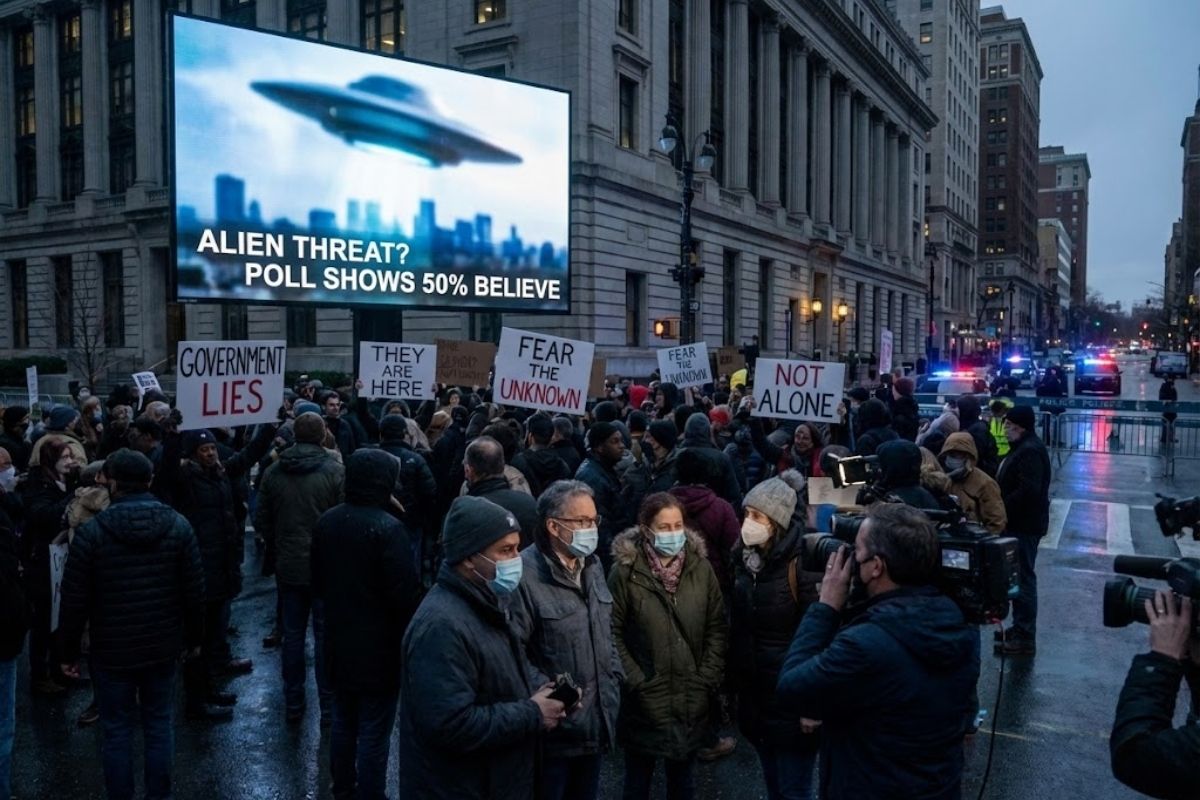


Online Survey with 1,114 Adults Conducted From November 4 to 9, 2025, Indicates 56% Believing That Extraterrestrials Exist and 47% That They Have Already Visited Earth. For 29%, the Impact Would Be Negative; 55% Fear Diseases and 73% Think the Government Would Hide Evidence Even If UFOs Have Another Explanation
Half of Americans say that extraterrestrials have definitely or probably visited Earth, according to a recent survey. This data appears alongside a broader picture: most believe that they exist, but the prevailing sentiment about an encounter is not celebration, but risk.
The survey shows the public is divided on the subject of recent visits: 42% say that extraterrestrials have definitely or probably been here in recent years, while 41% say the opposite. Against this backdrop, the idea grows that the government would hide evidence, and the fear of biological consequences outweighs scientific curiosity.
What the Survey Measured and How It Was Conducted

The survey was conducted online from November 4 to 9, 2025, with 1,114 adults from the United States.
-
Security Guard Rescued Alive After Over 150 Hours Trapped in Collapsed Venezuelan Mall Following Earthquakes

-
Mystery of the Crooked Forest: Hundreds of Pine Trees in Poland Grow with Identical J-Shaped Curves
-
Chinese Buildings Use Mist System to Combat Extreme Heat, Cooling Surfaces by Up to 8°C; Water Consumption Limits Use in Drier Cities

-
German Shepherd Fails Guide Dog Test Due to Attachment to Plush Elephant, Viral Moment Captured at Train Station




The sample was constructed to represent the adult population, with weighting for factors such as age, race, education, and voting history, and the margin of error for the total was approximately 4 percentage points.
Within this framework, 56% stated that extraterrestrials definitely or probably exist.
When the question shifts to visits to Earth, 47% say that extraterrestrials definitely or probably visited the planet at some point, indicating that belief is not limited to abstract existence.
UFOs, Competing Explanations, and Public Division
Regarding UFOs, 30% believe that unidentified flying objects are probably spacecraft or forms of alien life, while 45% say there is some other explanation.
This contrast shows that, even among those who accept the possibility of extraterrestrials, there is a high barrier to directly associating UFOs with alien origin.
The picture also changes based on party affiliation.
Democrats are more likely than Republicans to assert that extraterrestrials exist and to attribute UFOs to alien origin, while independents hold an intermediate position, reinforcing how the topic crosses politics, institutional trust, and reading of evidence.
Fear of Diseases, Harm, and Contact Viewed as a Threat
When the survey asks about the effects of a visit, Americans are about twice as likely to say it would be negative rather than positive: 29% point to a negative effect, against 14% who see a positive effect, and 25% evaluate that it would be neither positive nor negative.
The specific fear appears with clear numbers.
For 55%, it is very or somewhat likely that extraterrestrials would introduce new diseases capable of infecting humans.
Additionally, 43% think it likely that they would unintentionally harm or kill people, and 43% consider it likely that they would come in peace, a tie that translates to ambivalence rather than certainty.
Superior Technology, Intent to Remain Hidden, and Communication
The majority believe that, if they exist, extraterrestrials would be much more technologically advanced than humans, with 74% affirming this.
Also, 66% consider it likely that they would wish to remain hidden from humans, which supports the narrative of a discreet and hard-to-prove presence.
Regarding communication, 50% evaluate that it would be likely that extraterrestrials would be able to communicate with humans.
At the same time, only 29% think it likely that they would have a sense of humor, a detail that reinforces how the collective imagination tends to portray them as enigmatic and potentially dangerous, not as friendly visitors.
Distrust in Government and the Suspicion of Cover-Up
The perception of a lack of transparency is one of the central axes.
Three-quarters of Americans, 73%, believe that if the U.S. government had evidence of the existence of UFOs, it would hide it from the public. Only 13% think the government would disclose this information.
Personal experience also enters the debate. One in five Americans, 21%, says they have seen something they thought was a UFO.
Among these, 28% evaluate that it was more likely to be of extraterrestrial origin, while 48% point to another explanation, maintaining the division even when there is a direct report.
When People Think Contact Might Occur
The survey also maps the expectation of future contact.
Only 16% believe that we will make contact with extraterrestrial life in the next 10 years, but this percentage grows with the horizon: 29% in 50 years, 42% in 100 years, and 46% in 200 years.
The strongest difference arises among those who already believe in visits: among those who say that extraterrestrials have already visited Earth, 31% think contact will come in 10 years and 53% in 50 years.
Among those who do not believe in visits, only 2% bet on contact in 10 years, showing how current belief shapes the prediction of the future.
In your opinion, does this fear of extraterrestrials come more from the risk of diseases, distrust in the government, or the cultural impact of admitting that we are not alone?