Portuguese
  Spanish


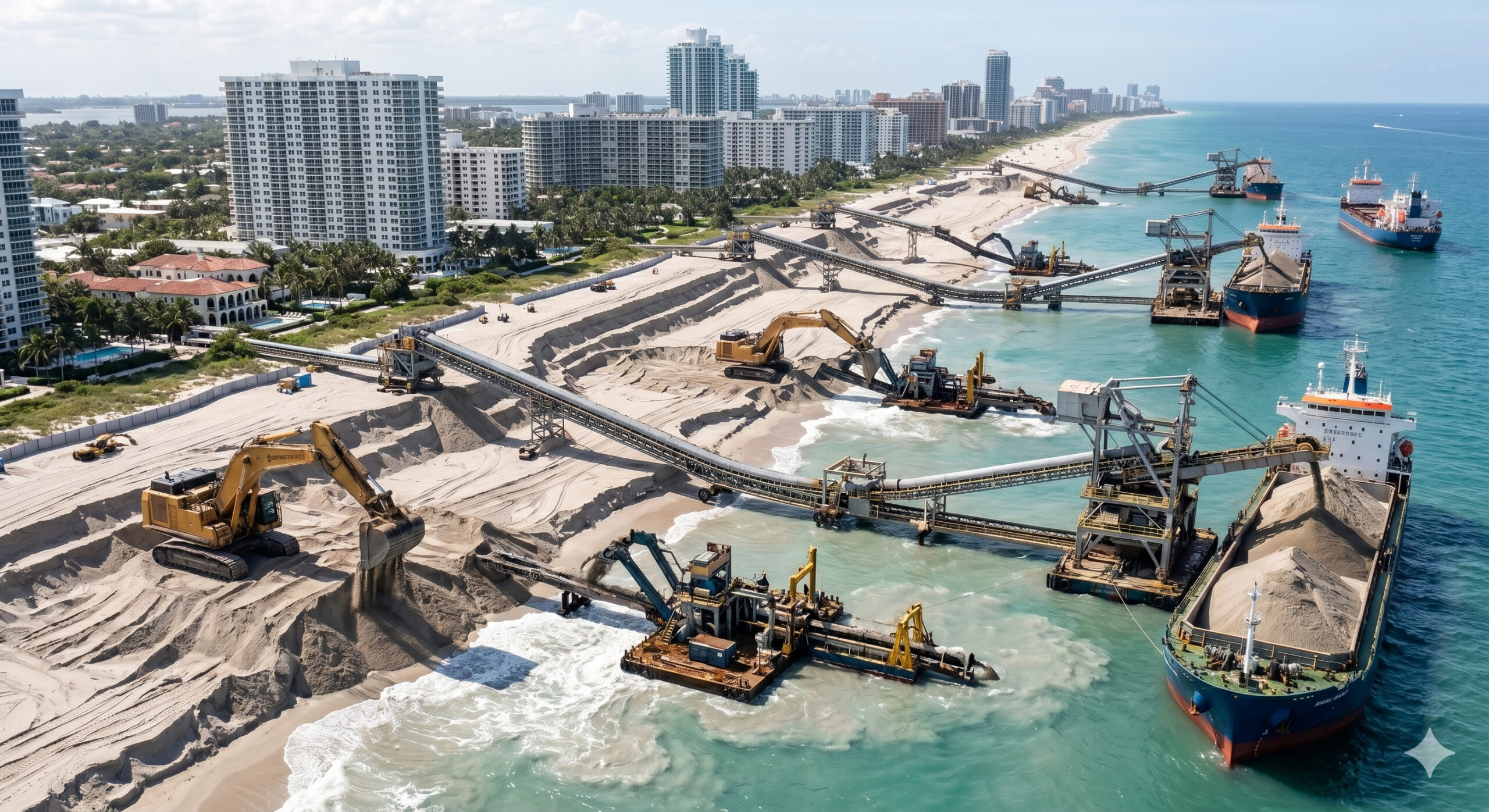

Miami Beach and Palm Beach spend millions of dollars on beach nourishment, dumping artificial sand to curb coastal erosion, protect high-value properties, and buy time against the Atlantic’s advance amid rising sea levels.
According to Coastal Care, a US$ 16 million project dumped fresh sand on four critical stretches of Miami Beach, using up to 100 trucks per day, between 100 and 250 daily loads, to transport 305,000 cubic yards of sand from inland Florida to areas of intense erosion along Collins Avenue. The project was completed in mid-2020.
In 2022, a new US$ 40 million project began near Allison Park. In 2025, another round advanced with a feasibility assessment by the U.S. Army Corps of Engineers. Meanwhile, Palm Beach, a neighboring city that has already received its 51st sand nourishment operation, continues its permanent dispute with the Atlantic.
Florida, New York, and New Jersey have already received about 500 million cubic meters of sand since the 1930s, with much of it funded by the U.S. federal government. The question posed by Coastal Care remains relevant: does beach nourishment keep pace with climate change, or is it just a temporary and expensive fix for a long-term problem?
-
Brazilian Fishing Couple Spends 4 Years Building Solar-Powered Floating Home on the Paraguay River, Now a Navy-Approved Vessel with Leisure Area and Tour Demand

-
While the World Opens New Airports and High-Speed Trains, Brazil Rushes to Complete Projects Stalled for 40 Years
-
Brazil Invests in Massive Waterway to Transport Soybeans by Barge, Reducing Costly Truck Reliance
-
Bridge Rebuilt in Just One Year Reconnects Two Brazilian States


Beach nourishment in the United States attempts to curb coastal erosion with artificial sand
Beach nourishment, known in English as beach nourishment or beach renourishment, is the artificial deposition of sand on a beach that has lost sediment due to erosion. The sand can come from offshore dredging, harbor channels, estuaries, inland mines, or areas where there is a natural accumulation of sediment.


The United States is the largest practitioner of this type of coastal engineering in the world. Six states, California, Florida, New Jersey, North Carolina, New York, and Louisiana, account for more than 83% of all artificially deposited sand volume on American beaches, according to the American Shore and Beach Preservation Association.
Federal funding usually covers about 65% of the costs, with a 35% local match. Since the first documented project in Coney Island, New York, in 1923, billions of dollars have been spent to move sand from ocean floors and continental areas to beaches that the sea continues to remove.
Artificial beaches protect coastal cities, but the sea’s advance challenges the cost
The economic rationale for beach nourishment is defensible in theory. Virginia Beach calculated that US$ 20.2 million spent on nourishment since 2002 prevented over US$ 1 billion in storm damages, an estimated 50-to-1 return.
Wide beaches absorb wave energy before it reaches streets, hotels, houses, avenues, and infrastructure networks. The wider the sand strip, the greater the distance between the ocean and built structures.
The central question is not whether beaches protect coastal cities. They do. The doubt is whether artificial beaches can sustainably protect cities in the long term, while sea levels rise and storms become more destructive.
Palm Beach has already undergone 51 sand nourishment operations
Palm Beach, Florida, has one of the most documented histories of beach nourishment in the United States. With 51 recorded operations, according to Western Carolina University’s national database, the city has become an extreme example of structural dependence on this strategy.
Each operation covers specific coastal stretches, called reaches in the coastal management system, with volumes ranging from 50,000 to 750,000 cubic yards per project.

The most recent operation before April 2026, the Palm Beach Mid-Town Beach Renourishment Project, reached 36% completion, while the dredging of the port’s entrance channel was almost 95% complete.
Sand is pumped from the bottom of the channel directly onto the beach through pipelines, while tractors redistribute and compact the material. The cost of each operation can range from US$15 million to US$100 million, depending on the volume, sand source, and transport distance.
Compatible Sand Scarcity Increases Project Costs in Miami Beach and Palm Beach
Beach renourishment depends on sand compatible with the original in color, grain size, and composition. When the nearest offshore source is depleted, it is necessary to seek material from further away, which increases dredging, transport, and environmental licensing costs.

Palm Beach has already faced a shortage of suitable sand in previous projects. In some cases, the Army Corps of Engineers had to evaluate non-domestic sources, a sign that keeping the beach artificially nourished may become increasingly expensive.
This is a critical point for Miami Beach and other coastal cities in Florida. The more erosion advances, the more sand is needed, and the more sand is used, the harder it becomes to find nearby and compatible sources.
Sea Level Rise Makes Beach Renourishment a Temporary Solution
Robert S. Young, director of the Program for the Study of Developed Coasts at Western Carolina University, points out a central contradiction: beach renourishment buys time, but it doesn’t change the physics of the coastline.
Rising sea levels progressively shift the coastline’s equilibrium point inland. Adding sand can protect the beach for months or years, depending on storm intensity, but it does not alter the long-term retreat trend.
Each new operation begins on a coastline more pressured than the last. The sand returns to the beach, but the ocean continues to rise, advance, and remove some of the material again.

Public Money Sustains Artificial Beaches in Million-Dollar Property Areas
The second critical point is economic and political. Many renourishment projects are funded by federal taxes paid by taxpayers across the country, including people who live far from the coast.
The benefits, however, are concentrated in high-value coastal real estate areas, such as Miami Beach and Palm Beach. Hotels, condominiums, mansions, and tourist developments receive direct protection from a project largely paid for with public funds.
The question raised by researchers is delicate: shouldn’t public money used to maintain artificial beaches in valuable areas be compared with structural adaptation alternatives, such as planned retreat, infrastructure elevation, and protection of natural zones?
Sea Turtles and Coastal Ecosystems Suffer Impact from Dredged Sand
An aspect rarely highlighted in official communications is the environmental impact of beach renourishment. Sand dredged from offshore sources does not always have the same grain size as the native beach sand.
Coarser or finer grains alter the temperature, humidity, and permeability of the sediment. This directly affects sea turtle nests, which depend on specific conditions for egg incubation.
A long-term study by the Sanibel-Captiva Conservation Foundation in Florida found an approximately 20% drop in sea turtle egg hatching success on re-nourished beaches compared to unaltered beaches. New sand protects properties, but it also changes the habitat where coastal species reproduce.
Intertidal zone can be buried by repeated renourishment works
The impact is not limited to turtles. Crabs, crustaceans, mollusks, and polychaetes live buried in the intertidal zone, the wet strip between low tide and high tide.
When a beach receives a large volume of artificial sand, this habitat can be buried in a few hours. For the ecosystem, the effect is similar to deforestation: the physical structure that supported local life is suddenly altered.
Recolonization can take months. If the operation is repeated before full recovery, the coastal ecosystem never fully returns to its previous state, especially on beaches subject to frequent works.
Dutch coastal management model uses sand in a planned and systemic way
The most important comparison for understanding Miami Beach and Palm Beach is not with another American city, but with the Netherlands. The Netherlands also artificially deposits sand on its coast, about 12 million cubic meters per year.

The difference lies in the strategy. The Dutch program does not seek to maintain a specific beach in front of a specific address. The goal is to preserve the 1990 reference coastline as an integrated system.
Projects like the Zandmotor deposit large volumes of sand at a single point and let currents and waves distribute the sediment naturally over decades. It is a logic of national coastal planning, not just an emergency response to eroded stretches.
Miami Beach and Palm Beach follow a reactive model against coastal erosion
The American beach renourishment system is more reactive. It responds to erosion at specific points, often linked to urbanized areas and high-value properties.
The Dutch system is more proactive and systemic, treating the coast as national survival infrastructure. In the United States, the model often functions as a protection service for coastal municipalities and the local real estate market.
This difference in philosophy matters. On a receding coast, depositing sand always in the same spots can become a Sisyphean strategy, pushing sand for the Atlantic to take back in the next sequence of storm surges.
The future of beach renourishment depends on cost, available sand, and sea-level rise
In 2026, with the Atlantic rising and compatible sand sources depleting, Miami Beach and Palm Beach face a bigger question than when to carry out the next operation. The question is how long the strategy remains financially, environmentally, and physically sustainable.
Beach renourishment can reduce storm damage, protect infrastructure, and sustain tourism economies in the short and medium term. But it does not prevent sea-level rise nor eliminate structural coastal erosion.
Engineering can buy time. What is still unclear is whether this time will be used for real adaptation or merely to repeat, every few years, the same operation: finding sand further away, spending more money, and waiting for the next storm surge to decide how long the artificial beach will last.