Portuguese
  Spanish


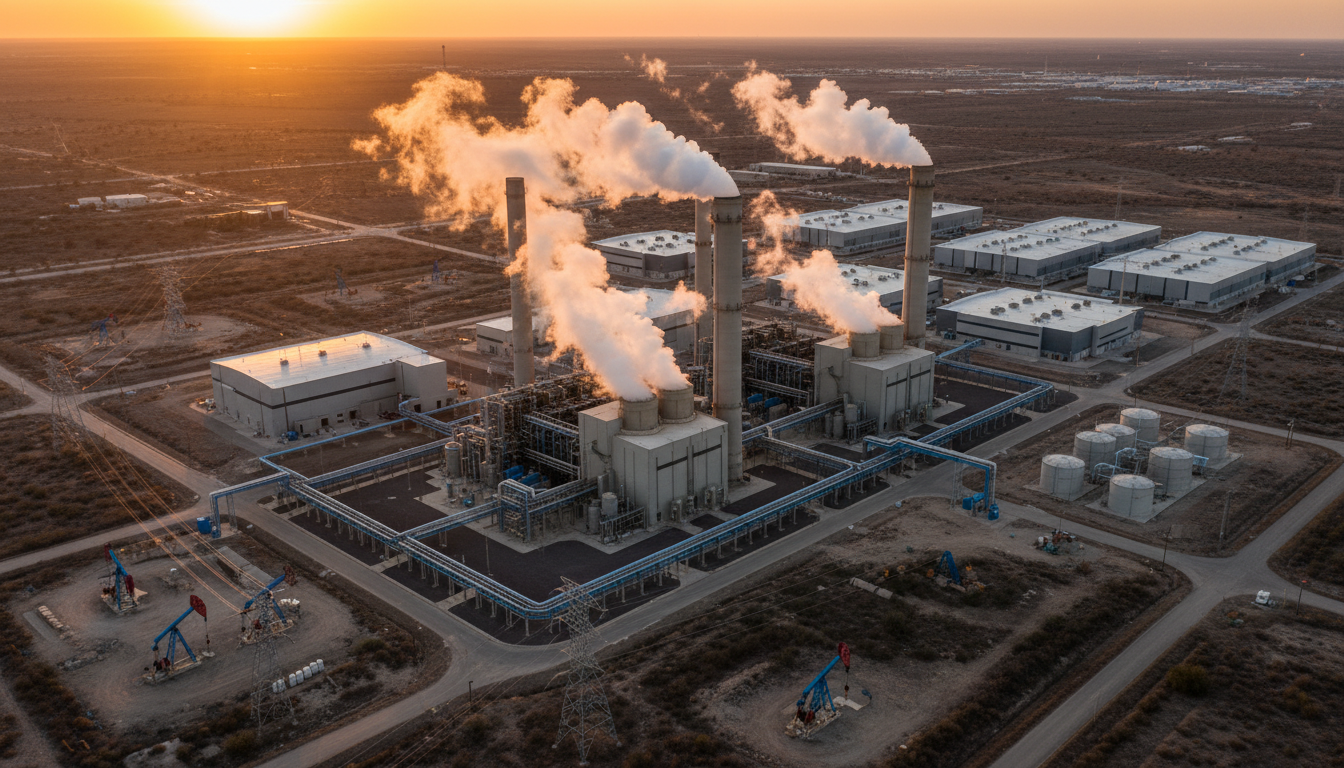

Microsoft, Chevron, and Engine No. 1 announced on April 2, 2026, an exclusivity agreement to build 2.5 gigawatts of natural gas generation in West Texas, dedicated to powering Microsoft’s AI campuses. The estimated investment is US$7 billion, scalable to 5 gigawatts in subsequent phases.
According to Fortune, the model is “behind-the-meter”: the plant will be located within the perimeter of the AI campus, directly connected to the servers, without passing through the public grid. In parallel, this eliminates dependence on substations and regional transmission to reach the load.
The agreement is the largest ever signed between a big tech company and an oil company for AI infrastructure. According to industry analyses, it marks the frontier where the supply of reliable energy has become scarcer than capital or chips to fuel the race for AI capacity.
-
Volvo’s New Loaders Feature Obstacle Detection, Automatic Braking, and 360-Degree Operator View

-
U.S. Women’s History Museum Stalled in Congress Amid Gender Identity and Diversity Debate

-
Chinese Manager Accused of Whipping Worker Sparks Protest by 1,200 Employees at Major Brazilian Factory

-
France Revamps 530 Social Housing Units with Large Balconies and Glass Facades Without Demolishing Existing Buildings




The figures for the Microsoft Chevron Texas agreement, according to the companies themselves and Bloomberg, tell the story in five points:
- 2.5 GW initial natural gas generation, scalable to 5 GW total
- US$7 billion estimated investment for the first phase
- Permian Basin, West Texas, near existing Chevron gas fields
- Behind-the-meter, without passing through the public grid or transmission substations
- End of 2027 the first phase comes into operation, with expansion until 2030

Why the Microsoft Chevron Texas Agreement is Different
According to Mike Wirth, Chevron’s CEO, “energy has become the main limiting factor for growth” for AI. In parallel, he coined a phrase that went viral in the sector: “you can’t just pull an extension cord to the grid and plug in a data center”.
The behind-the-meter model solves the bottleneck. According to analysts, with generation and consumption within the same physical perimeter, the plant delivers electrical power almost instantaneously, without network latency and without regulatory disputes with traditional utilities.
In parallel, natural gas was chosen for reliability. Solar and wind, while clean, have intermittency and require very high-cost battery storage to supply 24×7 loads like an AI factory.
According to Energy Capital HTX, the turbines will be supplied by GE Vernova, a recent industry standard. In parallel, there is discussion about integrating CO₂ capture (CCS) in the exhaust, a model that Chevron already operates in pre-combustion projects.
According to Chris James of Engine No. 1, “energy is the key to American dominance in AI.” In parallel, the explicit discourse positions the agreement as part of the strategic effort against China.

Microsoft in Texas: Already Gigantic and Growing
Microsoft has a massive operation in Texas. According to official data, the “Microsoft Pecos” data center, announced in April 2026, will have 2,500 MW. In parallel, this project adds to the Abilene expansion and the new Chevron agreement.
The Abilene campus has a 900 MW expansion operated by Crusoe Energy Systems for Microsoft. According to Crusoe, the plant uses natural gas and was specifically sized for AI.
Texas has become the largest AI data center hub in the US, surpassing historic Loudoun County in Virginia. Therefore, it attracts not only Microsoft, but also Meta (Louisiana via Entergy), Amazon (Pennsylvania nuclear), OpenAI/Oracle (Stargate in Abilene).
According to Lancium data, the Lancium Clean Campus site in Abilene has 1.2 GW operational for AI, dedicated to OpenAI and Oracle in Project Stargate. In parallel, it is the third largest AI cluster in the state.
CPG covered the topic in parallel in its coverage of the Joliet Technology Center in Illinois, which follows the same pattern of hyperscale dedicated to AI with massive power.

Why Chevron, and Not a Traditional Utility
The choice of an oil company to deliver electricity has clear logic. According to Mike Wirth, “nobody understands natural gas like we do,” and Chevron already has infrastructure, pipelines, and relationships with producers in the Permian Basin.
In parallel, traditional utilities like ERCOT (Texas grid operator) take years to release capacity. Therefore, behind-the-meter via Chevron bypasses this queue and delivers power within a timeframe compatible with AI expansion.
According to analysts, Chevron also benefits for two reasons. The first is to diversify revenue beyond crude oil exports. The second is to position itself as a central player in the energy transition, even via natural gas.
Engine No. 1, an activist fund that joined Exxon’s board in 2021, plays a financial stakeholder role. In parallel, the fund covered the venture capital side and the thesis of gradual decarbonization via CO₂ capture in the long term.
According to Bloomberg, the agreement follows the pattern of other recent deals: Amazon bought nuclear capacity from Talen in Pennsylvania, Meta closed with Entergy in Louisiana, Oracle/OpenAI did Project Stargate in Abilene with Crusoe.
What This Means for the Global AI Race
The Microsoft Chevron agreement consolidates the thesis that AI is an energy-intensive industry. According to Morgan Stanley, the electrical demand of AI data centers could double by 2030, exceeding the combined consumption of Argentina and Chile.
The scenario creates a gigantic opportunity for American natural gas. Therefore, Permian Basin producers (Chevron, ExxonMobil, ConocoPhillips, Diamondback) have constant offers to close long-term contracts with hyperscalers.
According to the Brookings Institution, the electrical race for AI could redraw the industrial map of the US. Cities without generation capacity will be left out of the new digital economy, even if they have technical talent.
In parallel, the total investment announced in AI data centers in the US exceeded US$500 billion in 2025-2026, according to Goldman Sachs estimates. Therefore, deals like Microsoft-Chevron are small pieces of a much larger movement.
According to JP Morgan analysts, the next frontier is small modular reactor (SMR) nuclear generation. In parallel, Bill Gates’ TerraPower, NuScale, and X-Energy already have preliminary agreements with hyperscalers for post-2030 deliveries.

Brazil: Pre-Salt Gas for National Data Centers?
Brazil has a similar opportunity, but on a different scale. According to Petrobras, national natural gas production is expected to reach 70 million m³/day by 2027, with the majority originating from the pre-salt.
This gas is currently flared offshore, exported raw, or used in complementary thermal generation. Therefore, redirecting part of it to data centers would be strategic.
According to analysts, Scala Data Centers’ Rio AI City, with 3.2 GW projected, could benefit from local natural gas in partnership with Petrobras. In parallel, this model has not yet been formally announced.
Brazil’s potential has a climate trade-off. The national electricity matrix is 80%+ renewable (hydro, wind, solar), and adding natural gas via behind-the-meter would increase sectoral emissions.
In parallel, the renewable advantage gives Brazil an option: to sell “green” AI capacity to global clients looking to reduce their carbon footprint. Therefore, Rio AI City explicitly positions itself as “100% renewable” in international marketing.
Agreement Schedule and Risks
The first phase of 2.5 GW is expected to come into operation by the end of 2027, according to the schedule released by the companies. In parallel, expansion to 5 GW depends on confirmed demand from Microsoft in subsequent phases.
The main risks are regulatory. According to analysts, behind-the-meter still faces challenges from utilities (who lose customers) and state regulators (who want to ensure the reliability of the public grid).