Portuguese
  Spanish


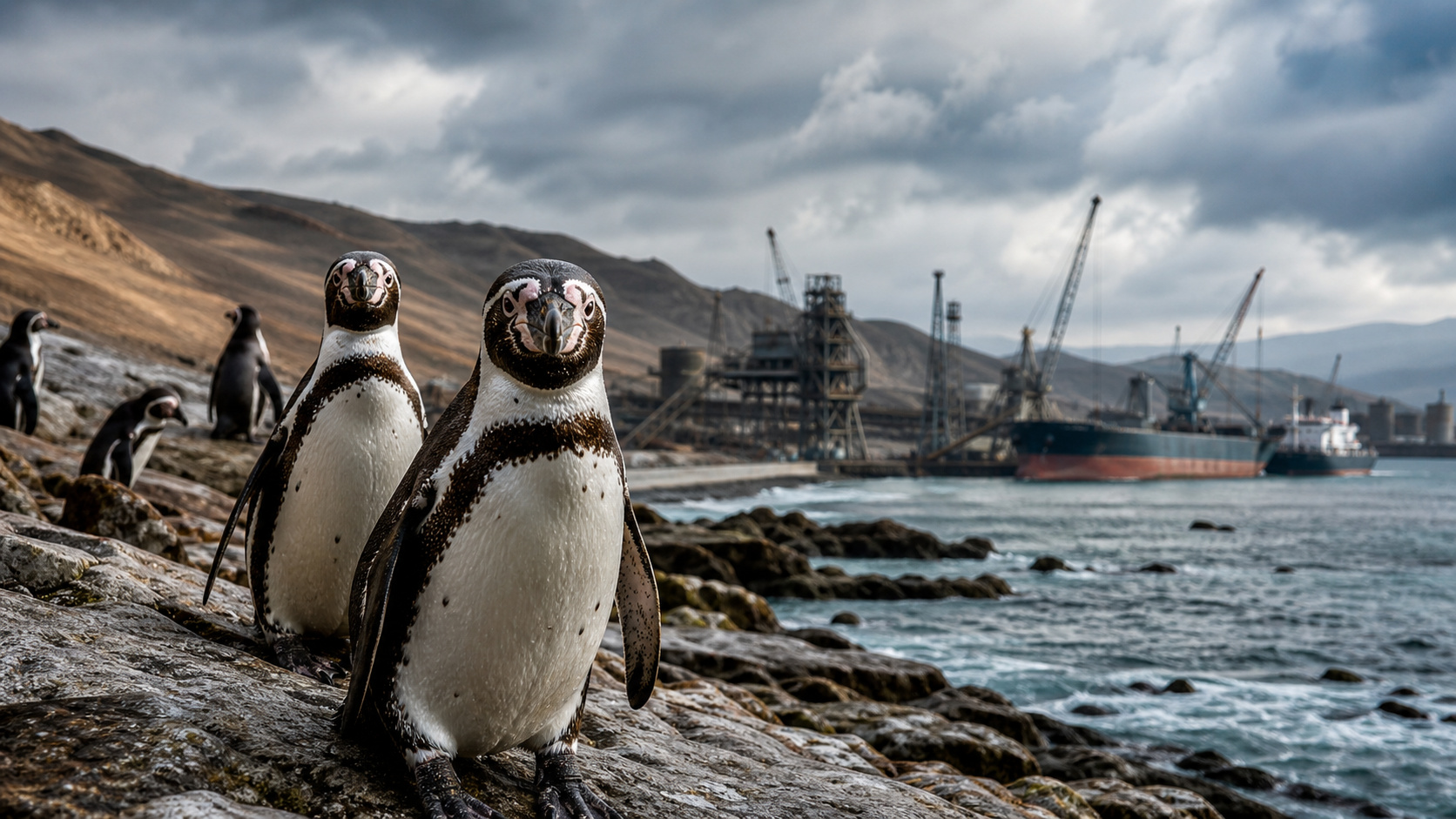

The rejection of the Dominga Project in Chile reignited the debate about mining near sensitive areas, placed Humboldt penguins at the center of the environmental dispute, and showed how an iron and copper mine with a port can become a problem for investors, authorities, and marine life advocates.
Chile blocked the billion-dollar Dominga mining megaproject near sensitive areas for Humboldt penguins, in a decision that halted the proposal for an iron and copper mine with a port in the La Higuera region.
The investigation was published by Noticias Ambientales, a news portal about environment and sustainability. The case gained traction because it brought together three high-impact elements: mining, a port, and an endangered species that became a symbol of marine protection.
The rejection in 2025 increased uncertainty for investors and was seen as a symbolic victory for environmentalists. The episode also showed that the risks of such a project are not limited to the mine, as maritime traffic, industrial dust, and port infrastructure also factor into the environmental assessment.
-
NASA Plans to Repurpose Mars Rover for Lunar Mission, Sending a 1-Ton Nuclear-Powered Vehicle to Explore the Moon’s South Pole Without Solar Dependence
-
NASA Plans to Repurpose Mars Rover for Lunar Mission, Sending a 1-Ton Nuclear-Powered Vehicle to Explore the Moon’s South Pole Without Solar Dependence
-
Expanded Polystyrene Gains Ground as a Lightweight Alternative to Traditional Masonry in Construction
-
Expanded Polystyrene Gains Ground as a Lightweight Alternative to Traditional Masonry in Construction
Humboldt Penguins Became a Symbol of Resistance Against Mining in Chile
Humboldt penguins came to occupy the center of a dispute that seemed unlikely. Endangered birds became protagonists in a battle involving mining, environmental licenses, a port, and pressure on the marine ecosystem.


The conflict drew attention because it pitted, on one side, a billion-dollar mining megaproject. On the other, a sensitive coastal area, linked to the survival of marine species and the protection of biodiversity.
The public image was easy to understand: penguins against mining. However, the discussion is broader. It involves how large-scale projects can alter fragile regions and generate effects that go beyond the point where the ore would be extracted.
Dominga Project Envisioned Iron and Copper Mine with Port in La Higuera
The Dominga Project envisioned an iron and copper mine in the La Higuera region of Chile. The proposal also included a port, an essential part for moving production and connecting the venture to maritime transport.
This point made the debate more sensitive. A mine can already cause impacts on land, but a port extends the concern to the sea. Ships, cargo, industrial dust, and constant circulation can alter the environment where coastal and marine species live.
Therefore, the rejection in 2025 was not restricted to mining. The decision also involved the protection of the coastal and marine ecosystem, with a focus on Humboldt penguins and other species in the region.
Port and Maritime Traffic Weighed Heavily in the Environmental Debate
In many cases, mining is remembered only for the extraction of ore. In the Dominga case, the port became a central part of the environmental concern, because the operation would depend on maritime movement near sensitive areas.

Ship traffic can put pressure on marine life. Cargo movement can also generate industrial dust and other environmental changes. For animals that depend on the balance of the sea, such changes can pose a risk.
The project’s rejection showed that the environmental impact of a project needs to be analyzed as a whole. Mine, port, transport, and industrial activity are all part of the same reality when linked to the operation of a large enterprise.
Rejection in 2025 Increased Uncertainty for Investors
The decision to reject the Dominga Project in 2025 sent an important message to the market. Large-scale projects depend on licenses, stability, and acceptance in areas where the environmental impact can be high.
When an enterprise of this size faces rejection, investors deal with increased risk. Uncertainty about authorization, deadlines, and feasibility weighs heavily on the planning of companies interested in mining and infrastructure.
Noticias Ambientales, a news portal about environment and sustainability, detailed the central points of the rejection and the weight of the Humboldt penguin’s defense in the case. The repercussion reinforced the strength of environmental issues in decisions regarding large mining projects.
Environmentalists gained a symbolic victory with the Dominga case
The project’s rejection was received as a symbolic victory for environmentalists. The case became significant because it showed that an endangered species can change the course of an undertaking of great economic interest.
Penguins gained a symbolic role because they represent something simple for the public to understand: the protection of vulnerable animals in the face of industrial expansion in natural areas. This image helped broaden attention on the project.
The dispute also showed that environmental defense is not limited to forests or areas far from the coast. The sea, ports, and coastal zones also become central to decisions when biodiversity is at risk.

What the case reveals about mining and biodiversity
The Dominga case shows that large mining projects face increasing scrutiny when they approach sensitive areas. It’s not enough to present a mineral exploration proposal. It’s also necessary to deal with the impact on marine life, coastal landscape, and endangered species.
The decision in Chile reinforced that biodiversity can influence the fate of billion-dollar projects. When environmental risk gains prominence, licenses can be denied, and business plans can be stalled.
At the heart of this story, Humboldt penguins ceased to be merely part of the local fauna. They thus transformed into a symbol of a dispute between mining, economic development, and environmental protection.
The Dominga Project was rejected in 2025 and came to represent a landmark case of conflict between large investment and marine life preservation. The decision increased uncertainty for investors and strengthened the debate about the limits of mining in sensitive coastal regions.
And after all, when a project promises investment and jobs but threatens a sensitive natural area, what should be the limit between economic development and marine life protection? Leave your opinion in the comments and share this publication with those who follow mining, energy, and the environment.