Portuguese
  Spanish


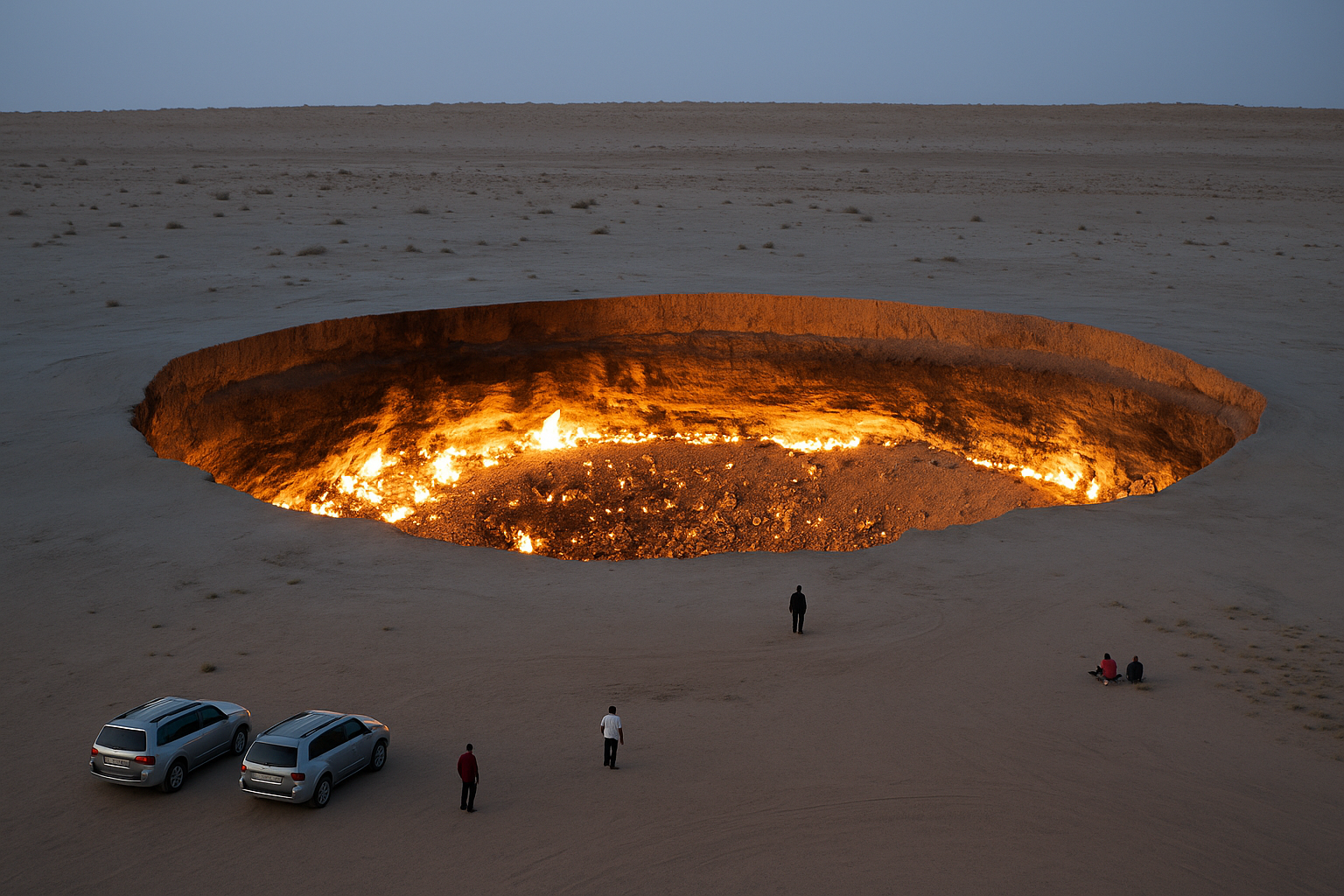

Portal of Hell in Turkmenistan Starts to Extinguish After 50 Years of Constant Fire Fueled by Natural Gas Leak.
The legendary “Gateway to Hell” in Turkmenistan is finally beginning to extinguish. The burning crater, which has been ablaze for five decades, now features a faint and nearly imperceptible flame.
Scientists attribute the reduction in flames to the decreased flow of flammable gas that fueled the fire.
The Accident That Created the Portal
In 1971, during a drilling operation, Soviet scientists accidentally struck an underground reservoir of natural gas in the Karakum Desert. The structure of the drilling station collapsed, forming a massive sinkhole.
-
Welder Discovers 16th-Century Diamond Ring in England After 7 Hours with Metal Detector; Gold Jewel Linked to Edward I Pattern Auctioned for £17,000

-
Former Merchant Marine Captain Invents Fuel-Free Barrier, Removes 20,000 Tons of Trash from Chennai Rivers
-
14-Year-Old Maxim Harris Turns School Project into Anti-Rage Gaming Accessory, Sells 1,000 Units Across 46 U.S. States, Donates 20% of Profits to Charity
-
Brazilian Health Agency Approves First Oral Medication for Cancer Patients




Unaware of how to contain the leak of toxic gas, the experts made the decision to ignite the site, believing the fire would extinguish itself within a few days.
However, contrary to expectations, the fire remained active for 50 years. Since then, the crater has become one of Turkmenistan’s main tourist attractions and also a significant source of methane emissions into the atmosphere.
Reduction of Flames
According to Irina Luryeva, director of the state energy company Turkmengaz, the fire no longer has its former intensity. “A huge glow from the fire was visible from several kilometers away, hence the name ‘Gateway to Hell’. Today, only a faint source of combustion remains”, she stated at a conference on fossil fuels.
Currently, the flames are three times smaller than in the past. The fire can only be seen up close, losing the supernatural glow that made it visible from long distances in the desert.
Structure of the Sinkhole
The “Gateway to Hell”, officially called the “Karakum Fire Crater”, is 70 meters wide and 30 meters deep. It is situated above a massive underground reservoir of natural gas, which continuously leaks towards the surface.
The exact origin of the sinkhole lacks official records, as the incident occurred during the Soviet era. Nonetheless, the most accepted theory is that of an accident during natural gas prospecting, when the Soviet platform collapsed after drilling into the gas pocket.
The Gas Reserves of Turkmenistan
Turkmenistan has the fourth largest natural gas reserves in the world. Many of these pockets are spread beneath the Karakum Desert.
It is believed that the Gateway to Hell is connected to this vast reservoir, which sustained the fire for decades with a nearly constant supply of methane.
Despite its accidental origin, the burning sinkhole has become an unlikely national symbol. The few tourists who visit the country camp near the heat emitted by the burning gas.
A President and His Challenge
In 2019, then-national leader Gurbanguly Berdymukhamedov filmed himself driving a rally car around the crater. The video was an attempt to dispel rumors of his death.
Three years later, in 2022, Berdymukhamedov announced his desire to be the ruler responsible for ending the eternal fire.
For him, extinguishing the flames would mean preserving natural resources and generating profits for the country. “We are wasting valuable natural resources for which we could obtain significant profits and use them to improve the well-being of our people”, he declared.
Measures to Contain the Leak
Since the announcement of the project, at least two new wells have been drilled around the crater. The goal is to capture the excess methane that would otherwise escape into the atmosphere.
Additionally, old and deactivated gasoline pumps have been reactivated to assist in gas extraction.
With the gradual decrease in methane flow, the flames of the Gateway to Hell have lost intensity. The gas drainage project has shown visible results in the reduced size of the fire.
Environmental Impact
The decrease in flames may represent a significant advance in reducing methane pollution. The gas is one of the main culprits of the greenhouse effect and climate change.
A study by the International Energy Agency identified Turkmenistan as the world’s largest methane emitter through gas leaks. The country contests this assessment, but data from other institutions support the issue.
The intelligence company Kayrros, for example, identified that two fossil fuel fields in the country emitted, in 2022, more gases than all carbon emissions from the United Kingdom that year.
Although the flames help to burn off some of the escaping gas, the sinkhole continued to release large volumes of methane into the atmosphere. The project to redirect gas to other wells, where it can be stored and converted into energy, may help reduce Turkmenistan’s carbon footprint.
Scientific Exploration
In addition to the environmental and tourist impact, the Gateway to Hell has also attracted researchers’ attention. In 2013, Canadian explorer George Kourounis descended into the crater to collect soil samples.
The expedition revealed that simple microorganisms managed to survive within the extreme and hot environment of the burning pit.
These findings show that forms of life can adapt to conditions considered inhospitable, even in places with high temperatures and high concentrations of toxic gases.
Tourism and Global Curiosity
Despite Turkmenistan’s isolation, around 6,000 foreign tourists visit the Gateway to Hell each year. The visual spectacle of an eternal fire in the middle of the desert has always attracted the curious, scientists, and travelers in search of impressive images.
Now, with the reduction of the flames, the site may lose some of its global fame.
However, the gradual extinguishing of the fire also represents an important step towards controlling emissions and utilizing natural resources more sustainably.
The fire that illuminated the Karakum Desert for half a century is coming to an end.
The gas extraction project continues to progress, and gradually, the legendary Gateway to Hell is transforming into a mere crater in the Turkmen soil. The last flames still persist, but their glow no longer echoes through the desert as it once did.